📌 Vanilla risotto with dried apricots: how to transform a savory dish into a creamy dessert in 55 minutes
Posted 24 February 2026 by: Admin
Sweet Risotto: A Creative and Unexpected Recipe
Risotto rice is no longer confined to savory preparations. This recipe transforms 120 grams of rice into a creamy dessert where vanilla replaces parmesan, and dried apricots take the place of traditional vegetables. The boldness lies in the rigorous application of Italian technique to a sweet universe, creating a smooth texture that defies culinary conventions.
The preparation uses 600 milliliters of vanilla-infused whole milk, enriched with 30 grams of sugar and two packets of vanilla sugar. The 20 dried apricots play a double role: eight are diced to be integrated during cooking, while twelve are rehydrated in warm sugar water for the final decoration. This textural duality distinguishes the dish from classic milk-based desserts.
Everything comes together in 30 minutes of preparation and 25 minutes of cooking, during which the rice gradually absorbs the fragrant milk. Each grain swells slowly, releasing its starch to create that characteristic silky consistency. The liquid vanilla diffuses its aromas throughout the process, permeating every element of the composition. The result transcends a simple adaptation of a savory recipe to offer a creation in its own right, where technique and creativity converge toward a sophisticated delicacy accessible to experienced cooks.
The Cooking Technique: Secrets of a Creamy Risotto
The creaminess depends on a preliminary step often neglected: rinsing the rice in cold water. This step removes excess surface starch that would burn upon contact with the pan, while preserving what is necessary for the creamy texture. Draining must be careful, with each grain dried before meeting the hot liquid.
The sweetened vanilla milk heats without ever boiling, kept at a constant temperature in an adjacent saucepan. The drained rice joins the diced apricots in a container where only a third of the prepared milk is initially poured. Cooking starts over low heat, punctuated by regular stirring with a wooden spatula which prevents sticking and stimulates the progressive release of starch.
When the liquid is almost absorbed, a new ladle of hot milk is added to the preparation. This fractionated incorporation over twenty minutes allows the rice to reach perfect tenderness without becoming suddenly waterlogged. Each addition restarts the cooking, creating that characteristic flowing consistency where the grains remain slightly firm at the center. The spatula leaves furrows that slowly close, the signal of a mastered risotto.
The final third of milk completes the transformation. The diced apricots have partially melted, their natural sugars enriching the mixture. The vanilla has permeated every component, forming a homogeneous dessert ready to receive its final garnish and caramelized accompaniment.
Milk Caramel: The Signature Accompaniment
The preparation of this accompaniment begins with careful monitoring: 150g of white sugar melts over very low heat for exactly two minutes. The heat must remain contained to avoid crystallization that would break the desired silky texture. The sugar turns from pearly white to golden amber, the precise moment when 70g of salted butter in pieces join the pan.
The mixture intensifies as the butter incorporates into the hot caramel, creating a golden emulsion. This is where vigilance becomes critical: 195ml of whole milk is added in fractions, never all at once. Violent splashes occur when the cold liquid contacts the burning caramel, requiring a safety distance and measured additions.
Once the milk is integrated, the preparation simmers for five minutes with constant stirring. The spatula travels across the bottom of the pan, preventing any sticking while the three components fuse into a homogeneous sauce. The texture evolves progressively from liquid to creamy, with the salted butter providing that depth of flavor that balances the sweetness of the caramel.
The heat is turned off when the consistency becomes coating. The caramel cools away from the heat source, its viscosity increasing naturally. This homemade salted butter sauce, signed by Anne Kerouédan for Cniel, waits patiently for the bowls of vanilla risotto to receive their final adornment.
Presentation and Gourmet Finishes
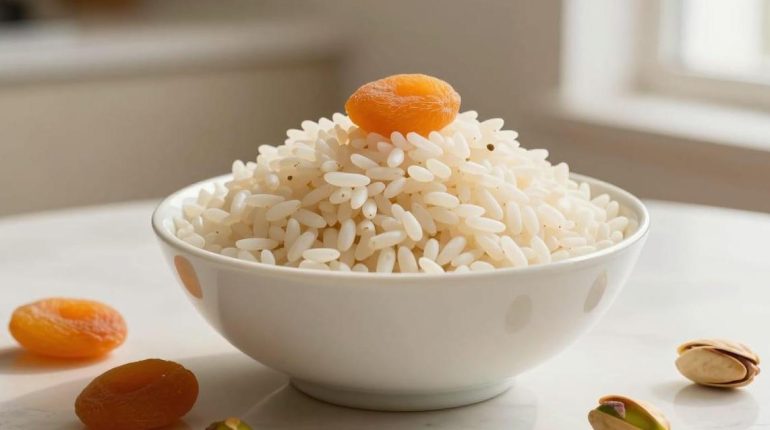
The vanilla risotto finds its final form in four individual bowls, receptacles for this sweet creation with contrasting textures. Distribution is done by ladle, each portion receiving an equal amount of this still-warm creamy preparation, whose steam diffuses scents of vanilla and apricot.
The twelve dried apricots rehydrated in sugar water at the start of the recipe now reveal their purpose: three of them crown each bowl, their plump and soft flesh creating a visual contrast with the milky whiteness of the risotto. Their amber hue evokes the tones of the caramel that will accompany the dessert.
The 50g of unsalted pistachios are chopped with a knife, breaking into irregular shards. These green pieces are scattered over the surface, providing the necessary crunch for textural balance against the creaminess of the rice and the tenderness of the fruit. The deep green of the pistachios contrasts with the ochre of the apricots, transforming each portion into a chromatic composition.
Anne Kerouédan proposes a bold alternative for Cniel: reversing the presentation by pouring a generous layer of milk caramel at the bottom of transparent verrines, then placing the risotto on top. This restaurant technique gradually reveals the golden layers through the glass, offering a visual experience even before the first spoon. The salted butter caramel simply waits to be drizzled or presented as an accompaniment, the final key to this recipe that transforms the traditional into the unexpected.