📌 Vanilla Cloud Cake
Posted 4 April 2026 by: Admin
A rainy Sunday afternoon, bored kids, and you don’t feel like starting anything complicated. This vanilla cloud cake is exactly for those moments. Forty-five minutes, five basic ingredients, and a result that would make anyone believe you spent the whole afternoon on it.
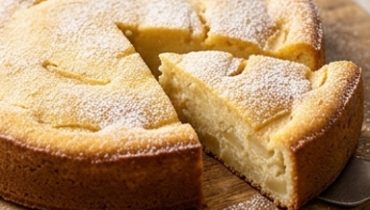
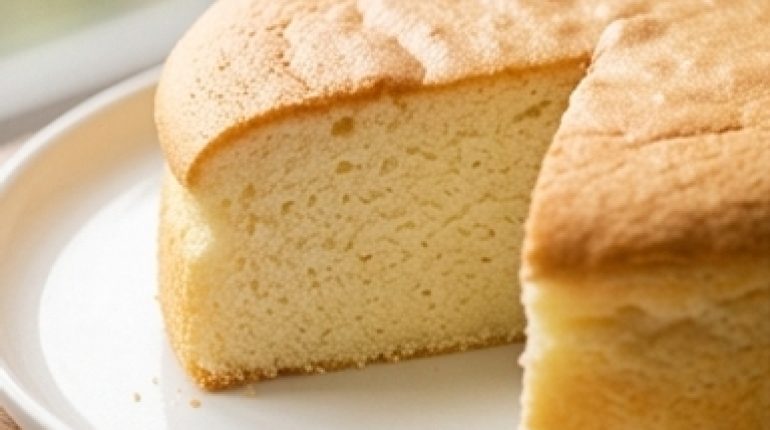
The surface is golden like a light caramel, slightly domed in the center, with that thin crust that barely cracks under the fork before vanishing. Inside, the crumb is a creamy white, speckled with tiny frozen air bubbles. The vanilla asserts itself as soon as you open the oven — not the artificial candy scent, but the real thing, round and warm. And in the mouth, it melts. No chewing required, just a silky texture that disappears.
Why you’ll love this recipe
Ingredient Notes
All the simple ingredients that make up this cloud cake: eggs, butter, flour, and lots of vanilla.
- The eggs : They do all the work here. The yolks provide fat and color, while the whites give the airy structure. Use room temperature eggs — cold whites straight from the fridge don’t whip as well or as fast. Size M or L, it doesn’t matter.
- Vanilla extract : One tablespoon is generous, and that’s intentional. Avoid the artificial aroma in transparent bottles that smells like gummy bears — get a real extract, the difference is immediate. Nielson-Massey or Bourbon if you can. A scraped pod also works very well.
- Melted butter : It must be melted and cooled. Not lukewarm, not hot. If you pour it still hot over the yolks, you’ll make an omelet. Let it sit for five minutes on the counter after melting.
- Warm milk : Warm, not hot. Cold milk will re-solidify the butter and create lumps. Thirty seconds in the microwave is enough. Whole milk is preferred — the fat helps the texture; semi-skimmed works but the result is slightly less creamy.
Start with the whites
Take your eggs out of the fridge ten minutes beforehand. Separate the whites from the yolks carefully — a single drop of yolk in the whites and they won’t whip. The whites go into a large clean, dry bowl, the yolks into another. Beat the whites with a pinch of salt. First foamy, then increasingly firm. Stop when they form peaks that hold but remain slightly soft at the tip — if you turn the bowl upside down, they don’t move. If they are too firm, they become dry and brittle, making them hard to incorporate later.
The batter, in two minutes
Beat the yolks with the sugar until the mixture whitens — one minute with an electric mixer, two by hand. You’ll see the color change from bright yellow to an almost pale ivory, and the texture becomes slightly foamy. Pour in the cooled melted butter and vanilla, then mix. Sift the flour directly into the bowl. Pour in the warm milk in a steady stream while stirring with a spatula. The batter is smooth, fluid, and slightly shiny. Nothing complex.
The moment you can’t miss
This is where many lose the cake’s lightness. Add one-third of the whites to the batter and mix vigorously — this lightens the batter and makes the rest easier. Then, pour the batter over the remaining whites. Use a spatula with slow movements from bottom to top while turning the bowl. You’ll see the white swirls gradually disappear. Stop as soon as there are no white streaks visible. Not a second longer. Every extra movement breaks air bubbles.
In the oven, don’t open it
Preheated oven to 180°C, buttered and floured or parchment-lined mold. Pour the batter, tap the mold twice on the counter to level it. Put it in and leave it alone. Twenty-five minutes without opening — the thermal shock would make the cake collapse instantly. From 25 minutes on, check with a knife blade: it should come out clean or with one or two moist crumbs, never liquid batter. The surface should be firm to the touch and uniformly golden.
Cooling, a step in its own right
Take the mold out of the oven and place it on a wire rack. Ten minutes without touching it. The cake will shrink slightly from the edges — that’s normal and actually makes unmolding easier. Slide a thin spatula all around before flipping it. Gently. The structure is still fragile when hot. Let it cool completely before slicing — cutting a cake while it’s still warm crushes the crumb and ruins all the lightness you just built.
Tips & Tricks
- Your whisk and bowl must be impeccably clean and dry to whip the whites. No traces of grease, even minimal. If you aren’t sure, wipe them with a bit of lemon juice on a paper towel.
- Don’t double the vanilla dose thinking more is better — beyond a tablespoon, the taste becomes slightly bitter. One spoon is the right balance.
- If your cake collapses after baking, either the whites were too firm and dry, or you opened the oven too early. Both are easily corrected next time — it’s really a matter of practice.
Why does my cloud cake collapse after baking?
There are two main causes: egg whites that were whipped too firm and dry (making them hard to incorporate without breaking them), or the oven was opened too early. The thermal shock causes the fragile structure to collapse. Always wait 25 minutes before checking, and do it quickly.
How to store the vanilla cloud cake?
At room temperature, under a cake dome or wrapped in cling film, it keeps for 2 days. The next day, it will have absorbed some moisture and the texture will be even more melting — it’s a nice surprise. Avoid the fridge as it dries it out.
Can this cake be prepared without an electric mixer?
Yes, but expect 5 to 7 minutes of manual whisking to whip the whites into firm peaks. It’s doable, just a bit of a workout. A large balloon whisk is more effective than a thin whisk for this step.
Can butter be replaced with oil?
Technically yes — a neutral oil like sunflower oil works. The result is slightly less rich in flavor, but the airy texture remains. Use the same quantity by weight.
Can fruits be added to the batter?
Yes, light fruits like blueberries, raspberries, or small pieces of pear work well. Flour them lightly before incorporating to prevent them from sinking to the bottom during baking.
Vanilla Cloud Cake
French
Dessert
A cake as light as a mousse, with generous vanilla. The airy texture comes from whipped egg whites folded in delicately — a simple technique that changes everything.
Ingredients
- 4 eggs (size M), at room temperature
- 120g granulated sugar
- 100g melted butter, cooled
- 120g flour
- 500ml warm whole milk
- 1 c. à soupe vanilla extract
- 1 pincée salt
Instructions
- 1Preheat the oven to 180°C. Butter and flour a 20-24 cm diameter mold.
- 2Separate the whites from the yolks. Beat the whites into firm peaks with the salt — peaks should hold but remain flexible. Set aside.
- 3Whisk the yolks with the sugar until the mixture whitens and becomes slightly foamy.
- 4Incorporate the cooled melted butter and vanilla extract into the yolks. Mix until homogeneous.
- 5Sift the flour and incorporate it gradually. Pour the warm milk in a stream while mixing with a spatula until you obtain a smooth batter.
- 6Incorporate one-third of the whites into the batter and mix without precaution to lighten. Then pour the batter over the remaining whites and fold in delicately with bottom-to-top movements.
- 7Pour into the mold, tap twice on the counter. Bake for 25 to 30 minutes without opening the oven.
- 8Check cooking with a knife blade: it should come out clean. Let cool for 10 minutes in the mold before unmolding onto a wire rack.
Notes
• Storage: 2 days at room temperature under a dome or cling film. The next day, the texture is even more melting.
• Variations: add the zest of a lemon or orange for a fruity version, or 2 tbsp of sifted cocoa for a chocolate version.
• Make-ahead: the base batter (without the whites) can be prepared in advance. Whip and fold in the whites just before baking.
Nutrition Facts (per serving, estimated)
| 285 kcalCalories | 7gProtein | 30gCarbs | 15gFat |