You have half a cabbage lingering in the vegetable drawer and some ground beef in the freezer? That’s pretty much all you need to make kapuska, the Turkish cabbage stew that comes together in one pot in under an hour. A rustic dish, spiced just right, that truly warms you up.
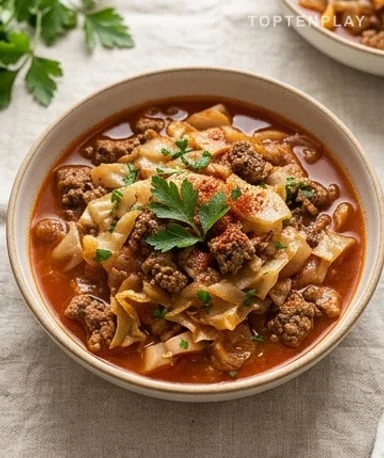
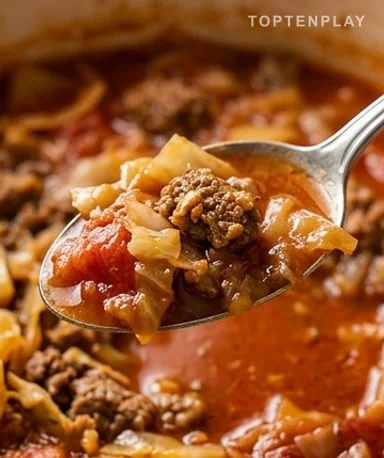
What strikes you first is the color of the broth: a deep red leaning toward copper, made dense by the tomato paste and spices heated together. The cabbage melts without falling apart—it retains just enough bite so each mouthful has texture. The smell rising from the pot blends the warmth of cumin, the slight acidity of tomato, and that buttery base that ties everything together. Simple, generous, and it smells like home cooking.
Why you’ll love this recipe
Ingredient Notes
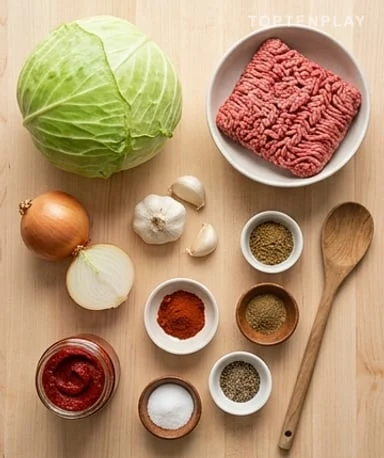
Simple and inexpensive ingredients: green cabbage, ground beef, red onion, tomato paste, cumin, coriander, and sweet paprika.
- Green cabbage : This is the central ingredient, the one that absorbs the spiced broth and gives the dish its melt-in-your-mouth texture. Green cabbage withstands moist heat better than savoy or red cabbage—it doesn’t turn to mush. Choose one that is dense and heavy for its size, a sign it’s tightly packed. Chop it coarsely: pieces that are too fine disappear into the broth, too large and they stay crunchy in the center.
- Ground beef (80% lean) : The 80/20 ratio is important here. Beef that is too lean stays dry after 45 minutes of cooking; too fatty, it drowns the bottom of the pot and overwhelms other flavors. 80% lean browns well, adds flavor to the cooking base, and stays juicy in the broth. Ground lamb—the traditional Turkish version—works very well too: the result is richer, slightly fattier.
- Red onion : Red onion is less aggressive than white when raw, but it caramelizes beautifully under heat and brings a slight sweetness to the pot. Slice it finely so it melts completely during cooking—you don’t want identifiable pieces in the final result.
- Tomato paste : It’s not just about coloring the broth. The tomato paste is cooked directly in the fat with the spices before adding liquid—this 1-2 minute dry cooking intensifies its flavor and removes its raw acidity. Use double-concentrated tomato paste for more depth.
- Cumin, ground coriander, sweet paprika : This trio is the aromatic signature of kapuska. Cumin brings a slightly earthy warmth, ground coriander a floral and warm note, sweet paprika color and a subtle sweetness. Don’t omit any of the three: together they create a profile that none can replicate alone. If you lack ground coriander, caraway is a passable substitute but the result will be different.
- Low-sodium beef broth : The broth serves as the liquid base, but don’t add too much: the cabbage releases a lot of water as it cooks and the stew will naturally lengthen. 250 to 300ml is enough. Definitely use a low-sodium broth to keep control of the final seasoning—with standard broth, you risk not being able to adjust.
Melt the onion, brown the meat
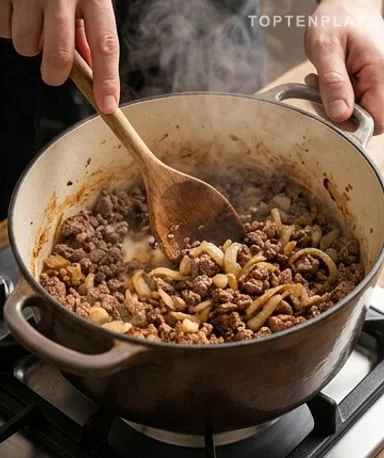
Start by melting the butter over medium heat in a heavy-bottomed pot—cast iron if possible, as it distributes heat without hot spots. Add the sliced red onion to the hot fat and let it cook gently for 4 to 5 minutes, stirring occasionally. It should become translucent and slightly golden on the edges, not brown. When it starts to smell sweet and nutty, it’s time to add the ground beef. Place it in a mound and leave it undisturbed for 2 minutes before breaking it up with a wooden spoon. The goal is to get a nice caramelized crust on the meat pieces—if you stir too soon, the meat steams and stays gray and flavorless. Allow 6 to 8 minutes for everything to be well browned and the bottom of the pot covered with a light brown fond.
The spices take the stage
Once the meat is browned, lower the heat slightly and add the tomato paste directly to the pot, followed by the cumin, ground coriander, sweet paprika, red pepper flakes, and a good pinch of salt. Stir vigorously for 1 to 2 minutes. At this point, the bottom of the pot becomes an intense red, almost burgundy, and a warm, slightly smoky aroma rises—that’s a good sign. This brief dry cooking is crucial: it lightly toasts the spices and cooks the raw acidity out of the tomato paste, giving the final broth a depth you won’t achieve by adding everything at once.
The cabbage, the broth, and let it simmer
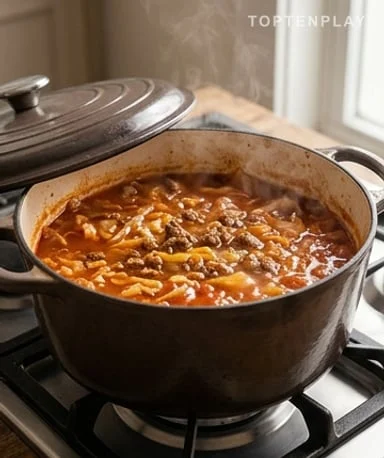
Add the coarsely chopped cabbage to the pot—it will seem far too much at first glance, but it will reduce by half as it cooks. Pour the broth over the top, stir to coat the pieces well in the spices and meat, then cover. Reduce the heat to low: you want a gentle simmer, not a vigorous boil that would soften the cabbage too quickly and make it watery. After 5 minutes, the cabbage will have already started releasing its water and the liquid level will have risen noticeably. Simmer for a total of 20 to 25 minutes, until a fork pierces the pieces without resistance. The target texture: tender, but not falling apart.
Taste, adjust, serve
Before serving, taste it. Salt is often the only correction needed, sometimes a bit more red pepper flakes if you like it spicier. The broth should be dense and coating—if you find it too thin, remove the lid and let it reduce over high heat for 5 minutes. Kapuska is eaten in deep bowls, with bread to soak up the sauce. Plain white rice cooked absorption-style with a little butter works very well as a side. Avoid garnishes that add richness: the dish is already generous, it doesn’t need to be weighed down.
Tips & Tricks
- Don’t exceed 300ml of broth initially: the cabbage releases a lot of water as it cooks, and if you start with too much liquid you’ll end up with a soup rather than a stew. You can always add more if the bottom sticks.
- Resist the urge to stir the beef too early—let it sit in contact with the hot pot without touching for a good 2 minutes. This prolonged contact creates the brown crust that gives flavor to the whole dish.
- If you plan to serve this dish the next day, stop cooking 5 minutes before the cabbage is completely tender. Reheating will finish the job, and the result will be perfect without being overcooked.
- Chop the cabbage into large irregular pieces rather than fine, uniform strips. Irregular pieces cook less evenly—some melt into the broth, others retain more bite—giving more texture to each mouthful.
Green cabbage or white cabbage, which to choose?
Both work well, with a subtle difference: white cabbage is slightly milder and sometimes sweeter, green cabbage has a slightly more peppery note. In both cases, they hold up well to cooking in liquid and don’t disintegrate. Avoid savoy cabbage (too tender) and red cabbage (it turns purple and changes the broth color).
Can beef be replaced with lamb?
Yes, and it’s actually the more traditional version in Turkey. Ground lamb gives a richer result, with a slightly more pronounced flavor that goes well with cumin and coriander. Cooking time remains the same, but lamb renders a bit more fat—you can skim some off with a ladle before adding the cabbage if needed.
The stew is too watery, how to fix it?
Simply remove the lid at the end of cooking and let it reduce over high heat for 5 to 8 minutes, stirring regularly. The broth will evaporate and the cabbage will continue to absorb the remaining liquid. To avoid this problem from the start, don’t exceed 300ml of broth: the cabbage releases a lot of water during cooking.
How long does kapuska keep and how to reheat it?
The stew keeps for 4 days in the refrigerator in a closed container. To reheat, a saucepan over medium heat with a little added water or broth does the trick—the cabbage has absorbed much of the liquid during resting and may seem very thick straight from the fridge. It also works well in the microwave in two 2-minute intervals, stirring in between.
Can you freeze this dish?
Yes, kapuska freezes well for up to 3 months. The cabbage changes slightly in texture after thawing—it becomes a bit more tender—but it’s still quite pleasant in the context of a stew. Freeze in individual portions and thaw overnight in the refrigerator before reheating over low heat.
What to serve with kapuska?
Rustic bread for soaking up the broth is the simplest and most effective. Plain white rice cooked absorption-style with a pat of butter also works very well as a base to absorb the juice. If you want something lighter, a side of plain yogurt—as many Turkish tables do—brings a tangy freshness that balances the warm spices nicely.
Turkish Cabbage Stew (Kapuska)
Turkish
Main course
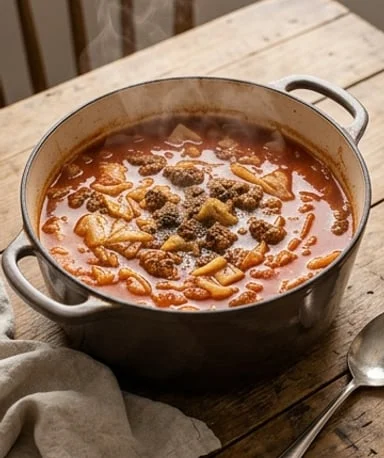
An authentic Turkish stew made with green cabbage, ground beef, and warm spices—cumin, coriander, paprika—simmered in a dense tomato broth. A complete, budget-friendly meal ready in one hour in a single pot.
Ingredients
- 1 medium green cabbage (~900g), roughly chopped
- 400g ground beef (80% lean)
- 1 large red onion, finely sliced
- 2 tbsp double-concentrated tomato paste
- 30g butter
- 300ml low-sodium beef broth
- 1 tsp ground cumin
- 1 tsp ground coriander
- 1 tsp sweet paprika
- ½ tsp red pepper flakes
- salt and freshly ground black pepper
Instructions
- 1Melt the butter in a heavy-bottomed pot over medium heat. Add the sliced red onion and cook for 4-5 minutes, stirring occasionally, until translucent and lightly golden.
- 2Add the ground beef to the pot. Leave it in contact with the bottom without stirring for 2 minutes, then break it up with a wooden spoon. Continue cooking for 5-7 minutes until the meat is well browned on all pieces.
- 3Lower the heat slightly. Add the tomato paste, cumin, ground coriander, sweet paprika, red pepper flakes, and a good pinch of salt. Stir vigorously and let it cook dry for 1-2 minutes until the bottom of the pot is an intense red and the spices are fragrant.
- 4Add the chopped cabbage and beef broth. Stir to coat the cabbage well in the spices and meat. Bring to a simmer, cover the pot, and reduce the heat.
- 5Let it simmer over low heat for 20-25 minutes, until the cabbage is tender and easily pierced with a fork. Do not lift the lid during the first 15 minutes.
- 6Taste and adjust seasoning with salt and pepper. If the stew is too liquid, remove the lid and let it reduce over high heat for 5 minutes. Serve hot in deep bowls with bread or plain white rice.
Notes
• Kapuska is better the next day: let it cool to room temperature, refrigerate overnight, and reheat over medium heat with a splash of broth if needed.
• Don’t exceed 300ml of broth initially—the cabbage releases a lot of water as it cooks and the stew will naturally lengthen.
• For the traditional Turkish version, replace the ground beef with ground lamb. The result is richer and pairs particularly well with the spices.
Nutrition Facts (per serving, estimated)
| 315 kcalCalories | 22gProtein | 17gCarbs | 18gFat |