📌 Tupperware: what the symbols on your containers reveal about their food safety
Posted 12 February 2026 by: Admin
Decoding Essential Food Safety Symbols
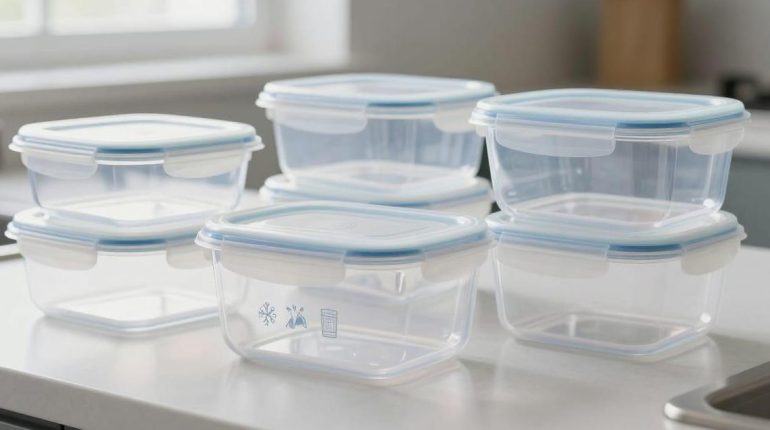
These pictograms engraved on the bottom of your containers are not simple decorative patterns. They constitute a standardized language that determines whether your container can safely go through the microwave, freezer, or dishwasher. Ignoring these indications exposes your food to plastic deformation, chemical migration, or sudden material failure.
The microwave symbol, represented by a stylized oven with waves, authorizes electromagnetic reheating. However, even if certified, an empty container subjected to high temperatures will deform irremediably. The snowflake guarantees resistance to negative temperatures without cracking, provided an expansion space is left for liquids. The dishwasher icon (plate with water drops) requires exclusive placement on the top rack to avoid melting due to proximity to the heating element.
The fork-and-glass pictogram certifies food contact according to European health standards. Any container without this marking must be excluded from food storage, even if it looks visually identical to an approved model. This certification is based on rigorous tests measuring molecular transfers between plastic and food. Beyond these four fundamental symbols, other markings reveal the exact nature of the polymer used and its specific chemical properties.
Recycling Codes: Understanding Numbers 1 to 7
The arrow triangle engraved under your container contains a number that precisely identifies the chemical composition of the plastic. This numbered classification from 1 to 7 is not limited to selective sorting: it directly determines the thermal resistance of the material and its propensity to release toxic molecules during heating.
PET (number 1), omnipresent in water bottles, degrades quickly under heat. Designed for single use, it supports neither repeated reheating nor dishwasher use. In contrast, HDPE (2) offers structural stability that makes it compatible with prolonged storage and freezing, without significant chemical migration. Polypropylene PP (5) represents the top of the hierarchy: its heat resistance allows microwave and dishwasher use without molecular alteration.
Two categories require absolute vigilance. PVC (3) and polystyrene PS (6) release potentially harmful compounds when subjected to high temperatures. These plastics, still present in some cheap containers, must imperatively stay away from any heat source. The number 7 groups all polymers not classified elsewhere, with variable properties requiring case-by-case verification. But beyond these classifications, correct use remains as decisive as the composition itself.
Usage Precautions for Each Symbol
A container’s compliance with safety standards does not guarantee its integrity in case of inappropriate use. A container labeled microwave-safe can deform irremediably if you heat it empty or maintain maximum power for several minutes. Concentrated heat causes localized melting points that weaken the molecular structure of the plastic, even in the most resistant compositions.
Freezing requires a precaution that is often neglected: systematically leave a free space of at least 2 cm at the top of liquids. Water increases in volume as it solidifies, generating internal pressure that cracks the walls if the container is filled to the brim. This physical expansion does not discriminate between low-end plastics and high-end containers.
In the dishwasher, position determines the container’s survival. The bottom rack exposes plastics to frontal heat that gradually softens them. Exclusive placement on the top rack preserves their geometry by keeping them away from the heating elements. This rule applies even to plastics certified as resistant to high temperatures.
The absence of the fork-and-glass symbol definitively disqualifies a container for food storage. These non-food containers can release industrial additives upon contact with fats or acidity. Their chemical composition, optimized for other uses, does not meet any toxicological standards for ingestion. Scrupulous respect for these instructions directly conditions durability and health safety, but one last criterion deserves special attention.
The Importance of the “BPA-Free” Label
The “BPA-free” mention on a container signals the absence of bisphenol A, a chemical compound long used to harden food plastics. Health authorities have gradually restricted its use after studies demonstrated its migration into food during heating or prolonged contact with fatty or acidic substances. This endocrine disruptor interferes with hormonal systems, particularly in vulnerable populations.
Manufacturers who display this certification guarantee an alternative formulation free of bisphenol A. This transparency is not a marketing approach, but a regulatory obligation in several jurisdictions. The European Union banned BPA in all containers intended for infants as early as 2011, a ban gradually extended to other product categories.
The presence of the label becomes decisive for uses involving high temperatures. The microwave considerably accelerates the release of chemical compounds from the plastic into the food. A container without this certification exposes you to transfers of potentially harmful substances amplified by heat, even if the plastic bears a microwave-safe symbol.
This technical distinction now clarifies your equipment choices. Systematically checking for this mention before any purchase constitutes an elementary health protection reflex, particularly for containers intended for daily reheating or storing food for children.