📌 Traveling seeds: why plants use your clothes to reproduce
Posted 18 February 2026 by: Admin
The Mystery of the Tiny Seeds Clinging to Your Clothes After a Walk
You return from a walk in the forest or a simple outing in a park, and looking down at your trousers, the surprise is immediate: dozens of tiny brown debris are clinging to the fabric, stubbornly, as if they had decided to come home with you.
The reaction is universal. You rub them mechanically with your fingertips — they resist. You try to shake them off — they hold fast. This inconvenience, as banal as it may be, affects every walker without exception: the Sunday jogger on a paved path, the hiker in dense forest, or simply the parent crossing a park with their children.
What is most surprising is their silent appearance. No memorable contact with a bush, no crossing of an identifiable brushy area — and yet, hundreds of these small seeds colonize the bottom of your legs as if they had always been there.
Yet, behind this harmless nuisance lies a reality far more captivating than it seems. This phenomenon, far from being random or accidental, obeys a precise natural logic, perfected over time by the plant world to ensure its own survival. What you take for a simple annoyance is, in reality, the discreet sign that nature is at work — and that it has chosen you as an involuntary accomplice.
A Plant Survival Strategy Millions of Years Old
This role of “involuntary accomplice” that you play unknowingly is not the result of chance. It is the result of plant engineering perfected over millions of years of evolution.
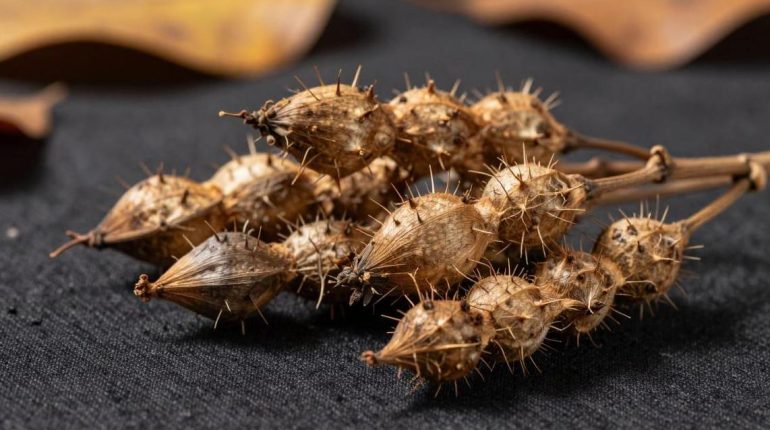
Those tiny seeds clinging to your trousers belong to a specific botanical category: hooked diaspores. Burdock, cleavers, ground elder — so many common plants that have developed microscopic curved structures, designed to attach to any fibrous surface upon simple contact. A mechanism so effective that it directly inspired the invention of Velcro in 1948, when Swiss engineer George de Mestral examined burdock seeds clinging to his coat under a microscope.
This dispersal system, called zoochory, consists of using animals — or humans — as transport vectors. Where the fur of wild mammals has played this role for millennia, our synthetic or cotton clothing now performs the same function with formidable efficiency.
The plant’s goal is simple: to move its seeds away from the mother plant to colonize new territories, avoid competition between individuals of the same species, and maximize the chances of germination. By clinging to you, these seeds travel in minutes distances they could never have reached alone. Your walk becomes, without you knowing it, a large-scale plant dissemination mission.
Why Your Clothes Are the Ideal Targets
If your clothes fulfill the role once held by animal fur so effectively, it’s no coincidence — it’s a matter of textile physics.
The most vulnerable materials are those whose surface has open and irregular fibers: wool, fleece, brushed cotton, velvet. These textiles offer the seeds’ microscopic hooks exactly the type of grip they need to attach durably. Conversely, smooth synthetic fabrics — nylon, tightly woven polyester — offer much higher resistance, as the hooks find no roughness to lock onto.
Walking conditions considerably amplify the phenomenon. The height of the grass plays a determining role: seeds are concentrated precisely at leg height, at the level where stems reach their reproductive maturity. Overgrown paths, dense undergrowth, riverbanks in late summer — all areas where plant density maximizes contact. Autumn represents the seasonal peak, when the majority of plants disperse their seeds simultaneously.
Your walking pace also plays a part: a steady cadence creates continuous friction against the vegetation bordering the path, multiplying contact points with every stride. The slower and more winding the passage, the more stowaways the fabric accumulates.
Understanding this precise mechanism opens the way to concrete strategies to limit its effects — without giving up the pleasure of the walk.
How to Get Rid of Seeds and Limit the Nuisance
Understanding the hooking mechanism is already the key to better protecting yourself.
The first line of defense remains the choice of clothing. Before a walk in a vegetated area, prioritize trousers made of nylon or tightly woven polyester — these smooth surfaces drastically reduce attachment points. Avoid fleece and brushed cotton, which turn your legs into real seed traps.
To remove seeds already attached, several methods have proven effective. A strip of wide adhesive tape on the fabric effectively captures fine debris. For more robust hooked seeds, a fine-toothed comb or a clothes brush is enough to untangle the grippers without damaging the textile. Putting the garment in the dryer for a few minutes at a low temperature also helps to detach the least securely fixed elements.
In the field, adopt simple gestures: stay on marked and clear paths, avoid brushing against high vegetation at the edge of the path, and shake your clothes before getting into the car so as not to transport the seeds to other environments.
Finally, changing perspective changes everything: these few minutes of maintenance after the walk are not a constraint, but the counterpart of an unexpected role — that of the involuntary carrier of a natural system that has been silently shaping our landscapes for millions of years.