📌 The Science Behind Venus Dimples: What These Lower Back Indentations Reveal About Your Genetics and Circulation
Posted 11 December 2025 by: Admin
The Anatomy Behind Venus Dimples: What Creates These Distinctive Marks
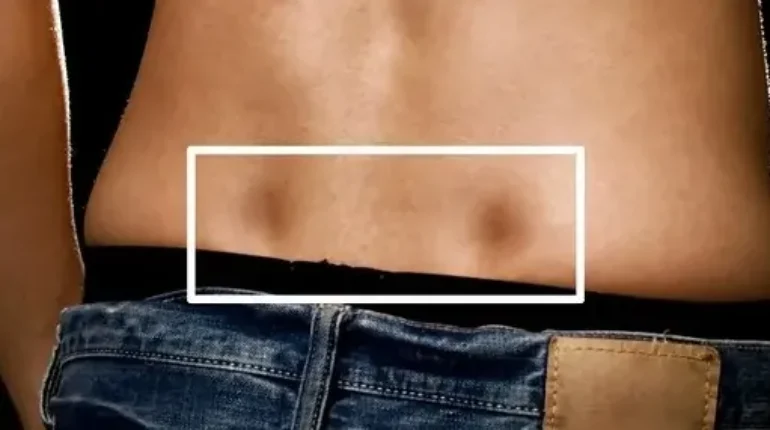
Those two small indentations on your lower back have a surprisingly straightforward explanation rooted in your body’s architecture. Venus dimples result from a short ligament connecting your skin directly to the posterior superior iliac spine, a bony structure on your pelvis. This anatomical connection creates the characteristic dimples you see, transforming what could be a flat surface into subtle, distinctive marks.
The critical factor determining whether you possess these dimples comes down to one thing: genetics. If your parents or grandparents have them, chances are you inherited the underlying skeletal structure necessary for their appearance. This isn’t something that develops randomly or emerges through lifestyle changes—it’s coded into your biological blueprint from birth.
Men experience this same anatomical phenomenon, though their version carries a different name. Called « Apollo holes » in honor of the Roman god of strength, these male equivalents follow the same genetic principle. Both variants represent natural anatomical variations, no more unusual than differences in height, eye color, or bone structure.
Understanding this genetic foundation is essential before considering whether anything can be done to enhance or reveal these dimples. The answer lies not in changing your anatomy, but in working with the genetic hand you’ve been dealt—a concept that becomes clearer when examining the relationship between fitness and their visibility.
The Fitness Connection: Can Exercise Create Or Reveal Them?
A persistent myth circulates through fitness communities: that dedicated training can sculpt Venus dimples into existence. The reality proves far simpler. Exercise cannot create dimples without the underlying genetic structure already in place. They remain fundamentally different from muscles—you cannot build them through repetition, resistance, or any training protocol.
However, genetics alone tells only half the story. If you inherited the anatomical foundation for Venus dimples, they may not be visible at all. Excess body fat can obscure the ligament’s connection to your skin, essentially burying the dimples beneath a layer of adipose tissue. This is where fitness enters the equation—not as a creator, but as a revealer.
Maintaining a healthy body weight and staying physically conditioned can make genetically present dimples increasingly prominent. As you lose excess fat, particularly around your lower back and core region, the distinctive indentations become more pronounced and visible. The dimples were always there; fitness simply removes the obstacle hiding them.
This distinction matters significantly for managing expectations. Someone without the genetic foundation will never develop Venus dimples, regardless of how disciplined their workout routine becomes. Yet for those who carry the genetic blueprint, a combination of consistent exercise and appropriate body composition creates the conditions for their natural emergence. The key lies in revealing what already exists rather than creating something entirely new.
Health Indicators: What Visible Dimples May Reveal About Your Body
The emergence of Venus dimples through consistent fitness reveals more than aesthetic transformation—it signals underlying physiological shifts. Visible dimples often correlate with lower visceral fat and improved circulation, both markers of enhanced cardiovascular health and metabolic efficiency.
This connection explains why fitness communities have long recognized dimples as natural indicators of physical conditioning. When ligaments become visibly apparent against the skin, it typically means the body has shed excess adipose tissue that once compromised circulation. The improved blood flow to this region reflects broader improvements in overall vascular health.
Research specifically examining Venus dimples remains limited, yet observed patterns suggest a meaningful relationship between their prominence and body composition. Individuals displaying these indentations tend to demonstrate stronger core musculature and better postural alignment—consequences of sustained physical training that extends beyond the lower back. A well-conditioned core naturally supports proper spinal positioning, which itself influences how visible the dimples become.
It’s essential to emphasize that these correlations don’t constitute definitive medical markers. Having Venus dimples suggests good physical conditioning; lacking them offers no reliable conclusion about your health status. The presence or absence of dimples represents one variable among countless factors determining overall wellness. Genetics ultimately determines visibility, and fitness merely optimizes what already exists biologically. Understanding this distinction prevents misinterpreting aesthetic features as comprehensive health assessments.
Beauty Standards vs. Body Diversity: The Real Meaning of Venus Dimples
The distinction between genetic inheritance and fitness achievement carries profound implications for how we perceive physical beauty. While Venus dimples have been romanticized as markers of aesthetic perfection since ancient times, their presence or absence reveals nothing about an individual’s attractiveness, health capacity, or physical strength.
The naming itself—drawing from the Roman goddess of beauty—established unrealistic expectations that persist today. Yet this cultural association obscures a fundamental truth: anatomical variations are intrinsic to human diversity. The posterior superior iliac spine’s positioning differs naturally across populations, making dimples absent in countless healthy, fit individuals through no fault of their own.
The absence of Venus dimples doesn’t indicate inferior physical conditioning, lower attractiveness, or compromised wellness. Conversely, their presence alone cannot validate someone’s dedication to health. What matters is the alignment between personal goals and individual physiology, not conformity to inherited traits beyond conscious control.
Body confidence emerges when individuals recognize that natural variations deserve celebration rather than judgment. Some possess Apollo holes or Venus dimples; others don’t. Both scenarios reflect the beautiful complexity of human anatomy. The real measure of health lies in how we care for our bodies—through consistent movement, proper nutrition, and mental wellness—regardless of whether our lower backs display these distinctive indentations.
True vitality transcends visible markers and resides in energy, strength, and self-acceptance.