Sunday mornings are divided between those in a rush and those who take their time. If you’re reading this, you’re one of the latter — the ones who put water on to boil, sit down, and wait without wanting to do anything else. A cooked egg might be the simplest thing to master in the kitchen, and yet, most people have never truly nailed it.

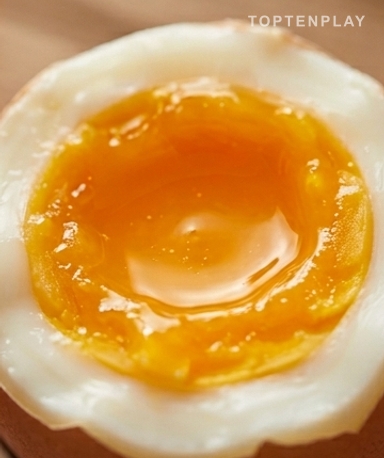
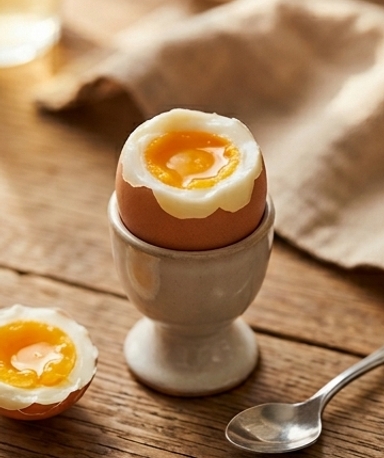
Imagine it in front of you: a cracked shell delicately lifted away, and underneath, a white that is firm but still trembling at the edges, pearly, almost translucent toward the center. The yolk — golden like light caramel — stands tall but slumps slightly the moment you dip a toasted soldier into it. It doesn’t just run. It flows. That is the whole difference between a failed egg and an egg you’ll remember.
Why you’ll love this recipe
Ingredient Notes
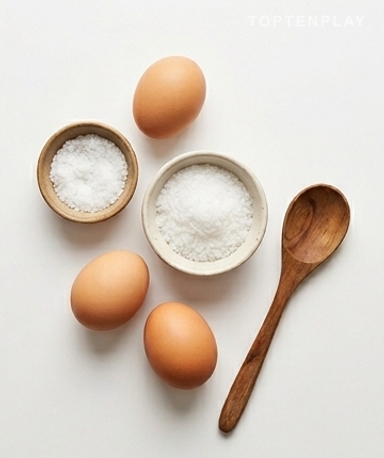
Everything you need for a perfect egg: fresh eggs and a pinch of fleur de sel.
- The eggs : Use room temperature eggs — this is the most ignored and most important piece of advice. A cold egg straight from the fridge takes an extra 30 to 60 seconds to heat to the core, which throws off your timing without you understanding why. Free-range or organic if you can: the yolk will be more intense, almost orange, much more beautiful when opened.
- The water : Plenty of water, at a rolling boil. Not simmering — boiling, with a clear roll. A large amount of water also ensures the temperature doesn’t drop sharply when you drop the eggs in, which is the second main cause of failed timing.
- Fleur de sel : Just to finish, a few crystals placed on the egg half still in its shell. They crunch slightly under the teeth, a tiny crackle that contrasts with the sweetness of the yolk. No fine salt here — really use fleur de sel or Maldon flakes if you have them.
- The bread for soldiers : A day-old baguette, slightly stale, toasted until golden and crispy. Cut it into long, thin strips. The crunch against the melt-in-the-mouth yolk is the most honest combination for breakfast.
Take your eggs out of the fridge half an hour before
This is the trick everyone skips, and it explains most failed eggs. Simply set them on the counter while you have your coffee. They don’t need to be hot — just room temperature. When you touch them with the back of your hand, they should be the same temperature as your fingers. Nothing complicated. But without this detail, you’ll be adjusting your timing blindly every time.
Wait for a full rolling boil — seriously
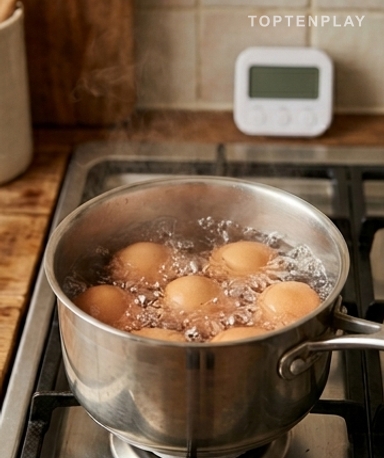
Put plenty of water over high heat and wait. Not the tiny bubbles sticking to the sides, not a timid simmer — a rolling boil, that deep and continuous rumble in the pot. That sound is your signal. At that precise moment, lower the heat slightly to maintain it without boiling over, then gently lower the eggs in with a spoon. Start your timer immediately. Not in ten seconds. Immediately.
Don’t touch anything for 6 to 10 minutes
The timing depends on what you want. Six minutes thirty: the yolk is runny and creamy, ideal for soldiers. Seven minutes thirty: it’s still soft but holds its shape when sliced. Nine minutes: firm and slightly matte in the center. Remember your exact timing from the first success. And don’t lift the lid, don’t feel them, don’t look — let the water do its work.
The ice bath — not an option
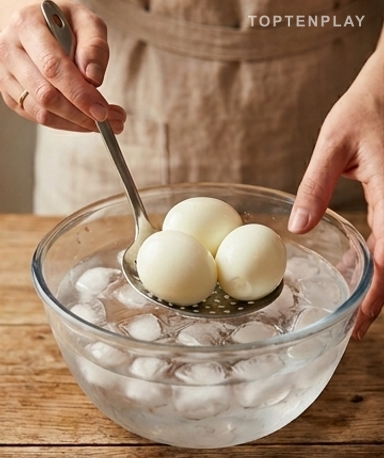
As soon as the timer rings, the eggs go into a bowl of very cold water with ice cubes. Not cold tap water — ice water. The shell makes a tiny, almost inaudible shock as it dives. This bath stops the cooking instantly. Without it, the eggs continue to cook with their own internal heat for another two to three minutes. Two minutes in the bath is enough — after that, they get too cold.
Peel with patience, not rage
Gently tap the egg on the edge of the bowl to create a crack that goes all the way around — not a big blow that crushes everything. Slip your thumb under the membrane and you’ll feel it peel away from the white almost on its own. Under a thin stream of cold water, it slides even better. The white should be firm, slightly elastic under the fingers, with a shiny surface. If it’s dull and sticky, the ice bath wasn’t cold enough.
Tips & Tricks
- Note your exact timing the first time you get what you wanted — on your phone, on a post-it. Every stove and every altitude varies slightly. Finding ‘your’ 7 minutes is worth gold.
- For several eggs at once, make sure they aren’t touching in the pot. Eggs bumping into each other can crack and let the white leak into the water.
- If you’re preparing soft-boiled eggs in advance for a salad or bowl, keep them unpeeled in the fridge. The shell protects them and they keep for 24 hours without any issues.
Why do my eggs crack in boiling water?
Two main reasons: the egg was too cold (thermal shock) or it was dropped in too abruptly. Take your eggs out of the fridge 30 minutes before, and lower them gently with a spoon. A small pinhole in the bottom of the egg before cooking can also prevent cracks.
How to store hard or soft-boiled cooked eggs?
Unpeeled, they keep for up to 5 days in the fridge — the shell protects them. Once peeled, consume within 24 hours. Never store them at room temperature once cooked.
Is the ice bath really necessary?
Yes, especially for runny or soft-boiled eggs. Without it, the internal heat continues to cook the egg for 2 to 3 minutes after being removed from the water, which completely shifts the target result. For hard eggs, it’s mostly useful to make peeling easier.
How to tell if an egg is still fresh before cooking?
Place it in a glass of cold water. If it sinks to the bottom and stays horizontal, it’s very fresh. If it stands upright but stays on the bottom, it’s a bit old but still edible. If it floats, throw it away without hesitation.
Should I salt the cooking water for the eggs?
It’s not necessary for flavor, but a small pinch of salt or white vinegar can help the white coagulate faster if an egg cracks. This limits the white leaking into the water.
Can I cook eggs straight from the fridge?
Technically yes, but you have to add about 1 minute to the timing. The problem is this extra time varies depending on the egg size and stove power, so results are less reproducible. Taking eggs out in advance remains the most reliable method.
The Perfectly Cooked Egg
French
Breakfast
The complete guide to mastering boiled eggs, from runny yolks to hard-boiled. Two ingredients, a timer, and the technique that changes everything.
Ingredients
- 8 fresh eggs (size L, at room temperature)
- 2L water
- 1 day-old baguette
- 40g unsalted butter
- 1 pinch fleur de sel
- 2 handfuls ice cubes (for the ice bath)
Instructions
- 1Take the eggs out of the fridge 30 minutes before cooking and leave them at room temperature.
- 2Bring a large pot of water to a rolling boil (continuous roll, not a simple simmer).
- 3Lower the heat slightly, then lower the eggs in one by one with a spoon. Start the timer immediately.
- 4Cook for 6 min 30 for a runny yolk, 7 min 30 for a soft yolk, or 9 min for a firm yolk.
- 5Transfer immediately to a bowl of ice water. Let them rest for exactly 2 minutes.
- 6Peel the eggs under a thin stream of cold water by gently tapping the shell all over.
- 7Toast the baguette slices, butter them, and cut into long soldiers.
- 8Serve the eggs in egg cups or cut in half, with fleur de sel on the side.
Notes
• Storage: unpeeled, cooked eggs stay fresh for 5 days in the fridge. Peeled, eat within 24 hours.
• Ramen variation: same method for poached eggs, but dropped directly into simmering water without shell — adding a splash of white vinegar helps the white stay together.
• Altitude timing: if you are over 1000m altitude, water boils at a lower temperature, add 30 to 60 seconds to each stage.
Nutrition Facts (per serving, estimated)
| 290 kcalCalories | 15gProtein | 18gCarbs | 17gFat |