This is the kind of recipe you pull out on a March Sunday, when the family drops by unexpectedly and the fridge doesn’t contain anything spectacular. Twelve eggs, a bit of flour, some milk — and the oven does the rest. The sugar shack-style baked omelet is one of the great inventions of Quebec brunch: generous, hands-off, and far more impressive than the effort it requires.
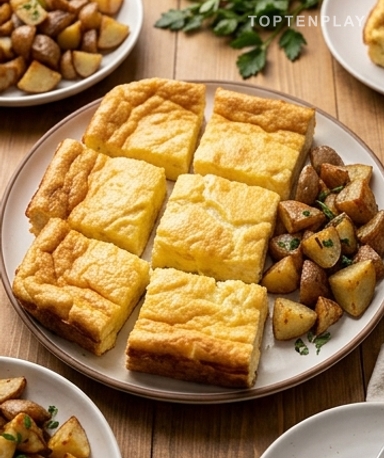
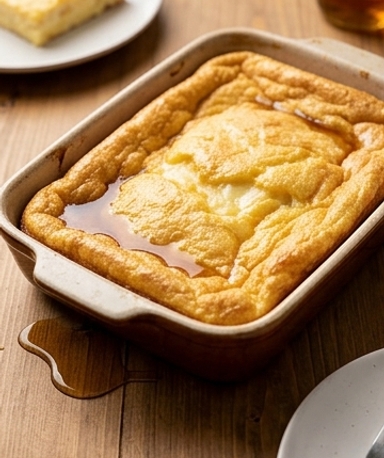
It comes out of the oven beautifully puffed, with a light caramel-colored surface, slightly cracked on the edges like a rustic soufflé. As you place the dish on the table, it smells of warm butter and cooked eggs — a frank, reassuring aroma that immediately calls everyone to the table. Inside, the texture is surprising: tender, almost airy, with a softness you never find in a pan-fried omelet. Cut into generous squares, it holds together perfectly, firm yet melting under the fork.
Why you’ll love this recipe
Ingredient Notes
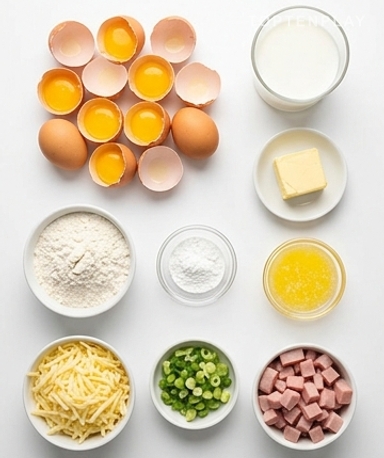
All the simple ingredients that create the magic of this puffed Quebec omelet.
- Eggs : The absolute base. Get them at room temperature if you can — they whisk better and provide more volume. Use free-range eggs if you can find them: the yolk is more orange and the texture richer once cooked.
- Baking powder : This is the secret behind the puffed texture. One teaspoon is enough — no need for more, otherwise it leaves a slightly bitter aftertaste. Check that it hasn’t expired: stale baking powder won’t lift a thing.
- Flour : One and a half tablespoons, no more. Its role is to stabilize the preparation and prevent the omelet from collapsing too quickly once out of the oven. Always mix it with the baking powder in a separate bowl before incorporating — otherwise you risk lumps.
- Grated cheese : Optional according to the recipe, but hard to skip once you’ve tried it. Emmental or Gruyère work well — they melt without releasing water. Avoid pre-shredded bags: they often contain anti-caking agents that prevent proper melting.
- Diced turkey ham : The topping that turns the omelet into a complete meal. Cut it into small, regular cubes so they distribute well. A lightly smoked turkey ham adds more character — look for one with fewer additives.
What nobody understands about flour and baking powder
Most people see ‘flour in an omelet’ and raise an eyebrow. Yet that is where the magic happens. Flour stabilizes the mixture and gives it impeccable hold when serving. Baking powder creates small air bubbles during cooking — that’s what makes the omelet rise and gives it that light texture that surprises every time. The important move: always mix the two together in a small bowl before adding them to the eggs. Otherwise, you risk pockets of un-distributed powder, and some bites will have a soapy taste that nothing can fix. Once gently integrated into the beaten eggs, the preparation should remain fluid and smooth, with a light white foam forming on the surface.
The part everyone rushes: whisking the eggs
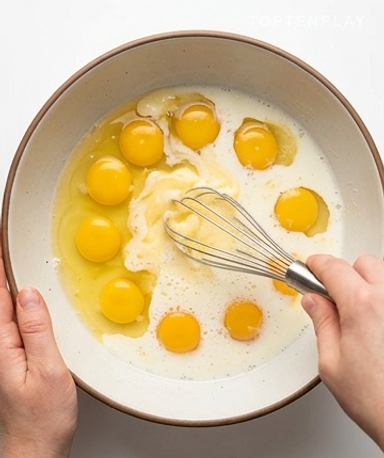
It seems obvious, but the difference between a dense omelet and an airy one is decided here. Crack twelve eggs into a large bowl, add the milk, melted butter, salt, and pepper, and whisk continuously for a solid two minutes. Not thirty seconds — two minutes. The mixture should change color, going from bright yellow to a pale, almost creamy yellow, and form a light foam on the surface that you can hear crackling softly under the whisk. This incorporated air, combined with the baking powder, gives the omelet its characteristic volume and lightness.
Why you should never open the oven before 25 minutes
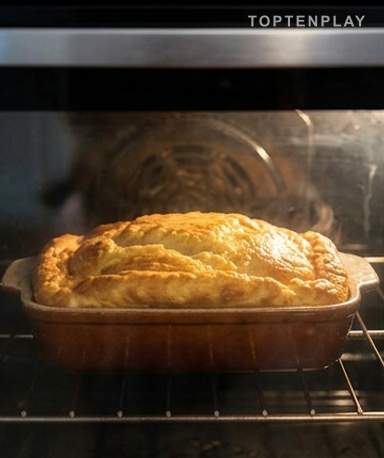
The omelet rises thanks to constant heat. Open the door too early, the steam escapes, the mixture falls, and you end up with something flat and dense. Twenty-five minutes minimum, oven closed. After that, a quick look through the glass is enough: the surface should be a beautiful uniform gold, puffed like a soufflé, with the edges slightly pulled away from the dish. To check doneness, slide a knife tip into the center — it should come out clean, without liquid. Take it out immediately and serve without delay. It will deflate a little as it cools; this is normal and doesn’t change the taste.
Tips & Tricks
- Don’t fill the dish to the brim — leave at least two centimeters of space. The omelet really puffs up during cooking and can overflow if the dish is too small.
- Butter the dish generously, even if it’s non-stick. The butter slightly caramelizes on the edges and gives an external crust that changes everything.
- You can prepare the mixture the day before and keep it in the fridge, but without the baking powder. In the morning, whisk it in just before baking — otherwise it loses its effectiveness before even reaching the oven.
- For an even more golden surface, place the dish under the broiler for two minutes at the very end of cooking. Keep an eye on it — it goes very fast and can burn in the blink of an eye.

Why didn’t my omelet puff up in the oven?
There are usually two culprits: expired baking powder or under-whisked eggs. Check the date on your box and really whisk the mixture for two solid minutes — it must become pale and foamy before going into the oven. If you open the oven too early, the steam escapes and the omelet collapses too.
Can I prepare the mixture the night before?
Yes, but without the baking powder. Keep the egg-milk-butter-flour mixture in the fridge in a bowl covered with plastic wrap, and whisk in the baking powder just before baking the next morning. If you add it too early, it reacts in the cold and has nothing left to give during cooking.
How do I know if the omelet is cooked through?
Slide a knife tip into the center of the dish: it should come out clean, with no trace of liquid. The surface should be uniformly golden and the edges slightly retracted from the mold. If the top is golden but the center is still wobbly, cover with foil and cook for another 5 minutes.
Can the leftovers be frozen?
It’s possible, but the texture changes a bit upon thawing — it becomes slightly denser and less airy. In the fridge, leftovers keep well for 2 days in an airtight container. To reheat, put them in the oven for 10 minutes at 150°C rather than the microwave, which softens everything.
What dish should I use if I don’t have a rectangular one?
A 26-28 cm round mold works very well. The important thing is that the dish is deep enough — at least 5 cm high — to leave room for the omelet to puff up. A loaf pan even gives a very nice result, with a beautiful shape for slicing.
Can I replace the milk with a plant-based beverage?
Yes, oat milk or unsweetened soy milk work well here without significantly changing the taste. Avoid coconut milk or almond milk that is too thin, which could modify the final texture. The quantity remains the same: 250 ml.
Sugar Shack-Style Baked Omelet
Quebec
Main course
A thick, puffed baked omelet, fluffy as a rustic soufflé. The Quebec secret to feeding the whole table with a single dish.
Ingredients
- 12 large eggs
- 250 ml (1 cup) milk
- 30 g (2 tbsp) melted butter + some for the dish
- 12 g (1½ tbsp) all-purpose flour
- 1 tsp baking powder
- ½ tsp salt
- ¼ tsp ground black pepper
- 150 g diced turkey ham
- 80 g grated cheese (Emmental or Gruyère)
- 3 sliced green onions
- a few sprigs fresh parsley (optional)
Instructions
- 1Preheat the oven to 180°C. Generously butter a rectangular baking dish about 30×20 cm.
- 2In a small bowl, mix the flour and baking powder. Set aside.
- 3In a large bowl, vigorously whisk the eggs with the milk, melted butter, salt, and pepper for 2 minutes, until the mixture is pale and slightly foamy.
- 4Gently incorporate the flour-baking powder mixture into the beaten eggs, whisking softly to avoid lumps.
- 5Add the turkey ham, grated cheese, green onions, and parsley. Mix briefly.
- 6Pour the mixture into the buttered dish, leaving at least 2 cm of space at the top.
- 7Bake for 30 to 35 minutes without opening the oven before 25 minutes. The omelet should be well puffed and golden on top.
- 8Check doneness with a knife tip in the center: it should come out clean. Serve immediately.
Notes
• Storage: keeps for 2 days in the refrigerator. Reheat in the oven at 150°C for 10 minutes rather than in the microwave.
• Make ahead: prepare the egg-milk-butter-flour mixture the day before without the baking powder. Stir it in just before baking.
• Variation: replace turkey ham with crumbled crispy turkey bacon for a smokier and punchier taste.
Nutrition Facts (per serving, estimated)
| 260 kcalCalories | 20 gProtein | 5 gCarbs | 17 gFat |