📌 Stuffed Jellied Eggs
Posted 30 March 2026 by: Admin
Eggs in jelly have a bad reputation. Totally unfair. We associate them with 70s buffets, embroidered tablecloths, and a style of cooking that no one does anymore — and yet, those who have eaten the real thing, homemade with a reduced broth and a colorful garnish, don’t understand why everyone stopped.
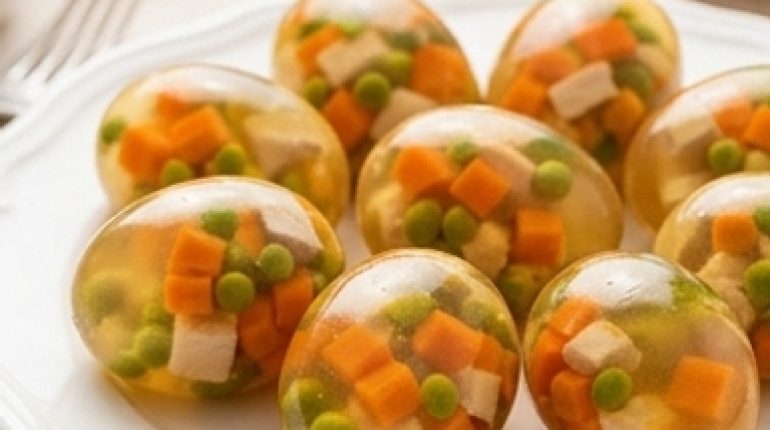
Imagine a translucent sphere the color of amber honey, like a glass of very strong tea backlit. Inside, bright orange carrot cubes, tender green peas, off-white chicken pieces — all suspended in jelly, frozen in amber. When you cut it in half, there’s that little sound: a clean click, the jelly giving way sharply. And the smell of the spiced broth rises all at once — that mixture of bay leaf, allspice, and fresh parsley that smells like Sunday cooking.
Why you’ll love this recipe
Ingredient Notes
Everything needed to make these jellied eggs: chicken, fresh vegetables, and gelatin for a spectacular result.
- The gelatin : This is the heart of the recipe and the only technical ingredient. Count 5 teaspoons for about one liter of broth — this is the dosage that gives a jelly that holds without being rubbery. Too little and it collapses when unmolded, too much and you’re serving a block. Use neutral powdered gelatin and always dissolve it in a hot liquid, never boiling, or it loses its properties.
- The chicken : A single breast is enough to garnish six eggs. Get it organic if you can — not for ideological reasons, but because the broth will be frankly better. A free-range chicken has more natural collagen, which helps the jelly set with a silkier texture.
- Allspice (Jamaica pepper) : If you don’t know this spice, now is the time to discover it. A few whole berries are enough. It tastes like a mix of cinnamon, cloves, and nutmeg in a single berry — you can’t really identify what it is in the broth, but you notice when it’s missing.
- Turkey ham and turkey bacon : For the garnish, we use turkey ham and turkey bacon instead of the classic pork versions — same salty and slightly smoky texture, same role in the recipe. Both are easily found in the deli section of your supermarket.
- The broth vegetables : Carrot, leek, celery, onion. Don’t skimp on the quantities. The more vegetables in the broth, the more flavorful the jelly will be. And don’t throw them away after cooking — taken out al dente, they go straight into the egg garnish.
The broth: don’t rush it, everything is decided here
The broth is both the base and the finish. All the taste you’ll have in these eggs comes from there. Cover the chicken and vegetables with cold water — not hot — so the flavors come out gradually rather than being seared abruptly. Cook over very low heat, a simple simmer, not a boil that will cloud the liquid. Count 50 to 60 minutes. When the smell of allspice and bay leaf starts spreading through the kitchen — something between an oriental grocery and a Sunday pot-roast — it’s a sign the broth is working well. The vegetables must remain al dente: they will also serve as a garnish.
The part everyone fails: filtering without rushing
Once cooking is finished, take out the vegetables and chicken, and filter the broth through a fine mesh sieve. Not a pasta colander — a fine sieve, or cheesecloth if you have some. The goal: a perfectly clear broth, amber black tea color, without the slightest suspended particle. This is what will give that translucent jelly where the garnish colors will stand out clearly. Add the gelatin to the still hot broth but off the heat, stir until completely dissolved, then let cool slightly. Taste and season properly — the jelly dulls the flavors a bit as it cools, so the broth needs to be well seasoned at this stage.
Emptying the shells without breaking them (less intimidating than it looks)
This is the scary part. And yet. Take a needle or the tip of a fine knife, make a tiny hole in the pointed end, then a slightly larger hole in the flat end — that’s where the contents will come out. Blow gently. It comes out gradually, without jolts. Then rinse the shells with hot water, then dip them for a few minutes in a bowl of boiling water. Place them opening-up in their egg tray while they dry — this simple detail of using the tray prevents everything from tipping over when filling.
The assembly: precise but not complicated
Fill each shell about three-quarters full — diced vegetables, chicken crumbles, small pieces of turkey ham or turkey bacon, a pinch of chopped parsley for green color. Don’t fill to the brim: space is needed for the jellied broth. Pour the cooled broth, still liquid but not hot, using a small spoon or a food syringe if you have one. Gently tap each shell on the table to bring up air bubbles. Then into the fridge — 4 hours minimum, overnight is even better.
Unmolding and serving
When serving, briefly scald the eggs or dip them for 10 seconds in very hot water to soften the inner membrane. Peel the shell in small pieces, delicately — the jelly is firm but not indestructible. The egg then reveals itself: translucent, shiny, with the bright colors of the garnish perfectly visible through it. Serve immediately on a cold plate. The jelly holds well at cool temperatures but doesn’t like waiting on a warm plate or in a room that is too heated.
Tips & Tricks
- If your broth is slightly cloudy after cooking, filter it twice through a very fine sieve. The key is to never bring it to a rolling boil during cooking — that’s what clouds the liquid irreparably.
- Think about the visual palette when preparing the garnish: orange carrot, green peas, yellow corn, red bell pepper. The more the colors contrast through the jelly, the more striking the effect when cut!
- Prepare the eggs the day before and leave them unpeeled in the fridge. The shell protects the jelly and you’ll only have to peel and plate five minutes before sitting down to eat.
- Powdered gelatin dissolves better if you first let it bloom for a minute in a little cold broth before incorporating it into the hot broth — this avoids lumps that refuse to melt.
Can Jellied Eggs be prepared in advance?
Yes, and it’s even recommended. The eggs are ideally prepared the day before and kept unpeeled in the refrigerator until the next day. The shell protects the jelly during this time. Once peeled, consume them within 2 hours.
How long do Jellied Eggs keep?
In their shells, they keep for 3 days in the refrigerator. Once peeled, the jelly is fragile and it’s best not to prepare them too far in advance — the surface starts to dry and lose its shine after a few hours.
Can leaf gelatin be used instead of powdered gelatin?
Yes. Count about 8 gelatin leaves (about 16g) for one liter of broth. Soak them for 5 minutes in cold water, squeeze them well, then incorporate them into the hot broth off the heat, stirring until completely dissolved.
My jelly isn’t setting — what should I do?
Test it before filling the shells: place a spoonful of the jellied broth in the fridge for 10 minutes. If it doesn’t set, dissolve an extra teaspoon of gelatin in a little hot broth and incorporate into the rest. Boiled gelatin loses its properties, so check that it was added off the heat.
Can molds be used instead of real eggshells?
Absolutely. Silicone egg-shaped molds or small verrines work very well and simplify unmolding. You lose the somewhat surprising ‘real egg’ effect, but the result is just as beautiful and service is faster.
How to get a perfectly clear broth for the jelly?
Two simple rules: cook at a very gentle simmer without ever boiling, and filter through a fine sieve (or cheesecloth) after cooking. If the broth remains cloudy regardless, let it rest for 15 minutes off the heat so particles fall to the bottom, then filter again by pouring gently.
Stuffed Jellied Eggs
Eastern European
Appetizer
Eggshells filled with chicken, colorful vegetables, and turkey ham, suspended in a translucent homemade aspic. An elegant and surprising Easter appetizer that is prepared entirely in advance.
Ingredients
- 6 fresh eggs (for the shells)
- 200g chicken breast (1 whole breast)
- 1 litre cold water
- 12g (5 tsp) neutral powdered gelatin
- 1 large (150g) carrot
- 1 (100g) yellow onion
- 1 white (80g) leek
- 1 stalk (60g) celery
- 2 bay leaves
- 5-6 berries allspice (Jamaica pepper)
- 10g fresh parsley (1 small bunch)
- Salt and pepper to taste
- 80g turkey ham, finely diced
- 60g turkey bacon, finely diced
- 50g peas (fresh or frozen)
- 50g canned corn, drained
- ½ (50g) red bell pepper, finely diced
- 30g dill pickles, finely diced
Instructions
- 1Place chicken, carrot, onion, leek, celery, bay leaves, allspice, and parsley in a pot. Cover with one liter of cold water and bring to a simmer over low heat.
- 2Cook for 50 to 60 minutes over very low heat without ever letting it boil. Remove vegetables when al dente and set aside. Remove chicken and let cool.
- 3Filter the broth through a fine sieve until a clear liquid is obtained. Off the heat, stir in the powdered gelatin until completely dissolved. Season with salt and pepper. Let cool until lukewarm.
- 4Make a small hole in the pointed end of each raw egg and a larger hole (1 cm) in the flat end. Blow gently to empty the contents. Rinse with hot water, then sterilize for 5 minutes in boiling water. Drain in the egg tray.
- 5Dice the cooked chicken and broth vegetables. Mix with the turkey ham, turkey bacon, peas, corn, bell pepper, and pickles.
- 6Place the shells opening-up in their tray. Fill each shell ¾ full with the garnish.
- 7Pour the lukewarm jellied broth into each shell to the top. Tap gently to release air bubbles.
- 8Refrigerate for at least 4 hours, ideally overnight.
- 9To serve, dip each egg for 10 seconds in very hot water, then delicately peel the shell. Plate immediately on a cold dish.
Notes
• Storage: unpeeled eggs keep for 3 days in the refrigerator. Once peeled, consume within 2 hours as the surface dries quickly.
• Gelatin test: before filling the shells, put a spoonful of the jellied broth in the fridge for 10 minutes. If it doesn’t set, add an extra teaspoon of gelatin dissolved in a little hot broth.
• Vegetarian variation: replace chicken with sautéed button mushrooms and asparagus, and prepare a vegetable broth robust with fresh herbs.
Nutrition Facts (per serving, estimated)
| 95 kcalCalories | 12gProtein | 5gCarbs | 3gFat |