Have you ever wondered why asparagus always ends up as a boring side dish when it clearly deserves better? This stuffed chicken breast finally gives it the starring role. And once you’ve tasted this version, a plain chicken breast feels frankly sad.
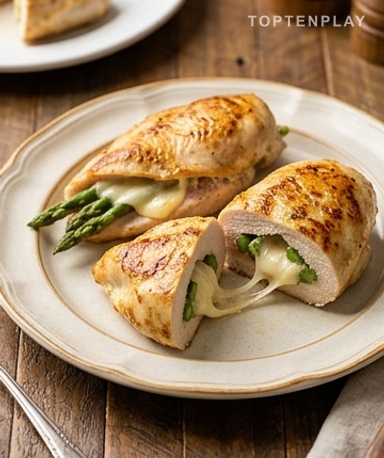
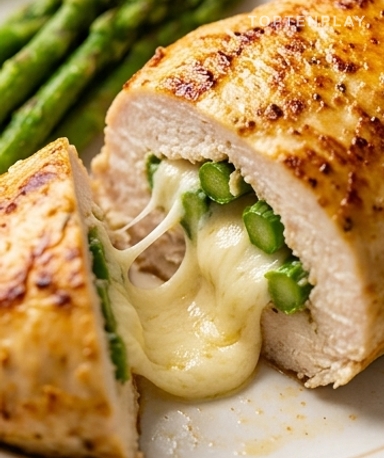
Slice into the center of the breast and the mozzarella stretches into shiny white strings. The asparagus appears, bright green, still slightly firm to the bite. The exterior of the chicken has taken on a light caramel color—almost auburn at the edges—with that thin crust that resists for a fraction of a second before giving way. The aroma rising from the dish blends slightly smoky paprika, warm cheese, and oregano: the kind of smell that brings people into the kitchen without even being called.
Why you’ll love this recipe
Ingredient Notes
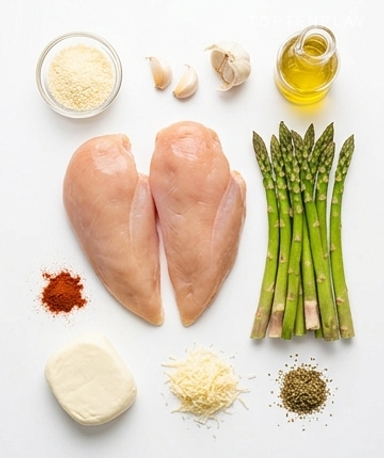
Everything you need for this recipe: simple ingredients that make a stunning dish.
- Chicken Breasts : Choose thick ones of similar size for even cooking. A fillet that’s too thin is hard to open—the pocket might tear and the stuffing will leak during cooking. If you can visit a butcher, ask for supremes: they are generally better calibrated than supermarket vacuum packs.
- Green Asparagus : Go for green rather than white here, no hesitation. They hold up better to double cooking (blanching then oven) and keep a bold color. Choose medium-sized stalks: not too thin, or they’ll melt and disappear into the cheese, nor too thick, or they won’t fit neatly into the pocket.
- Mozzarella : Get a block of fior di latte mozzarella and grate it yourself. Pre-shredded bagged cheese contains anti-caking starch that prevents it from melting properly. Also avoid buffalo mozzarella here—it’s too moist and will soggy the inside of the fillet rather than melting cleanly.
- Paprika : Smoked paprika rather than sweet if you have the choice. It gives the surface of the chicken a very light ember aroma that contrasts well with the freshness of the asparagus. Half a teaspoon is plenty for it to be noticed without overpowering.
The pocket in the fillet: the part everyone fails
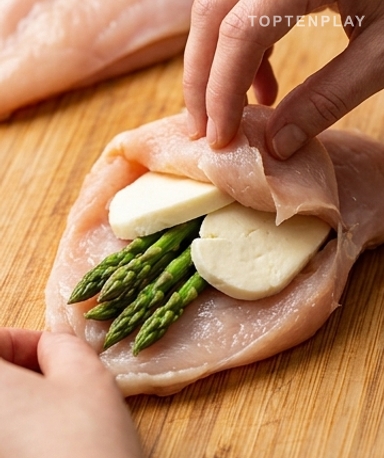
The movement is simple but requires a minimum of attention. Lay the fillet flat on the board, press down gently with your palm to stabilize it, and insert the blade of a sharp knife into the thickness—not on top, but on the side. The idea is to create a cavity like an opening wallet, without going all the way through or cutting the edges. If you feel the blade approaching the edge, stop. A pocket with too many holes lets all the cheese out during cooking, leaving you with a puddle in the dish and a half-empty fillet. Take your time on this step—it determines everything else.
Asparagus and mozzarella: why this pairing really works
Blanching the asparagus before stuffing is not an optional step. Two or three minutes in boiling salted water, then immediately into cold water—this fixes their bright green color and par-cooks the stalks so they don’t stay raw in the heart of the fillet. Raw asparagus in cooked chicken is hard, fibrous, and disappointing. Pre-cooked, it keeps its natural crunch and integrates well with the mozzarella melting around it. When stuffing, place the asparagus in first, then the cheese on top: it forms a layer that keeps the asparagus in place. Close with two or three toothpicks.
Sear first, finish in the oven—in that precise order
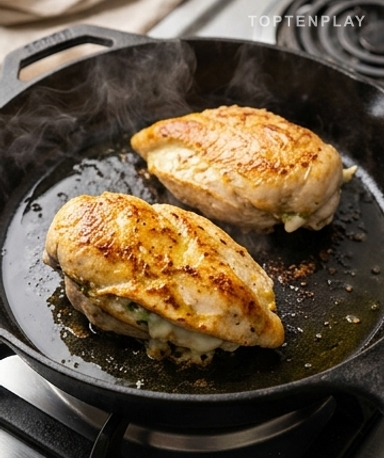
A very hot pan with a drizzle of olive oil. Not lukewarm—really hot, to the point where the oil begins to shimmer when you tilt the pan slightly. The fillets make contact with the surface and you hear that loud, brief sizzle that indicates a proper crust is forming. Two to three minutes without touching, without moving the fillets. Flip them. Another two minutes. Then, into the oven at 190°C for 20 to 25 minutes depending on thickness. Searing creates a barrier that locks the juices inside—if you skip this step and go straight to the oven, the chicken will dry out.
The 4 minutes after the oven that change everything
Once out of the oven, the fillet needs to rest. Four minutes. This is the time it takes for the cheese to stabilize slightly after being at over 180°C. If you cut immediately, the mozzarella will run entirely onto the plate and you’ll lose all that internal melt. Four minutes under a folder piece of foil placed loosely—not airtight, just resting—and when you cut, the cheese strings will stretch. It is this precise moment that justifies the whole recipe.
Tips & Tricks
- Count the toothpicks before serving and remove them all—place them on the edge of the plate as you go. A forgotten toothpick in the dish happens quickly and completely ruins the experience.
- If the asparagus stalks are longer than the fillet, trim them to the right size before stuffing. No need to let them poke out—it weakens the closure and the chicken has trouble staying in place during cooking.
- Use a meat thermometer if you have one: 74°C at the core is cooked. No more need to cut to check and let all the juices escape.
How do I prevent the stuffing from escaping during cooking?
Two things: don’t pierce the pocket all the way through when cutting, and close properly with at least two toothpicks placed diagonally. If you see some cheese starting to ooze out during searing, that’s normal—the bulk will stay inside once in the oven.
Can I prepare the stuffed fillets in advance?
Yes, up to 4 hours in advance. Prepare the stuffed and closed fillets, place them in a covered dish in the refrigerator. Take them out 15 minutes before cooking so you’re not searing them cold—a cold fillet extends the cooking time and results in less even cooking.
Can I use a cheese other than mozzarella?
Absolutely. Cream cheese like Philadelphia gives a creamier, less stringy filling. Grated Emmental or Comté work well if you want a stronger taste. Avoid hard, non-melting cheeses like dry Pecorino—they remain grainy when cooked.
How do I know if the chicken is cooked through without cutting it?
A cooking thermometer inserted into the heart of the fillet should read 74°C. Without a thermometer, pierce the center with a thin knife: the juice that runs out should be clear, not pink. Allow 22-25 minutes in the oven at 190°C for a standard-sized fillet.
Is blanching the asparagus really mandatory?
In practice, yes. Raw asparagus placed directly in the pocket stays hard in the center, even after 25 minutes in the oven—the chicken protects the stuffing too well from the heat. Two minutes of blanching is enough: they finish cooking inside the fillet and keep their crunch.
Can I freeze this dish?
Not ideal, but possible before cooking only. Freeze the raw stuffed fillets on a tray, then transfer to an airtight bag. Thaw in the refrigerator the night before, and cook as normal. Cooked then frozen mozzarella loses its stringy texture and becomes rubbery.
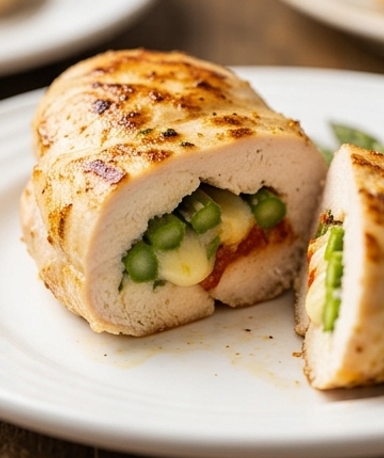
Stuffed Chicken Breast with Asparagus and Melting Mozzarella
Mediterranean
Main course
Chicken breasts sliced into pockets, stuffed with green asparagus and melting mozzarella, seared in a pan and finished in the oven. Simple to prepare, spectacular at the table.
Ingredients
- 2 large chicken breasts (about 200g each)
- 200g green asparagus (8 to 10 stalks)
- 100g fior di latte mozzarella, shredded at home
- 30g grated parmesan (optional)
- 1 tablespoon olive oil (15ml)
- 1/2 teaspoon smoked paprika
- 1/2 teaspoon garlic powder
- 1/2 teaspoon dried oregano
- 1 clove fresh garlic, minced (optional)
- to taste salt and freshly ground black pepper
Instructions
- 1Preheat the oven to 190°C.
- 2Blanch the asparagus for 2 to 3 minutes in boiling salted water, then plunge immediately into cold water. Drain and set aside.
- 3Slice each chicken breast through the thickness to create a pocket, without piercing the edges or the bottom.
- 4Mix the olive oil, paprika, garlic powder, oregano, salt, and pepper. Brush the fillets inside and out.
- 5Fill each pocket with 4 to 5 asparagus stalks, then the mozzarella and parmesan. Close with 2 to 3 toothpicks.
- 6Heat an oven-safe skillet over high heat with a drizzle of olive oil. Sear the fillets for 2 to 3 minutes on each side until caramel brown.
- 7Place in the oven for 20 to 25 minutes, until the core temperature reaches 74°C.
- 8Let rest for 4 minutes out of the oven under a loosely placed piece of foil. Remove all toothpicks before serving.
Notes
• Storage: keeps for 2 days in the refrigerator, well covered. Reheat at 160°C in the oven for 10 minutes under foil—do not microwave, as the mozzarella will harden.
• Make-ahead: the stuffed and closed fillets can be prepared up to 4 hours in advance and kept in the refrigerator. Take out 15 minutes before cooking.
• Cheese variant: replace mozzarella with Philadelphia cream cheese for a creamier filling, or with grated Emmental for a more intense flavor.
Nutrition Facts (per serving, estimated)
| 380 kcalCalories | 42gProtein | 4gCarbs | 20gFat |