📌 Stuffed Cabbage Rolls with Beef and Rice in Slow-Simmered Tomato Sauce
Posted 20 April 2026 by: Admin
Stuffed cabbage rolls are the kind of dish that divides people. Some find them too long to make, too laborious. Personally, I think that’s exactly what makes them one of the best weekend dishes — when you finally have the time to cook without watching the clock.
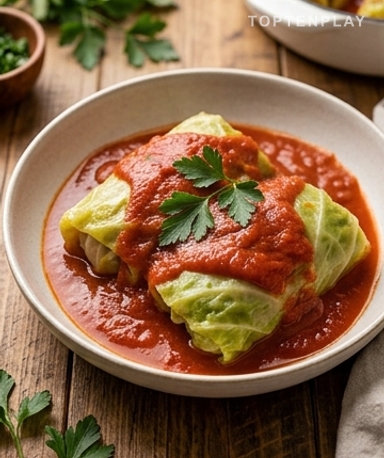
The tomato sauce, after an hour of cooking, has taken on a brick-red, almost orange hue — dense, concentrated, almost candied. The rolls are nestled tightly against each other, the cabbage leaves a translucent olive green, soaked in juices. As you open them with a spoon, the steam escapes all at once. The filling — meat and rice melted together — crumbles slightly, just as it should.
Why you’ll love this recipe
Ingredient Notes
All the ingredients gathered to prepare these generous stuffed rolls.
- Green cabbage (or Savoy cabbage) : Savoy cabbage is easier to work with — its crinkled leaves pull away without tearing. A regular green cabbage also works but requires more attention during blanching. Choose a large, dense head, at least 1.2 kg.
- Ground beef 15% fat : Not 5%. Fat is what prevents the filling from becoming a dry, grainy lump. Beef that is too lean results in a flavorless outcome. 15% is the right balance — neither dry nor greasy.
- Short-grain rice : Classic round/short-grain rice absorbs the broth within the filling without bursting during cooking. Definitely no basmati rice: it cooks too fast, doesn’t hold up, and makes the filling crumbly.
- Canned crushed tomatoes : A can of whole peeled tomatoes crushed by hand gives more flavor than industrial crushed ones. Less water, more flesh. As long as the tomatoes are Italian, the brand doesn’t matter much.
- Onion and garlic : They go into both the filling AND the sauce. Don’t skip them in either: without them, the sauce is flat and the filling lacks depth.
The cabbage: the step everyone rushes too quickly
Blanching the cabbage leaves takes ten minutes and changes absolutely everything. A leaf that isn’t blanched enough will tear when you try to fold it. Over-blanched, and it disintegrates during cooking. The right texture is flexible but with a little resistance — like wet leather. Submerge the leaves in a large pot of boiling salted water for two minutes maximum, then directly into cold water to stop the cooking. The color turns from bright green to deep olive: that’s the sign it’s ready. Cut the thick central rib at an angle so the leaf rolls without creating a bulge under the filling.
The filling is where it all happens
In a bowl: ground beef, raw rice — not precooked, it continues to cook in the sauce —, finely chopped onion, crushed garlic, salt, pepper, and a bit of smoked paprika. Mix by hand. The coldness of the raw meat contrasts with the heat of the kitchen. Don’t over-mix: you want a homogeneous filling, not a compact puree. Use a ball about the size of a large walnut per roll, no more — if it’s too full, the leaf will open during cooking and the filling will disperse into the sauce.
The rolling, or how not to undo everything
Lay the leaf flat, rib side toward you. Place the ball of filling in the center. First, fold the bottom of the leaf over the filling, then both sides inward, and roll upward like a spring roll. Tight, but not so much that you crush the filling. Place the seam underneath so the roll stays closed during cooking. If the leaf is really too large, trim it — better a clean roll than a leaf overflowing everywhere.
Why slow cooking makes all the difference
Pack the rolls tightly into the pot, seam side down. The tomato sauce — crushed tomatoes, sautéed onion, garlic, salt, a pinch of sugar to balance the acidity — should cover them three-quarters of the way. Lid on. Low heat. This is where the real magic begins. For an hour, the rolls soak up the sauce, the rice cooks in the meat juices, and the sauce concentrates until it becomes thick and almost velvety. Halfway through, the smell in the kitchen is that of Sundays at the home of someone who really cooks — caramelized tomato, meat, warm herbs. Don’t open it every five minutes. Trust the process.
Tips & Tricks
- Make the rolls the day before and leave them in the fridge overnight: the sauce penetrates the leaves and the next day, the flavors are unified and rounder — it’s significantly better than when served immediately.
- Never cook over high heat: the rice will swell abruptly and the rolls will burst open. Constant low heat is key, even if it takes longer than expected.
- If the outer leaves of the cabbage are damaged, keep them to line the bottom of the pot — they prevent the rolls from sticking and burning, and they also absorb all the sauce.
Can cabbage rolls be prepared in advance?
Yes, and it’s even recommended. Prepared the day before and kept in the fridge in their sauce, they are even better the next day — the flavors meld and the sauce penetrates the leaves. Simply reheat over low heat with a lid for 15 minutes.
How do I prevent the rolls from opening during cooking?
Two things: don’t overfill the leaf (a ball of filling the size of a walnut, no more) and place the rolls seam-side down in the pot. The pressure from the other rolls packed tightly together also helps.
Can stuffed cabbage rolls be frozen?
Yes, very well. Freeze them in their sauce in an airtight container for up to 3 months. To defrost, move them directly from the freezer to the fridge the day before, then reheat over very low heat. The texture of the cabbage remains good.
The rice isn’t cooked after an hour, what should I do?
Add a little broth or hot water (100 ml is enough) and continue cooking covered for 15 to 20 minutes. This is often due to a heat that was too high, evaporating the liquid too quickly before the rice had time to absorb it.
What can I use to replace ground beef?
Ground veal works very well and gives a finer, slightly milder filling. Ground lamb is also a good option for a bolder flavor. You can even do half beef, half rice if you want to lighten it up.
Green cabbage or Savoy cabbage: which one to choose?
Savoy cabbage (with curly, crinkled leaves) is more flexible after blanching and tears less during rolling. Regular green cabbage is firmer and requires an extra 30 seconds of blanching. Both work, but Savoy is more forgiving for beginners.
Stuffed Cabbage Rolls with Beef and Rice in Slow-Simmered Tomato Sauce
Eastern European
Main Course
Tender cabbage leaves stuffed with a beef-rice mixture and simmered slowly in a concentrated tomato sauce. The ultimate weekend dish.
Ingredients
- 1 grosse tête (~1,2 kg) green cabbage or Savoy cabbage
- 500g ground beef (15% fat)
- 100g raw short-grain rice
- 1 (environ 150g) yellow onion, finely chopped
- 3 garlic cloves, crushed
- 1 boîte (400g) canned crushed tomatoes
- 200ml beef broth
- 2 càs (30g) tomato paste
- 1 càc smoked paprika
- 1 càc sugar
- 2 càs olive oil
- à votre goût salt and black pepper
Instructions
- 1Bring a large pot of salted water to a boil. Carefully detach 12 large leaves from the cabbage and blanch them for 2 minutes. Immediately transfer them to a cold water bath, drain, and trim the central rib at an angle.
- 2In a bowl, mix the ground beef, raw rice, half of the chopped onion, 2 crushed garlic cloves, smoked paprika, salt, and pepper by hand.
- 3Lay a cabbage leaf flat. Place a ball of filling (walnut-sized) in the center. Fold the bottom, the sides, then roll upward. Repeat with all leaves.
- 4In a pot, sauté the remaining onion and garlic in olive oil over medium heat for 3 minutes. Add the crushed tomatoes, tomato paste, broth, and sugar. Season with salt and pepper and mix.
- 5Arrange the rolls tightly in the pot, seam side down. The sauce should cover them three-quarters of the way. Bring to a simmer, cover, and let cook over low heat for 60 minutes.
- 6Check for doneness: the rice should be tender and the sauce thickened. Serve directly from the pot with a little sauce drizzled over the top.
Notes
• Storage: keeps for 3 days in the fridge in an airtight container with its sauce. Reheat over low heat with a lid. Freezes very well for up to 3 months.
• Make-ahead: rolls can be assembled (un-cooked) up to 24h in advance in the fridge, covered with plastic wrap. Start cooking when ready.
• Variation: add a teaspoon of cumin to the filling and a few black olives to the sauce for a Mediterranean version.
Nutrition Facts (per serving, estimated)
| 415 kcalCalories | 29gProtein | 34gCarbs | 17gFat |