You see ‘verrines’ and your brain immediately jumps to fine pastry, mousse rings, gelling agents, and chef-level techniques. Except here, there’s none of that. Ten minutes, a cold mixing bowl, and an electric whisk — that’s all it takes to turn out something that really looks the part.
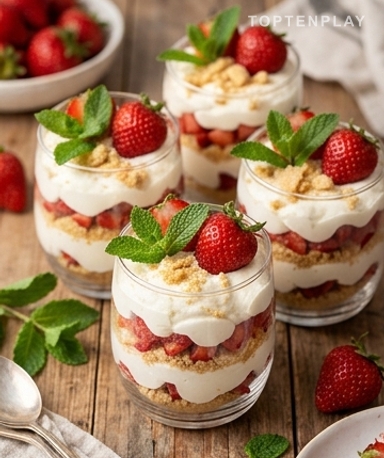
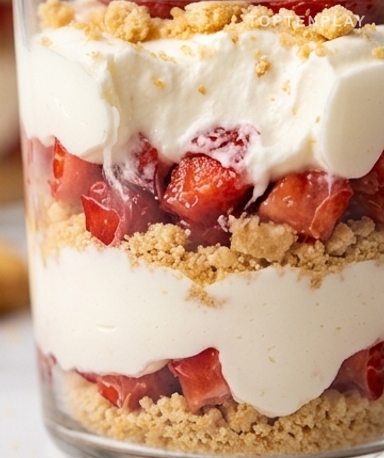
The verrines arrive at the table and they speak before you do. Neat layers are stacked in the glass: the pearly white of the mascarpone cream, the bright red of the strawberries, the golden beige of the shortbread crumbs. The cream is smooth and slightly glossy, with that firm hold you get when all ingredients are well chilled. The strawberries give off a slightly tangy scent — that of ripe fruit cut at the last minute. Under the spoon, everything gives way together: the melting, the juicy, the crunchy.
Why you’ll love this recipe
Ingredient Notes
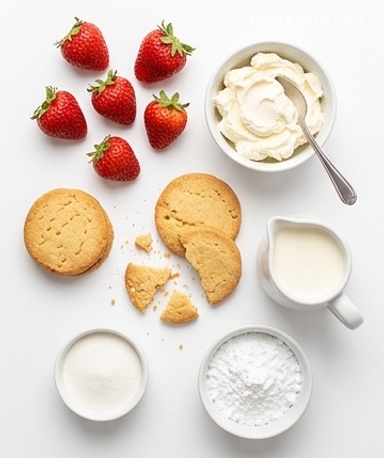
All ingredients gathered: fresh strawberries, very cold mascarpone, Sablés Bretons, and heavy cream.
- Mascarpone : This is the base of the cream, and it must be very cold — taken out of the refrigerator at the last second. Lukewarm mascarpone won’t whip correctly and you’ll end up with a runny cream. Get the full-fat version, not light. The light version doesn’t have enough fat to hold its shape.
- Fresh strawberries : Choose strawberries that actually smell of something. If you put your nose to the punnet and nothing happens, move on. Gariguettes are ideal in season — small, fragrant, slightly tart. Off-season, thawed and well-drained frozen strawberries can work, but the texture will be softer.
- Sablés Bretons (French salt butter cookies) : Not ‘petit beurres’, not digestive biscuits. Specifically Sablé Breton, because it is thicker, more buttery, and resists the cream’s moisture better. You can find them easily in supermarkets. After a few minutes in the verrines, they start to soak up the juices — this is intentional, but don’t assemble the glasses too far in advance.
- Heavy liquid cream : Full-fat is mandatory, minimum 30% fat content. Light cream will not whip. And like the mascarpone, it must be cold. If you want to go faster, put your bowl and whisk attachments in the freezer ten minutes before.
Why Sablé Breton and not just any biscuit
The question seems trivial but it really changes the result. A well-buttered Sablé Breton has a texture that is dense and crumbly at the same time — when you coarsely crush it between your fingers, it releases a scent of slightly salty butter that rivals many commercial pastries. It is not a subtle biscuit. It has character, thickness, and resistance. In the glass, it will slowly absorb the cream and strawberry juices without turning into an unformed mush — which would happen with a thinner biscuit. Keep irregular pieces, some larger, others almost powder. It is this mix that creates interest in the mouth.
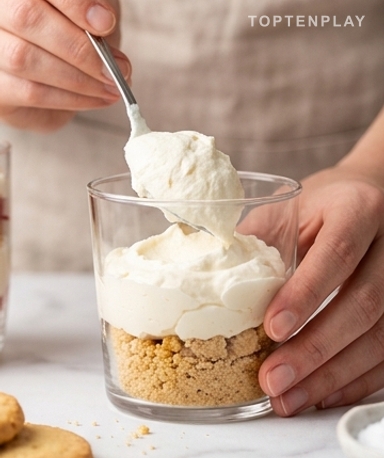
Mascarpone cream: the part everyone messes up
The electric mixer goes fast — too fast if you’re not careful. The goal is a cream that holds its shape, smooth and airy, neither too liquid nor too firm. When you start whisking the mascarpone with the cream, powdered sugar, and vanilla, the mixture is quite liquid at first. Then, in less than two minutes, it starts to set. You see it change: the cream goes from milky white to matte white, and the whisks leave tracks that no longer disappear. That’s when you must stop. If you continue, the cream will split — it will become grainy, close to churned butter, and it’s unrecoverable. Stop as soon as the whisks leave a clear, firm furrow.
Layering: order, not random chance
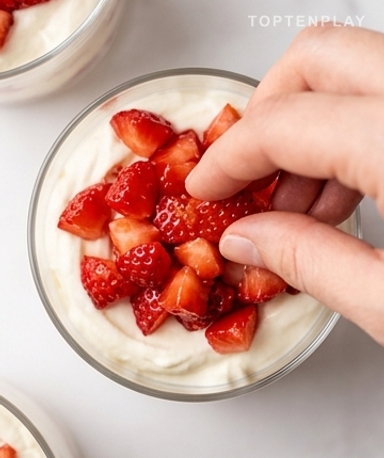
Always start with the shortbread. It acts as an absorbent base — it catches the moisture from the cream and strawberries without dissolving completely. Then place the strawberries as a second layer, distributed well to the edges of the glass so the layers are clearly visible from the outside. The mascarpone cream comes on top, thick, so it won’t run between the fruit pieces. If the glasses are tall enough, repeat the process a second time. Always finish with the cream and a neat decoration: a few cleanly placed strawberry pieces, a pinch of crumbled shortbread, a mint leaf if you have one. This isn’t just for looks — it’s what makes you want to dive in with a spoon.
Chilling time: the step we wrongly skip
Thirty minutes in the refrigerator, minimum. The cream firms up a bit more, the strawberries start to release a tiny bit of juice that will seep into the shortbread, and the flavors harmonize. Eaten straight from the mixing bowl into the glasses, the dessert is good. After a stint in the fridge, it’s better. The verrines keep for up to twenty-four hours, but beyond that, the shortbread loses its crunch permanently. The ideal is still to assemble the verrines two hours before serving, no more.
Tips & Tricks
- Put your bowl and beaters in the freezer ten minutes before whisking — the cream whips twice as fast and holds better. In hot weather, this is almost essential.
- If you use a piping bag to add the cream, the visual result is much neater than with a spoon. You don’t need a fancy nozzle: a simple freezer bag with a corner cut off does the trick.
- Assemble the verrines at the last minute if you really value the shortbread’s crunch. The cream and strawberries can wait in the fridge separately — assembly only takes three minutes.
Why is my mascarpone cream too runny?
Almost always, the cause is temperature: the mascarpone or the cream were not cold enough. Put the whole bowl back in the fridge for twenty minutes and start whisking again. If the cream stays liquid despite this, it can no longer be salvaged — you must start over with new, very cold ingredients.
Can I prepare the verrines the day before?
You can prepare the mascarpone cream and the strawberries the day before, keeping them separately in the refrigerator. The final assembly should be done on the same day — ideally two hours before serving. Beyond 24 hours, the shortbread loses all its crunch and the texture is no longer interesting.
Can I replace the Sablés Bretons with another biscuit?
Yes, but the result will be different. Speculoos bring a spicy note that works very well with strawberries. Breton pucks (palets) or Scottish shortbread are good alternatives. Avoid very thin biscuits like ‘petit beurres’ — they dissolve too quickly in the cream and disappear completely.
Do frozen strawberries work in this recipe?
Yes, provided you thaw them completely and drain them well before use. They will release much more juice than fresh strawberries, which will soften the shortbread faster. The result is okay, but the texture of the strawberries will be softer — save this option for seasons when fresh strawberries have no flavor.
Can I make this recipe without an electric mixer?
Technically yes, with a hand whisk, but it’s long and physically tiring — expect five to eight minutes of intensive whisking. There is also a risk of warming the cream with the heat from your hands, which makes it harder to whip. A fifteen-euro electric mixer really is a life-changer for this kind of preparation.
How do I prevent the shortbread from getting soggy before serving?
The shortbread’s crunch doesn’t survive long in contact with the cream — it’s inevitable. To maximize it, assemble the verrines as late as possible, ideally one to two hours before serving. You can also place the shortbread as the top layer just before serving, instead of at the base.
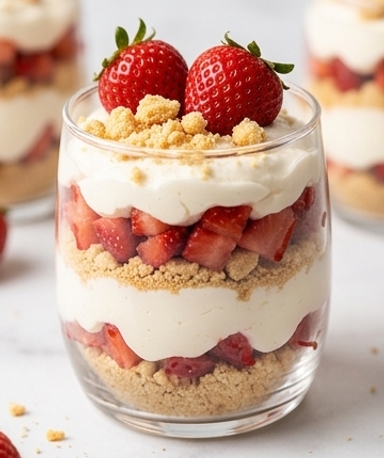
Strawberry Mascarpone Verrines with Sablés Bretons
French
Dessert
A no-bake dessert ready in ten minutes: airy mascarpone cream, fresh strawberries, and crunchy Sablés Bretons layered in glasses. Simple, elegant, and incredibly effective.
Ingredients
- 250g very cold mascarpone
- 200ml (20cl) very cold heavy liquid cream (min. 30% fat)
- 60g powdered sugar
- 1 sachet (8g) vanilla sugar
- 250g fresh strawberries
- 8 Sablés Bretons
- a few leaves fresh mint (optional)
- 1 lemon zest (optional)
Instructions
- 1Wash and hull the strawberries, then cut them into small pieces. Reserve a few whole strawberries for final decoration.
- 2Coarsely crumble the Sablés Bretons between your fingers or in a bag by crushing them with a rolling pin. Keep pieces of various sizes for contrast.
- 3In a very cold mixing bowl, whisk the mascarpone, liquid cream, powdered sugar, and vanilla sugar with an electric mixer until getting a firm and airy cream. Stop as soon as the whisks leave a clear, firm furrow.
- 4In each glass, place a layer of crumbled shortbread, then strawberry pieces, then a generous layer of mascarpone cream. Repeat the layers if the glass is tall enough.
- 5Finish with a layer of cream, a few strawberry pieces, a little crumbled shortbread, and a mint leaf. Refrigerate at least 30 minutes before serving.
Notes
• Storage: the verrines keep for up to 24 hours in the refrigerator. Beyond that, the shortbread softens completely and loses its appeal.
• Make-ahead: prepare the cream and strawberries separately the day before. Assemble the verrines 1 to 2 hours before serving to keep the texture contrast.
• Variations: replace the Sablés Bretons with speculoos, or the strawberries with raspberries, fresh mango, or blueberries depending on the season.
Nutrition Facts (per serving, estimated)
| 430 kcalCalories | 8gProtein | 35gCarbs | 30gFat |