📌 Strawberry mascarpone swiss roll: the damp cloth technique that prevents cracks
Posted 4 February 2026 by: Admin
The Strawberry Mascarpone Swiss Roll: A Classic Revisited with Softness
The strawberry mascarpone swiss roll stands out as a great classic of French pastry, revisited with remarkable lightness. Its success relies on a subtle alliance: a flexible and airy sponge cake meets a smooth, lightly sweetened mascarpone cream, enhanced by the vibrant freshness of strawberries. This elegant dessert transcends occasions, naturally finding its place at the end of a refined meal, during a gourmet snack, or to celebrate a special moment.
Its ultra-moist texture is its true asset. Unlike traditional logs that can sometimes be heavy, this one seduces with its finesse and perfect balance. The contrast between the enveloping sweetness of the mascarpone, the fruity intensity of the jam, and the crisp freshness of the strawberries creates a harmonious balance in the mouth, without ever being excessive. This mastered combination explains why this dessert wins over both children’s palates and those of demanding adults.
The success of this log is not due to chance. It requires meticulous care at every stage of preparation. The sponge cake demands delicate handling to preserve all its airy volume, while the cream needs to be whipped very cold to achieve impeccable hold. These precise, seemingly simple gestures make all the difference between an ordinary dessert and a truly memorable creation.
The Secrets of a Perfectly Moist Sponge Cake
This airy texture that characterizes the log relies above all on the technical mastery of the sponge cake. Preparation begins with a decisive step: separating the egg whites and yolks. The yolks are whisked vigorously with the sugar until a light and frothy mixture is obtained, thus incorporating the air essential for the final lightness. The addition of sifted flour is done delicately, with flexible movements, to avoid any formation of lumps that would compromise homogeneity.
Whipping the egg whites into stiff peaks with a pinch of salt constitutes the second critical phase. Their progressive incorporation into the mixture, by lifting the mass with a spatula rather than mixing vigorously, preserves the trapped air bubbles. Once spread uniformly on parchment paper, the batter bakes for precisely 10 minutes at 180°C. The sponge cake must remain pale and flexible, never golden: excessive baking would dry it out irremediably.
The professional tip lies in the gesture that immediately follows removal from the oven. Flipping the sponge onto a clean, slightly damp cloth, removing the parchment paper, and then rolling it onto itself while still hot prevents any cracking. This hot handling allows the structure to “memorize” its rounded shape. Left to cool rolled up like this, it will then unroll without resistance, ready to receive its generous filling without the slightest crack.
Mascarpone Cream: Balance Between Creaminess and Hold
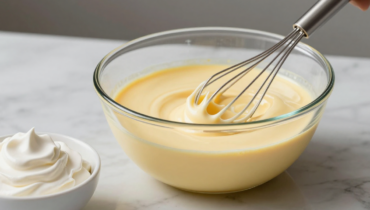
If the sponge cake constitutes the architecture of the log, the mascarpone cream shapes its gustatory soul. Its preparation requires thermal rigor: the bowl and the liquid cream must be perfectly cold before whipping. This condition guarantees a stable emulsion, capable of holding during rolling without collapsing. In this chilled container, 250g of mascarpone meet 200ml of heavy liquid cream and 60g of icing sugar, whisked together until they form a firm but airy whipped cream.
The desired texture lies at the precise intersection between lightness and consistency. Too soft, and the cream will escape during rolling and weigh down the result. Too firm, and it will lose its characteristic creaminess and break the fragile sponge cake. The whisk must turn until the mass forms soft peaks that fall back delicately, a sign of sufficient density to structure the filling without compromising the moistness.
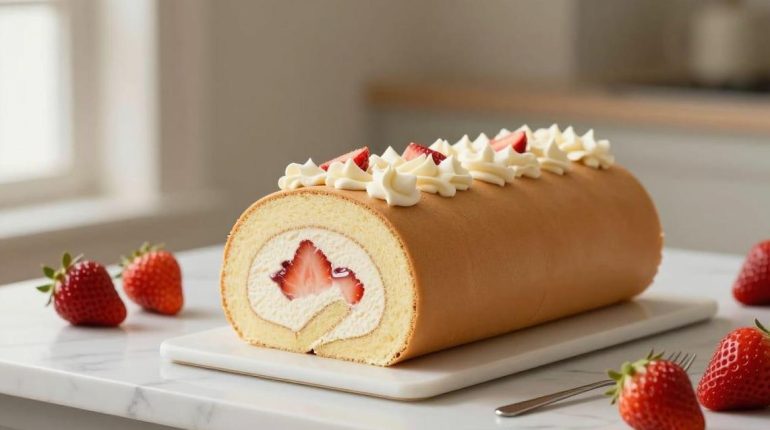
The final assembly integrates 150g of strawberry jam, spread as the first layer on the unrolled sponge, followed by the mascarpone cream and then pieces of 6 to 8 fresh strawberries distributed uniformly. This stratification brings the promised contrast: the milky sweetness of the mascarpone tempers the sugary intensity of the jam, while the fresh strawberries inject their vegetal acidity. Three distinct components that, when layered, create a remarkable gustatory balance, avoiding any heaviness despite the apparent generosity of the dessert.
Assembly and Finishing for a Professional Result
Once the cream is stabilized, the final assembly transforms these distinct preparations into a harmonious pastry. The cooled sponge cake unrolls carefully, revealing a flexible surface ready to receive its filling. The spreading of the jam is done in an even layer, without reaching the edges to avoid overflow during rolling. The mascarpone cream then covers it generously, spread with a spatula over the entire length. The pieces of fresh strawberries are distributed homogeneously, guaranteeing their presence in every slice.
Rolling requires a firm but delicate hand. By maintaining constant pressure, the log forms progressively, tight enough to eliminate air pockets without crushing the sponge cake. The seam is naturally placed downwards, ensuring an impeccable presentation. A light coating of cream smoothes the surface, while a drizzle of jam traces decorative swirls before the final dusting of icing sugar.
Resting in the refrigerator for at least one hour is not a mere formality: it allows the cream to firm up slightly, facilitating clean slicing. This break also firms up all the flavors, creating a gustatory cohesion absent immediately after assembly. The 30 minutes of preparation and 10 minutes of cooking produce a dessert for 6 to 8 people, with the possibility of adjusting the fruity intensity by substituting the jam with a more tart raspberry coulis.