📌 Spreadable crepe cake: the three-layer recipe to transform your crepes into a festive dessert
Posted 30 January 2026 by: Admin
The Mystery Recipe Behind The Pastry Phenomenon
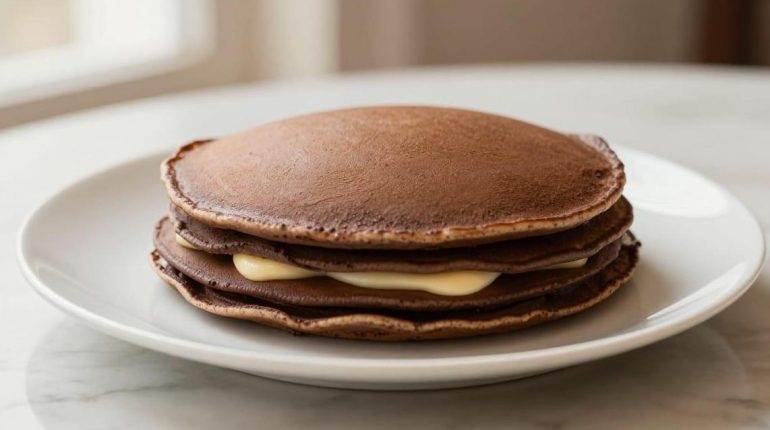
Behind the doors of professional kitchens lies a creation that defies traditional categories. The spreadable crepe cake embodies this audacity: a French layer cake where the simplicity of crepes meets the sophistication of an architect’s dessert. Far from the solitary, hastily topped crepe, this pastry construction requires a considerable time investment: 30 minutes of preparation, 30 minutes of cooking, and then a mandatory 24-hour wait for the assembly to reveal its full texture.
The recipe relies on a triple technical strategy very rare in home pastry making. First, cocoa crepes where 35g of cocoa powder transform the traditional base into a chocolate support. Next, a classic Chantilly cream (150g cream, 15g icing sugar) brings lightness and contrast. Finally, the dessert’s signature: a whipped ganache made with 50g of Cluizel 42% Hazelnut spread, 160g of cream, and a sheet of gelatin to stabilize the whole.
This tripartite combination radically distinguishes the cake from a simple pile of filled crepes. Integrating cocoa directly into the batter creates aromatic continuity with the premium spread ganache, while the gelatin guarantees structural integrity worthy of an entremet. The result promises six portions of a spectacular dessert that reconciles unashamed indulgence with rigorous pastry technique.
The Technical Architecture Of An Exceptional Dessert
The structural base relies on precise proportions: 110g of flour combined with 35g of cocoa powder create a self-supporting chocolate batter, capable of handling the stacking without collapsing. This cocoa framework accommodates 4 eggs, 15g of neutral oil, and 280g of milk, a dosage calculated to obtain thin but resistant crepes, capable of absorbing the fillings without falling apart.
The first filling adopts a minimalist approach: 150g of whipped cream with 35% fat content, stabilized by 15g of icing sugar. This classic chantilly plays an essential balancing role, counteracting the richness of the ganache with its airy lightness. Its modest volume avoids taste saturation while providing the soft texture expected of a layer cake.
The true signature lies in the whipped ganache: 160g of cream merge with 50g of Cluizel 42% Hazelnut spread, a high-end product where the hazelnut content far exceeds industrial standards. The addition of a gelatin sheet transforms this mixture into a stable, whippable, and sliceable cream, essential for maintaining the cake’s architectural cohesion during the mandatory 24-hour rest period.
This triple structure demonstrates technical mastery where each component assumes a precise role: chocolate foundation, intermediate lightness, concentrated creaminess.
The Manufacturing Method: Between Simplicity And Precision
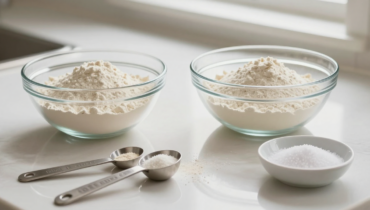
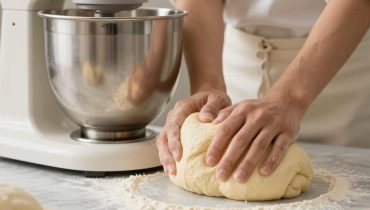
The creation begins with a fundamental gesture: gathering flour, cocoa, and salt in a professional mixing bowl. This dry mixing, done with a whisk, guarantees a homogeneous dispersion of the cocoa before any liquid incorporation, eliminating the risk of concentrated lumps that would compromise the uniform color of the crepes.
The 4 eggs are incorporated all at once, whisked until a thick and smooth batter is obtained. This initial emulsion creates the necessary protein structure, transforming the powder into a coherent base. The constant circular movement prevents the formation of pockets of unhydrated flour, a major technical flaw in cocoa batters where dark particles visually mask imperfections.
The neutral oil (15g) is then integrated, providing softness without interfering with the chocolate-hazelnut flavor profile. The 280g of milk arrive last, diluted progressively to reach the ideal consistency: a flowing but coating texture, fluid enough to form thin 2-3mm crepes, dense enough to avoid tearing when flipping.
This chronology of incorporation respects a classic emulsion logic, adapted to the constraints of cocoa which absorbs more liquid than flour alone. The result: regular, flexible, and resistant discs, ready to receive the two creamy fillings without structural failure.
The Mystery Of Exclusive Access
At the precise moment the technique is revealed, the recipe stops abruptly. An unequivocal message blocks progress: “This article is reserved for subscribers.” The cooking steps, the layer assembly, and the crucial rest times remain inaccessible without crossing the entry threshold set at €1.49 per month.
Kiss My Chef fully assumes this monetization strategy. In exchange, the site promises unlimited access to more than 16,000 recipes, renewed at a rate of 20 new creations weekly. Two newsletters structure the experience: one dedicated to new recipes, the other to culinary news. Reading comfort is presented as a differentiating argument, with voluntarily limited advertising to preserve editorial immersion.
This economic model transforms pastry expertise into premium content. The crepe cake recipe becomes a strategic bait: detailed enough to prove the editorial team’s technical competence, voluntarily truncated to encourage subscription. The underlying promise? To support an independent and dynamic media capable of regularly producing original content, far from free aggregators with standardized recipes.
The user faces a dilemma: reproduce the recipe through deduction and additional research, or yield to the subscription to obtain the complete, tested, and guaranteed methodology. Kiss My Chef bets on the perceived value of professional reliability against the uncertainty of amateur improvisation.