This is the late October recipe, when the cold truly sets in and maple stops being a seasonal flavor and becomes a real craving. Round, plump cookies, soft as cake, topped with a glossy icing that smells like caramel and warm syrup. A North American classic that deserves a place in any kitchen, well beyond the holidays.
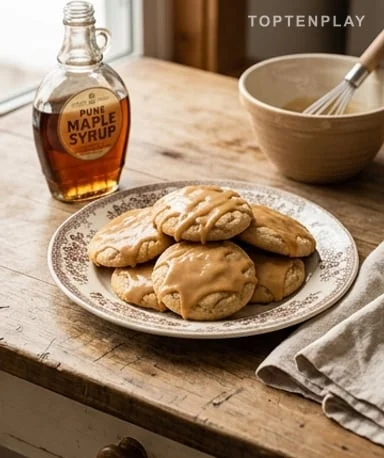
Fresh from the oven, they fill the room with a sweet-buttery scent that lingers on clothes. The golden surface yields slightly under your thumb — neither crunchy nor sticky. The still-warm icing slowly drips over the edges and sets into a thin, shiny layer, pale caramel. This is not your ordinary Sunday cookie.
Why you’ll love this recipe
Ingredient Notes
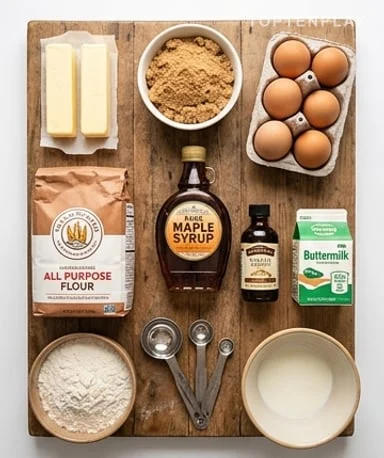
No surprises in this list: butter, brown sugar, real maple syrup. The quality of the latter makes all the difference.
- Pure maple extract : Not the artificial flavor sold in small vials in the baking aisle — that tastes like sweet medicine and doesn’t hold up during baking. Pure extract has a warm, woody depth that remains even after 12 minutes in the oven.
- Amber or dark maple syrup : The darker, the more flavorful. Light syrup is fine for morning pancakes, not for an icing that needs character. Amber or dark grade brings a pronounced caramelized note.
- Buttermilk : It reacts with the baking soda and powder to leaven the dough and give it that cake-like softness. In a pinch: one cup of whole milk with a teaspoon of white vinegar, let sit 5 minutes — works perfectly.
- Soft butter, definitely not melted : The final texture depends entirely on this. Melted, the cookies spread on the sheet and brown too quickly. Soft — taken out of the fridge an hour before — they keep their round shape and rise properly.
- Brown sugar in the icing : It caramelizes slightly during cooking and gives the icing that amber color and sweet, pot-bottom taste. That’s what makes the difference between a flat icing and a memorable one.
The dough is ready in 10 minutes, really
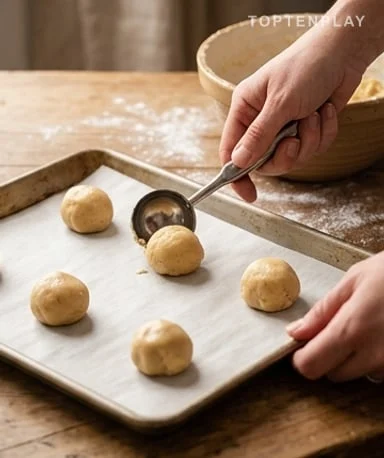
Cream the soft butter with the sugar until the mixture lightens and slightly puffs — that takes 3 to 4 minutes at medium speed. You hear the change: the sound of the dough slapping against the bowl becomes duller, airier. Add the eggs one by one, then the buttermilk and both extracts. The flour goes in last, in two additions, mixed just enough for the white streaks to disappear. The dough is soft and slightly sticky — exactly as it should be.
Taking the cookies out early is the right decision
350°F (175°C), 10 to 12 minutes depending on your oven. The edges should be just barely golden, and the center should seem almost underbaked — it will firm up as it cools on the sheet for 5 minutes. A cookie taken out too soon can be saved. An overbaked cookie stays dry forever. The difference often comes down to 2 minutes. Better to test with one cookie before baking all batches.
The icing is like liquid sugar pie
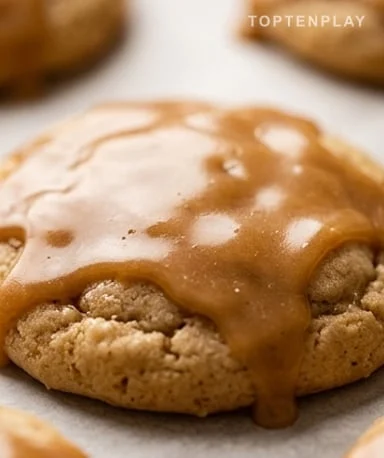
Butter, brown sugar, milk, maple syrup — all in a saucepan over medium heat. Stir constantly until a gentle boil, cook for one minute, then remove from heat. Let rest for 10 minutes, no more: beyond that it starts to set. Whisk in sifted powdered sugar until the texture coats the back of a spoon without immediately dripping. Too thick: a spoonful of warm milk. Too thin: a bit more powdered sugar. It sets quickly — work in small batches.
The way you ice changes the final look completely
One tablespoon is enough per cookie. Drop the icing in the center and let it flow naturally over the edges without spreading it — irregular drips are part of the charm. Within seconds it begins to set on the surface with a slight matte veil. Ice by the dozens while the icing is still fluid and warm. If the pan cools too much between batches, 30 seconds over very low heat is enough to revive it.

Tips & Tricks
- Make the dough the day before and wrap it in the fridge: the cookies will have a neater shape when baked and a more developed flavor. Take out of the fridge 20 minutes before forming the balls.
- To double the icing quantities, double all ingredients except the salt. There’s rarely any leftover, but having extra lets you ice generously without rationing.
- Un-iced cookies freeze very well for up to 2 months in an airtight container. Thaw at room temperature, then ice freshly when serving.
Can I replace pure maple extract?
Pure maple extract is what gives these cookies their signature flavor — an artificial flavor will yield a much flatter, sometimes chemical result. If you can’t find it, double the amount of maple syrup in the dough (2 teaspoons) and reduce the buttermilk by one tablespoon to compensate for the extra moisture.
I don’t have buttermilk, what can I use?
Pour 240ml of whole milk into a glass, add a teaspoon of white vinegar or lemon juice, stir, and let sit for 5 minutes. The milk will slightly curdle and work exactly like buttermilk in this recipe.
Why do my cookies spread too much while baking?
Two common causes: the butter was too soft (almost melted) when creaming, or the dough was too warm before going into the oven. If the dough seems very soft after mixing, wrap it and let it rest in the fridge for 30 minutes before forming the balls.
How long do these cookies keep?
In an airtight container at room temperature, they stay soft for 4 to 5 days. Avoid the fridge, which dries out the cookie — if the kitchen is cool, a metal tin on the counter is ideal.
Can I freeze them?
Yes, frozen un-iced, they keep up to 2 months without losing their texture. Let them thaw for an hour at room temperature, then prepare fresh icing when serving.
The icing set before I finished icing all the cookies — what to do?
Return the pan to very low heat for 30 seconds while stirring — the icing becomes fluid again. If the texture seems grainy after reheating, add a teaspoon of warm milk and whisk vigorously to smooth it out.
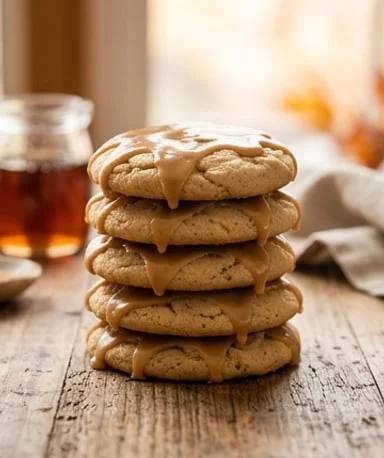
Soft Maple Cookies with Homemade Icing
American
Cookies
Tender, airy cookies scented with pure maple extract, topped with a buttery maple syrup icing that sets into a thin shiny shell. A one-bowl recipe, common ingredients, and a result that far exceeds expectations.
Ingredients
- 226g unsalted butter, softened to room temperature
- 400g granulated sugar
- 3 large eggs, at room temperature
- 240ml buttermilk
- 1 tsp pure maple extract
- 1 tsp vanilla extract
- 540g all-purpose flour
- 1 tsp baking soda
- 1 tsp baking powder
- ½ tsp salt
- 113g unsalted butter (icing)
- 200g packed brown sugar (icing)
- 60ml milk (icing)
- 2 tbsp pure maple syrup (icing)
- 1 pinch salt (icing)
- 240g sifted powdered sugar (icing)
Instructions
- 1Preheat oven to 175°C (350°F). Line baking sheets with parchment paper.
- 2In a large bowl, cream the softened butter with the sugar using an electric mixer for 3 to 4 minutes, until the mixture is pale and airy.
- 3Add the eggs one at a time, mixing well after each addition. Then incorporate the buttermilk, maple extract, and vanilla.
- 4In a separate bowl, whisk together the flour, baking soda, baking powder, and salt. Gradually add to the wet ingredients, mixing on low speed — stop as soon as the flour is incorporated.
- 5Drop heaping spoonfuls of dough onto the baking sheets, spacing them about 2 inches (5 cm) apart. Bake for 10 to 12 minutes, until the edges are lightly golden and the center feels firm to the touch.
- 6Let cool on the sheet for 5 minutes, then transfer to a wire rack to cool completely before icing.
- 7For the icing: melt the butter in a saucepan over medium heat. Add the brown sugar, milk, maple syrup, and salt. Bring to a gentle boil, stirring constantly, and cook for exactly 1 minute.
- 8Remove from heat and let cool for 5 to 10 minutes. Whisk in the powdered sugar until smooth and shiny. Adjust consistency if needed: a spoonful of milk to thin, a bit more powdered sugar to thicken.
- 9Drop a tablespoon of icing onto the center of each cookie and let it flow naturally over the edges. Let set at room temperature before serving or storing.
Notes
• Use pure maple syrup, not pancake syrup — the taste difference is significant in the icing.
• The dough can be prepared the day before, wrapped in the fridge. Take out 20 minutes before forming balls to bring back to a workable texture.
• The icing sets quickly at room temperature: ice in batches of 10 cookies at a time, and reheat the pan over very low heat between batches if necessary.
Nutrition Facts (per serving, estimated)
| 224 kcalCalories | 2gProtein | 32gCarbs | 10gFat |