📌 Silverfish in the house: why their presence reveals a humidity problem to be fixed
Posted 7 February 2026 by: Admin
The Silverfish: A 400-Million-Year-Old Insect In Your Bathroom
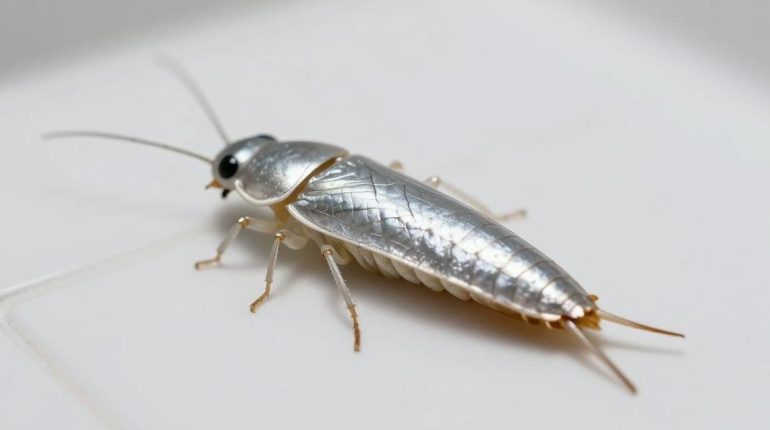
This silvery creature darting across your bathroom tiles holds a secret: it survived the extinction of the dinosaurs. The Lepisma saccharina, better known as the silverfish, has traversed 400 million years of evolution with virtually no change in form.
About half an inch long, its silvery-grey carrot-shaped body ends in three characteristic tail appendages. Its jerky zigzag movement, reminiscent of a small fish swimming, earned it its name. Unlike most household insects, some specimens can live up to 8 years — an exceptional longevity for an arthropod of this size.
First reassuring revelation: these ancestral insects represent no direct danger to humans. No sting. No venom. No documented disease transmission. Their presence often causes disgust, but their nature remains perfectly harmless from a health perspective.
Yet, spotting them is never insignificant. These nocturnal creatures flee from light and move with disconcerting speed. If you come across one, others are likely hiding in the damp corners of your home. Because the silverfish does not appear by chance — it responds to very specific environmental conditions that your home involuntarily offers it.
Diet: What Really Attracts These Creatures To Your Home
The silverfish never settles by chance. Its diet reveals why certain rooms become its preferred hunting grounds.
These insects target three specific nutritional categories: starches, sugars, and proteins. But not just any. They specifically seek out bookbinding glue, wallpaper paste, cotton textile residues, and even dead skin scales that accumulate in corners.
Unlike termites that attack wood, the silverfish devours anything containing processed cellulose: old documents, antique photographs, natural fiber clothing. A dusty library, a pile of forgotten newspapers in a basement, a rarely opened linen drawer — all are silent invitations.
This dietary preference explains why they are frequently found in bathrooms (presence of glue on product labels), attics (archive boxes), or behind aging wallpaper. They do not seek confrontation with humans, but proximity to organic materials rich in starch.
Their presence therefore signals less an infestation than a specific food availability. Identifying these sources radically transforms the approach: rather than eliminating the insects, it is about understanding what, in your habitat, composes their ideal pantry.
The Hidden Message: What Their Presence Reveals About Your Living Conditions
Observing an isolated silverfish is rarely a unique incident. These insects generally evolve in discreet colonies, active at night when occupants are asleep.
Their appearance signals three precise environmental conditions that transform your home into an ideal refuge: relative humidity above 75%, a stable temperature between 21 and 27°C, and the prolonged darkness of certain spaces. Poorly ventilated bathrooms, damp basements, closets closed for months — all are perfect microclimates for their development.
This combination of humidity-heat-darkness explains why they favor tile joints, the back of bathroom furniture, spaces under sinks, or corners of laundry rooms. Unlike cockroaches that seek the heat of electrical appliances, the silverfish tracks residual moisture: a minimal leak behind a wall, chronic condensation, insufficient drainage.
Their presence thus functions as a living hygrometer. They detect humidity problems that you may not have identified yet: faulty insulation, inadequate ventilation, or emerging infiltrations. Some homeowners thus discover minor structural defects before they become costly.
It is not an invasion to be feared, but a diagnosis to be deciphered. Understanding their environmental requirements allows for precisely targeting the necessary corrections to make your interior inhospitable — without chemical warfare.
Response Strategy: Understanding Rather Than Fearing
The discovery of a silverfish justifies neither massive extermination nor systematic chemical spraying. These ancestral creatures react to specific stimuli — modifying these parameters is generally enough to dislodge them.
The first action consists of drying out their habitat. Reducing humidity below 50% makes your interior uninhabitable for them: dehumidifiers in basements, increased ventilation after showers, repair of even minor leaks. Window seals, seeping pipes, forgotten damp towels — every source of persistent humidity maintains their ecosystem.
Next, eliminate their food resources. Store old documents, photos, and natural fiber textiles in airtight containers. Vacuum regularly to remove skin scales and organic debris. Seal packages of flour, sugar, and cereals that can attract them through their cardboard packaging.
Since prolonged darkness favors their activity, periodically air out closets, move furniture away from damp walls, and expose confined areas to light and air circulation. Silverfish instinctively flee dry, bright, and disturbed spaces.
If the infestation persists despite these adjustments, strategically placed non-toxic sticky traps reveal their nocturnal routes. This targeted approach avoids unnecessary insecticides while protecting your vulnerable belongings. Because controlling a silverfish is first and foremost about controlling your environment — not declaring war on a 400-million-year-old survivor simply looking for a damp corner to thrive.