📌 Shortbread Lemon Bars
Posted 30 March 2026 by: Admin
Lemon bars are intimidating. You see ‘lemon curd,’ ‘shortbread,’ and you immediately imagine French pastry with its gram-perfect precision. The reality: six ingredients, one bowl, one rectangular pan.
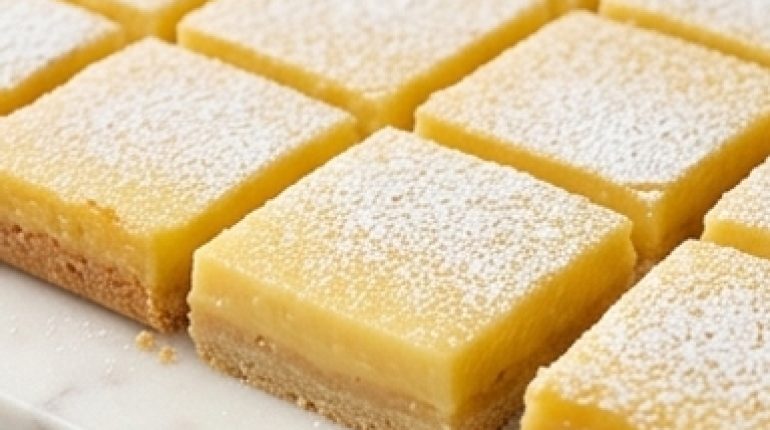
Look at this bar. The bottom layer is compact, crumbly, and a warm beige like a shortbread fresh from the oven. Above it, the lemon curd is an almost aggressive yellow — not the pale yellow of industrial creams, but the bright yellow of a lemon just sliced in half. The powdered sugar forms a light veil that almost disappears at the edges. And it smells like lemon, but not the artificial kind: the real one, the kind that stings your eyes slightly when zesting.
Why you’ll love this recipe
Ingredient Notes
Six simple ingredients, a ton of lemon zest: that’s all it takes.
- Lemons : Fresh, mandatory. Bottled juice gives a flat bitterness and a cleaner aroma that ruins everything. You need 6 to 8 lemons for about 25 cl of juice — zest them all before juicing; you’ll use the zest both in the crust and in the cream.
- Butter : Unsalted, at room temperature. When you press it with a finger, it should sink in slowly without resistance. Butter that’s too cold makes a dough that crumbles in sheets; butter that’s too soft results in a crust that slumps during baking. One hour on the counter, no more.
- Eggs : Six, and at room temperature. A cold egg poured into a lukewarm cream creates cooked strands — exactly what we don’t want. If you forgot to take them out, place them in a bowl of warm water for 5 minutes.
- Flour : It plays two different roles here: structure in the crust, thickener in the cream. Don’t try to reduce it in the filling for the sake of lightness — without it, the cream won’t hold up when sliced and will remain runny.
Take the butter out an hour before starting
This is the most boring and most important advice in the whole recipe. Butter at the right temperature creams correctly with the sugar and gives the shortbread its unique texture — that moment when the bar yields under your teeth without completely collapsing. To make the dough, start by rubbing the lemon zest into the sugar with your bare hands for about thirty seconds. You’ll feel something change: the sugar becomes damp, slightly greenish, and the scent of lemon suddenly fills the kitchen. This is exactly what should happen. Then add the butter, beat until the mixture pales and gains volume, then stir in the vanilla and flour all at once — just enough for dough clumps to form. No more. The dough is thick, almost sticky.
Stick the parchment paper with spray so it doesn’t move
Before pressing the dough into the pan, spray the bottom with cooking spray, then place the parchment paper on top. The spray acts as glue — the paper won’t buckle while you flatten the dough with your palms. Press evenly to the edges, smoothing the corners with the bottom of a glass. Bake at 175°C for 20 to 22 minutes. The surface should be a very light caramel color — not off-white, not dark gold, just in between, like a barely colored butter shortbread. This pre-baking is essential: a raw crust under lemon cream becomes soggy within a few hours.
Stop whisking as soon as the cream is smooth
While the crust is baking, prepare the filling by mixing the eggs, sugar, zest, lemon juice, and flour. Stop as soon as everything is smooth and homogeneous — vigorous whisking incorporates air which will form bubbles on the surface during baking. It’s not a disaster, but it spoils the visual finish. Pour the cream over the still-hot crust as soon as it comes out of the oven, holding the bowl close to the surface to limit splashing. Put it back in the oven immediately for 20 to 24 minutes. The edges should be set and matte; the center, slightly jiggly if you shake the pan. Think of an almost-baked cheesecake, not a jelly.
Resist for at least 3 hours. An entire night if possible.
This is where many people fail. The bar comes out of the oven and looks set, so they cut too early. Result: the edges hold, the center runs. Let it cool completely at room temperature — about an hour — then cover loosely with foil and put in the fridge. Three hours is enough for a presentable cut. But after a whole night, the texture changes: denser, meltier, and the flavors have truly settled. For clean slices, use a large knife, run it under hot water, and wipe the blade between each cut.
Tips & Tricks
- Use a glass pan rather than metal. Glass conducts heat more gently — the edges and center bake at the same pace, preventing overcooked edges while the center is still raw.
- The powdered sugar is for the last moment. Sprinkled too early, it gets absorbed by the cream and disappears. Just before serving, not before.
- Cracks on top? You either over-whisked the cream or the temperature was too high. Next time, lower it by 5°C and whisk minimally.
How long do lemon bars keep?
In the refrigerator in an airtight box, they easily keep for 5 days. The texture even improves after the first day. Do not leave them at room temperature for more than 2 hours, as the lemon cream contains eggs.
Can lemon bars be frozen?
Yes, very well. Freeze them in a single layer first, then transfer them to a freezer bag with parchment paper between the layers. They keep for 3 months. Thaw overnight in the fridge and sprinkle with powdered sugar at the last moment, not before.
My lemon cream stayed liquid after baking. What happened?
Two likely causes: either you reduced the sugar or flour in the filling, or the baking time was too short. Sugar and flour are both essential for setting. Check that the center jiggles slightly but the edges are matte and firm before removing from the oven.
Can I use lime instead of lemon?
Yes, no problem. The result is more acidic and slightly more bitter. You can also do a 50/50 mix for a more complex citrus profile. The quantities remain the same.
Can I reduce the sugar in the filling?
No, and this is a rule not to be bypassed. Sugar isn’t just for sweetening — it directly contributes to the texture of the cream. Less sugar = a filling that is too liquid and never sets properly, even after a night in the fridge.
My shortbread puffed up and cracked while baking. Is that normal?
Slight cracking is normal. If the shortbread puffed up a lot, your butter was probably too warm and released too much steam while baking. Next time, ensure the butter is at room temperature and not melted, and don’t beat too long after adding the flour.
Shortbread Lemon Bars
American
Dessert
Lemon bars with a crumbly zest-infused shortbread crust and a thick, creamy lemon curd filling. The recipe contains only 6 ingredients.
Ingredients
- 230g (1 cup) unsalted butter, at room temperature
- 100g (½ cup) sugar (for the crust)
- Zest of 4 lemons divided (2 for the crust, 2 for the filling)
- 1 tsp vanilla extract
- 300g (2 cups + 2 tbsp) flour (for the crust)
- 6 eggs, at room temperature
- 400g (2 cups) sugar (for the filling)
- 240ml (1 cup) fresh lemon juice (6 to 8 lemons)
- 60g (6 tbsp) flour (for the filling)
- 40g powdered sugar (for serving)
Instructions
- 1Preheat the oven to 175°C. Spray a 23x33cm pan with cooking spray, then line with parchment paper.
- 2Rub the zest of 2 lemons into the 100g of sugar with your hands for 30 seconds until the mixture is damp and fragrant.
- 3Add the butter and beat at medium speed until the mixture turns pale and creamy, about 2 minutes. Stir in the vanilla.
- 4Add the 300g of flour and mix on low speed until clumps form. Press the dough evenly into the pan.
- 5Bake for 20 to 22 minutes until the surface is a very light caramel color. Do not overbake.
- 6While the crust is baking, whisk the eggs, 400g of sugar, zest of the remaining 2 lemons, lemon juice, and 60g of flour until smooth. Do not over-whisk.
- 7Immediately upon removing from the oven, pour the filling over the hot crust, holding the bowl close to the surface. Put back in the oven immediately.
- 8Bake for another 20 to 24 minutes, until the edges are set and the center is slightly jiggly.
- 9Let cool completely on a wire rack (about 1 hour), then cover loosely with foil and refrigerate for at least 3 hours.
- 10Lift the block out using the parchment paper and place on a board. Dust with powdered sugar and cut into 16 squares with a knife wiped clean between each cut.
Notes
• Storage: 5 days in the refrigerator in an airtight box. Dust with powdered sugar just before serving to prevent it from being absorbed.
• Freezing: freeze the bars in a single layer first, then in an airtight bag for up to 3 months. Thaw overnight in the fridge.
• Glass pan recommended: it conducts heat more evenly than a metal pan and prevents the edges from cooking before the center.
Nutrition Facts (per serving, estimated)
| 330 kcalCalories | 5gProtein | 49gCarbs | 13gFat |