📌 Seafood Pot-au-Feu in a Casserole
Posted 1 April 2026 by: Admin
It’s an October Sunday, the first chills are arriving, and you want to put something beautiful on the table without spending three hours in the kitchen. Seafood Pot-au-feu is exactly that: a dish that looks impressive, smells wonderful as it simmers, and requires no special technique. Just good produce and a little organization.
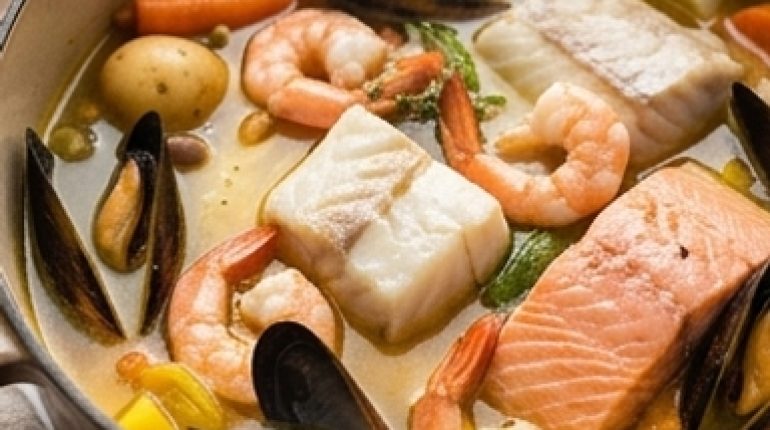
The broth is a pale amber, almost translucent, with golden reflections where the olive oil floats on the surface. The chunks of cod and salmon are thick, still slightly pearly in the center. The mussels have opened their black shells on the side, revealing their orange flesh. And above all, a sweet marine scent — the smell of the sea mixed with thyme — the kind of smell that brings everyone to the kitchen even before you serve.
Why you’ll love this recipe
Ingredient Notes
All the seafood pot-au-feu ingredients together: fresh fish, seafood, and seasonal vegetables.
- Cod and salmon : Two fishes with very distinct characters: the cod flakes into large white petals, firm yet tender, while the salmon keeps a fattier, melting texture. Together, they provide variety in every spoonful. Get thick fillets if you can — thin slices break apart in the broth before they’re even cooked.
- Mussels : Buy them alive, the same day. They must be closed before cooking and open during. Those that stay stubbornly closed after cooking are discarded without negotiation. Their cooking water will perfume the whole broth with a powerful hit of iodine — that’s what gives it that seaside taste.
- Leeks : The leek is the soul of simmered dishes. It melts gently, becomes almost silky, and brings a vegetable sweetness that balances the marine side. Cut them into chunks that aren’t too thin — they need to hold up during cooking, not dissolve into filaments.
- Vegetable or fish stock cube : A good cube is more than enough here — the mussel water and vegetables do the rest. If you have one on hand, a fish stock cube gives even more depth. But with a classic vegetable cube, the result is already very good.
- Olive oil finish : Just a drizzle when serving, directly in the bowls. Not during cooking. Raw olive oil keeps its fruitiness and roundness. Heated in the broth, it disappears completely. That difference, you can really taste it.
Start the broth first — everything else can wait
Pour cold water into the pot with the stock cube and heat it over medium-high heat. While it comes to temperature, prepare the vegetables. Carrots in thick rounds, leeks in 4-5 cm chunks, potatoes in large cubes. The onion cut in half, the garlic lightly crushed — just so it releases its aromas without falling apart entirely. Once the water is simmering, everything goes into the pot with the bay leaf and thyme. At this stage, the smell is still neutral, almost herbaceous. It will change in twenty minutes.
Let the vegetables do their work without rushing
Twenty minutes at medium heat, at a steady low simmer. No rolling boils that will damage everything. The carrots should start to give under the tip of a knife — still slightly resistant, not mushy. The broth has already taken on an amber tint and you start to smell the bay leaf asserting itself. This is the right time to prepare the fish: cut the cod and salmon into pieces of about 5-6 cm. Better large than small, they will shrink slightly during cooking.
Lower the heat before adding the fish — this is non-negotiable
Turn the heat down to low before sliding the fish pieces into the broth. Carefully, without stirring — a sudden spoon stroke and the cod will fall into crumbs. Five to seven minutes are enough. The salmon loses its translucent color to become an opaque matte pink on the edges, while staying slightly pearly in the center. That’s exactly where you want to stop. Overcooked, it dries out and loses all its grace.
Don’t touch anything for two minutes after the seafood
Add the shrimp and mussels. Cover. Low heat, five minutes. The moment when the mussels open makes a small dull sound, almost inaudible under the lid. Turn off the heat, let it rest covered for two minutes — the residual heat finishes the cooking without risking drying anything out. Adjust the salt, taste the broth. A squeeze of lemon juice directly in the bowls when serving wakes up the marine flavors without masking the base of the pot.
Tips & Tricks
- Never put the fish into a rolling boil — the turbulence breaks them into pieces before they are cooked. Low heat, five minutes, is the only rule that really matters here.
- Prepare the broth and vegetables up to two hours before the meal and let them rest in the pot. Add the fish and seafood at the last minute, just before sitting down. You’re free during the whole appetizer.
- If you want a more elegant look on the plate, strain the broth through a small sieve before serving. This removes bits of herbs and onion — clear broth around the fish really changes the presentation.
- Closed mussels after cooking are non-negotiable. Throw them away without trying to force them. One dead mussel in the dish ruins everything else.
Can I use frozen fish?
Yes, but you must thaw it completely and pat it dry with paper towels before adding it to the broth. Fish that is still wet or semi-frozen drops the broth temperature and lengthens the cooking time unpredictably. Fresh remains the best choice if you can.
Can I prepare seafood pot-au-feu in advance?
The broth and vegetables can be prepared up to two hours beforehand and left in the covered pot. Fish and seafood, however, must be added at the last minute — ten to twelve minutes before serving. Fish reheated twice is a failure.
How to store leftovers?
In the refrigerator in an airtight container, for 1 to 2 days maximum. Reheat over very low heat, never boiling — just a simmer. Freezing is not recommended: fish and especially mussels completely lose their texture after thawing.
What if several mussels stay closed after cooking?
Discard them without trying to force them. A mussel closed after cooking was dead before entering the pot — it can cause food poisoning. This is a rule with no exceptions.
Can I replace the shrimp or mussels with something else?
Absolutely. Scallops added at the same time as the fish work very well. Clams replace mussels with no problem. If you don’t like seafood, you can simply double the quantities of fish — the dish remains balanced.
Why is my broth cloudy?
Heat that is too high during the vegetable cooking is the main cause. Large bubbles emulsify fats and particles in the water. Always cook at medium heat, with a gentle simmer. If you want a perfectly clear broth for presentation, pass it through a fine sieve before serving.
Seafood Pot-au-Feu in a Casserole
French
Main course
A light and marine version of the great French classic: cod, salmon, shrimp, and mussels simmered with vegetables in a broth scented with thyme and bay leaf.
Ingredients
- 400g cod fillet, cut into large chunks
- 400g salmon fillet, cut into large chunks
- 12 king prawns (about 200g), whole or peeled
- 12 fresh mussels (about 300g with shells), scrubbed and rinsed
- 3 carrots (about 250g), peeled, in thick rounds
- 2 leeks (about 200g), in 4-5 cm chunks
- 2 potatoes (about 300g), in large cubes
- 1 onion, cut in half
- 1 celery stalk, in pieces
- 1 garlic clove, lightly crushed
- 1,5 litre water
- 1 vegetable or fish stock cube
- 1 bay leaf
- 1 thyme sprig
- 1 tbsp olive oil (for finishing)
- 1 pinch salt and pepper, to taste
Instructions
- 1Peel the carrots and potatoes, cut them into medium pieces. Cut the leeks into chunks, the onion in half, crush the garlic, and cut the celery.
- 2In a large casserole pot, bring the water to a boil with the stock cube.
- 3Add carrots, potatoes, leeks, celery, onion, garlic, thyme, and bay leaf. Simmer over medium heat for 20 minutes.
- 4Meanwhile, cut the cod and salmon into large 5-6 cm chunks.
- 5When the vegetables start to get tender, lower the heat to minimum and carefully add the fish pieces. Cook for 5 to 7 minutes without stirring.
- 6Add the prawns and mussels. Cover and cook for 5 minutes until the mussels open.
- 7Discard any mussels that remain closed. Adjust the salt and pepper.
- 8Serve in deep plates with broth and a drizzle of olive oil.
Notes
• Make-ahead: the broth and vegetables can be prepared up to 2 hours in advance. Only add the fish and seafood at the last moment, just before serving.
• Storage: 1 to 2 days in the refrigerator. Reheat over very low heat. Do not freeze — seafood loses its texture upon thawing.
• For a more elegant presentation, strain the broth through a fine sieve before plating. For a festive version, add scallops with the fish.
Nutrition Facts (per serving, estimated)
| 390 kcalCalories | 37gProtein | 26gCarbs | 13gFat |