📌 Seafood Blanquette: hake, salmon, and bay scallops in a creamy sauce
Posted 8 April 2026 by: Admin
Blanquette de veau is a great classic, but it can quickly feel heavy on the stomach. This version takes exactly the same principle — creamy sauce, tender vegetables, comforting warmth — and makes it light, delicate, and almost elegant. It’s the dish you make on a rainy Sunday when you want to treat yourself without spending the whole day in the kitchen.
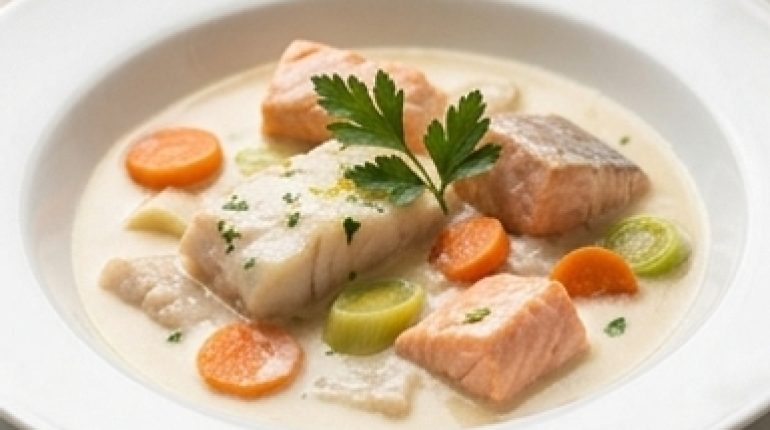
The sauce is a pearly white, slightly translucent, with bright orange carrot slices punctuating the whole dish. Pieces of hake and salmon peek through the surface, tender and barely held together. The aroma of a cream-based fish stock escapes from the dish, with a subtle lemony undertone that prevents everything from feeling too heavy. As you dip a spoon in: the sauce flows slowly, coating and silky, enveloping each piece of fish as if it were made for it — which it is, exactly.
Why you’ll love this recipe
Ingredient Notes
Hake, salmon, scallops, and fresh vegetables: everything you need for a homemade seafood blanquette.
- Hake (Colin) : This is the white and neutral base of the dish. It absorbs the broth, stays firm if handled gently, and flakes nicely in the mouth. Pollock works just as well and is often cheaper — the taste is slightly more pronounced, but in this creamy sauce, that’s not a flaw.
- Salmon : It brings a pink-orange color to this very white dish, and above all, the fat that gives the sauce body. Get it thick enough — at least 2 cm — so it doesn’t disintegrate during cooking.
- Bay scallops : Cheaper than sea scallops, but careful: they become rubbery if overcooked. 3 to 4 minutes in the simmering broth, not a second more. If you find small sea scallops, they make for a more festive version.
- Thick crème fraîche : Thick, not liquid — the difference matters. Thick cream stays stable in the sauce and won’t separate with heat. Aim for 30% fat minimum. Light versions result in a sauce that lacks character for this specific dish.
- Fish stock : Ideally homemade, but a commercial cube diluted in hot water works very well. Plain water also works — but the sauce will be blander. The important thing: keep the cooking broth from the vegetables and fish, as it will be used to build your roux.
Start with a broth that already smells like a promise
Pour the stock into a large pot with the sliced carrots, sliced leek, and chopped onion. Add the thyme and bay leaf. Bring slowly to a simmer over medium heat — no rolling boils; the idea is to let the vegetables infuse quietly. After about fifteen minutes, the carrots are tender but still firm when pressed with a fork. The broth smells of herbs and sweet vegetables, that warm soup aroma that heralds something comforting. Taste and add a little salt.
Fish requires attention, not nervousness
Slide the pieces of hake, salmon, and scallops into the hot broth — simmering, not boiling. Fish doesn’t need to be attacked. In 8 to 10 minutes over low heat, the hake turns from translucent to a matte opaque white, a sign it’s cooked. The scallops become firm to the touch. Remove everything gently with a slotted spoon, placing them in a covered dish to keep warm. Strain the broth — you’ll need it in a minute.
Make your roux without taking your eyes off it
In a second pot, melt the butter over low heat until it foams: a fine, white foam that smells of warm milk. Add the flour all at once and whisk immediately. You’ll get a pale yellow, slightly grainy paste that catches the bottom a bit — that’s normal and desired. Cook for 2 minutes while stirring constantly to eliminate the raw flour taste; don’t skip this step. Then pour in the hot broth in several stages, whisking between each addition. The sauce thickens gradually and becomes smooth. Stir in the crème fraîche, season, and let simmer for 3 minutes.
The egg yolk liaison — remove the pot from the heat first
This is the step that gives the sauce that slightly glossy, velvety texture that coats the back of a spoon like a chef’s velouté. In a bowl, beat the egg yolk with a spoonful of the hot sauce taken beforehand — this tempers the yolk and prevents it from scrambling. Add the lemon juice. Pour this mixture into the pot away from the heat, whisking constantly. Do not let it boil again after this — ever: the yolk would coagulate and the sauce would become grainy. Gently return the fish and vegetables to the sauce, mixing carefully.
Tips & Tricks
- Strain the broth before making the sauce. Small bits of vegetables floating in it will disrupt the texture of the roux. Clean broth, smooth sauce — it’s as simple as that.
- If the sauce is too thick after the liaison, add a few spoonfuls of hot broth and whisk gently. It will loosen up without losing its creaminess.
- A pinch of freshly grated nutmeg just before serving — it rounds out the flavors, adds depth, and no one can ever quite identify what it is. That’s the goal.
- The dish reheats very well the next day over very low heat with a splash of water or broth. The fish will be even more tender.
Can I prepare seafood blanquette in advance?
Yes, it’s actually recommended. Prepare the broth and vegetables the day before and store them separately from the fish. On the day of serving, cook the fish and build the sauce. The egg yolk liaison must always be done at the last moment — it cannot handle being reheated to a boil.
How do I prevent the sauce from getting lumpy?
Two rules: pour hot broth (not cold) onto the roux, and proceed in several stages, whisking well between each addition. If lumps appear anyway, a quick burst with an immersion blender or passing it through a fine-mesh sieve solves the problem in 30 seconds.
Can I replace the hake or salmon with another fish?
Absolutely. Cod or pollock can replace hake without any problem — same firm texture, same cooking behavior. For salmon, trout is an interesting alternative. The main thing is to avoid fish that are too thin or delicate and disintegrate the moment you look at them.
Can I freeze seafood blanquette?
Not really. A sauce thickened with egg yolk and cream tends to separate when thawed, and the fish loses its texture. This dish keeps for 2 days in the refrigerator and reheats very well over very low heat.
What if I don’t have fish stock?
A store-bought stock cube diluted in 500 ml of hot water works well. Failing that, plain water with a vegetable bouillon cube gives a decent result. What matters most is collecting and using the cooking liquid from the vegetables and fish — that’s where all the aromas are.
What should I serve with seafood blanquette?
White basmati rice is the classic and reliable pairing. Steamed potatoes or homemade mash absorb the sauce even better. Fresh tagliatelle also works very well if you want something a bit more festive.
Seafood Blanquette: hake, salmon, and bay scallops in a creamy sauce
French
Main Course
A delicate and comforting version of the classic blanquette, featuring fish and scallops coated in a velvety sauce thickened with egg yolk. Ready in 50 minutes.
Ingredients
- 400g hake, cut into 3 cm cubes
- 200g salmon, cut into 3 cm cubes
- 120g bay scallops
- 2 carrots, peeled and sliced into rounds
- 1 leek, thinly sliced
- 1 onion, chopped
- 1 celery stalk, cut into small pieces (optional)
- 1 bay leaf
- 1 sprig of thyme
- 500ml fish stock (or water + 1 stock cube)
- 30g butter
- 30g flour
- 200ml thick crème fraîche (minimum 30% fat)
- 1 egg yolk
- 1 tbsp fresh lemon juice
- salt and freshly ground black pepper
- 1 pinch freshly grated nutmeg (optional)
Instructions
- 1Peel carrots and slice into rounds. Clean and slice the leek, chop the onion, and cut celery into small pieces if using.
- 2Pour the stock into a large pot. Add the vegetables, thyme, and bay leaf. Cook over medium heat for 15 minutes until carrots are tender but slightly firm.
- 3Gently slide the fish pieces and scallops into the simmering broth. Cook for 8 to 10 minutes over low heat.
- 4Remove the fish and scallops with a slotted spoon and keep warm. Strain and reserve the broth.
- 5In a second pot, melt the butter over low heat. Add flour and whisk. Cook this roux for 2 minutes, stirring constantly without letting it brown.
- 6Pour the hot strained broth over the roux in several additions, whisking between each. Stir in the crème fraîche and season. Simmer for 3 minutes over low heat.
- 7Off the heat, mix the egg yolk with 1 tablespoon of the sauce, then add the lemon juice. Whisk this mixture back into the sauce. Do not boil again.
- 8Gently return the fish, scallops, and vegetables to the sauce. Add a pinch of nutmeg if desired. Warm for 2 minutes over very low heat and serve immediately.
Notes
• Storage: keeps for 2 days in the refrigerator. Reheat over very low heat with a splash of broth or water, without boiling.
• Rich alternative: add 100g of peeled shrimp or 50g of sliced mushrooms sautéed in butter along with the fish.
• Make ahead: the broth and vegetables can be cooked the day before. Store separately and finalize the sauce and fish on the day.
Nutrition Facts (per serving, estimated)
| 390 kcalCalories | 32gProtein | 14gCarbs | 22gFat |