📌 Scallops with lemon butter: the chefs’ technique for a caramelized crust in less than 5 minutes
Posted 17 January 2026 by: Admin
Accessible Excellence: When Luxury Enters The Kitchen In Minutes
Scallops embody natural elegance: that velvety texture, that delicate sweetness that transforms into a golden crust under the effect of heat. A culinary paradox fascinates here. This dish, renowned for its gastronomic sophistication, requires less than five minutes of cooking, placing it among the fastest solutions for an improvised dinner.
The refined reputation often intimidates home cooks. Yet, the technique requires no exceptional skills. A hot pan, a few minutes of attention, and the classic lemon-garlic-butter alliance naturally enhances the marine flavors without complex intervention.
This accessibility revolutionizes the approach to a sophisticated meal. When guests ring unexpectedly, when the evening calls for a touch of exception without a marathon preparation, scallops are ready. Their speed of execution transforms what seemed reserved for Michelin-starred tables into a practical solution for everyday life.
The lemon-garlic-butter trio works like a proven formula: acidity cuts through the richness, garlic brings depth, butter envelops the whole in a silky smoothness. No exotic ingredients, no esoteric techniques. Just universal components orchestrated with precision.
This demystification opens a door: culinary luxury does not belong exclusively to professionals. It simply waits for its fundamental simplicity to be understood.
The Science Of Perfection: Understanding The Maillard Reaction
That golden crust that fascinates the eye and seduces the palate is not a matter of chance. It results from a precise chemical reaction: the Maillard reaction, a process that transforms proteins and sugars under intense heat. When the scallop meets the searing surface of the pan, this culinary alchemy operates instantly.
The result transcends aesthetics. This caramelization forms a barrier that traps moisture inside, preserving the melting heart while developing complex aromas absent from the raw product. The texture contrast then becomes the signature of a successful dish: the crispy exterior gives way under the tooth to reveal a pearly, almost creamy flesh.
This phenomenon requires a non-negotiable condition: a sufficiently hot pan. Insufficient temperature, and the scallops release their water, simmer sadly, and become rubbery. High heat immediately triggers caramelization, sealing the surface before moisture escapes.
This scientific understanding demystifies culinary expertise. No need for mysterious intuition or innate talent. Mastery rests on an objective parameter: reaching and maintaining the temperature that activates this molecular transformation. A pan that sizzles on contact with a drop of water signals the precise moment to act.
This Maillard reaction explains why Michelin-starred restaurants achieve this visual and gustatory signature. Now, this knowledge becomes accessible, transforming theory into reproducible practice.
The Balance Of Flavors: When Three Ingredients Orchestrate Harmony
That perfect crust is not enough. It constitutes the foundation, but the architecture of flavors transforms a mastered technique into a memorable experience. Three components play this score with surgical precision.
Lemon intervenes first. Its bright acidity cuts through the natural richness of the mollusk, bringing that luminous freshness that wakes up the palate. Without this lemony touch, the dish becomes heavy, loses its brilliance, and sinks into excess. This fruity note acts as an indispensable counterpoint.
Garlic enters the scene with its characteristic aromatic warmth. Neither aggressive nor timid, it diffuses a savory depth that anchors the dish in the Mediterranean register. This garlicky power dialogues with the marine sweetness of the scallops, creating a gustatory tension that maintains interest in every bite.
Butter orchestrates the whole. Its silky texture coats the flavors, unifies them, and prolongs them. This smoothness masks nothing: it reveals. It carries the lemon and garlic, melting them into an emulsion that delicately coats each scallop.
This trinity is not random. Each ingredient occupies its precise function in the global balance. None dominates, all converse. The result indeed evokes those coastal bistros where apparent simplicity hides an intuitive understanding of perfect pairings.
This minimalist sauce proves that in cooking, subtraction often surpasses addition. Three components are enough when their interaction creates a complexity greater than their sum.
The Determining Choice: Selecting Quality Scallops
This orchestration of flavors forgives no approximation. With a cooking time of less than five minutes, the initial quality of the product becomes the unique variable between mediocrity and gastronomic excellence. The time of exposure to heat is too brief to correct a freshness defect or mask a deficient texture.
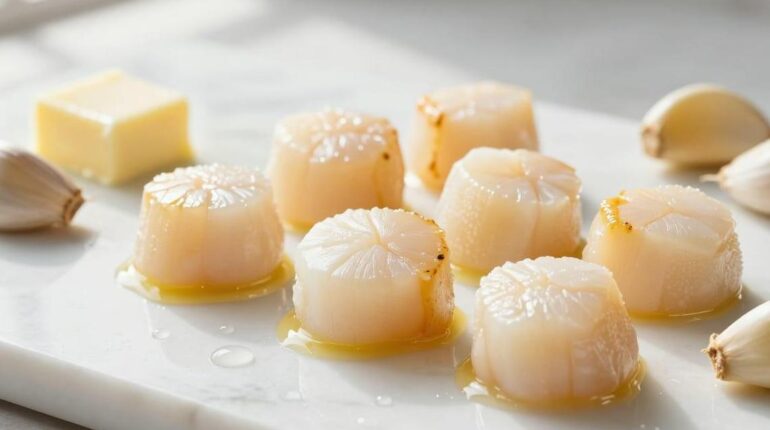
At the fishmonger, several criteria immediately betray quality. The visual aspect reveals first: the scallops must have a pearly white color, slightly translucent, never opaque or yellowish. Their firmness to the touch is the second reliable indicator. Soft flesh or flesh that sags under pressure indicates prolonged or inadequate storage.
The smell confirms or condemns. Fresh scallops release a delicate, almost sweet marine scent, never ammoniacal or frankly fishy. This subtle oceanic scent signals a product recently landed, transported in compliance with the cold chain.
The size also matters. Medium-sized scallops (about 3 to 4 cm in diameter) cook uniformly, developing that golden crust without drying out the heart. Overly large specimens require a prolonged cooking time that compromises the desired melting texture.
Choosing “untreated” scallops guarantees an optimal sear. Some producers add water retention agents that sabotage caramelization. These scallops release their liquid during cooking, simmering rather than browning.
This vigilance during purchase directly conditions the final success of the dish.