📌 Savory squash-spinach cake: the separate cooking technique that changes everything for the texture
Posted 21 February 2026 by: Admin
Butternut Squash And Spinach: A Balanced Vegetable Base
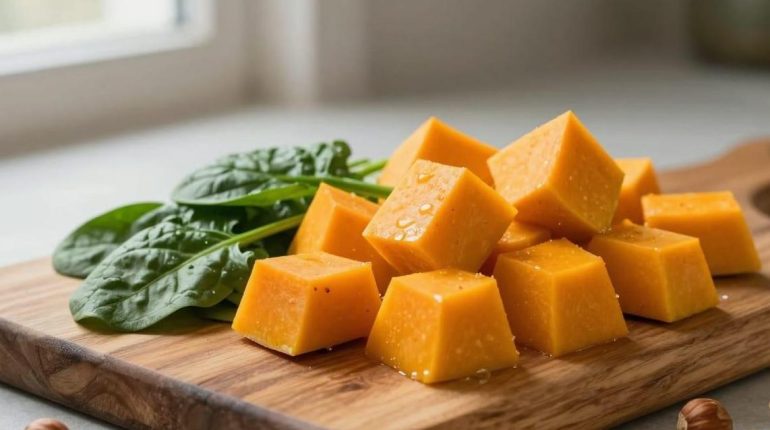
The assembly of a successful savory cake relies on meticulous preparation of the vegetables. The butternut squash, peeled and cut into regular small cubes, requires special attention: its 15 to 20-minute cooking in olive oil must be stopped before it becomes too soft. This mastery guarantees a firm texture that will perfectly withstand the final baking without falling apart in the batter.
At the same time, 250 g of fresh spinach undergoes an express treatment. Rinsed and spun dry, they quickly wilt in a pan with a spoonful of olive oil. The objective: to concentrate their flavors without excess water, which would compromise the balance of the mixture. Careful draining eliminates any residual moisture.
The 50 g of hazelnuts provide the final touch to this vegetable base. Dry-roasted for 5 minutes while stirring constantly, they reveal their deep aromas before being crushed. A handful of squash cubes is set aside: these reserved pieces will transform the final plating, creating a visual and taste reminder of the star ingredient. This differentiated preparation of the three vegetable components builds the foundations of a recipe where each element retains its identity.
The Skillful Assembly: Ricotta, Eggs, And Aromatics
The construction of the mixture begins with the emulsion of 3 eggs beaten with 5 cl of milk and 11 cl of olive oil. This liquid base then welcomes 210 g of ricotta, whose creamy texture is integrated with a whisk to create a homogeneous and airy mixture. This proportion of ricotta determines the characteristic moistness of the cake, avoiding the excessive density of a preparation that is too floury.
The incorporation of 180 g of flour mixed with baking powder is done delicately, without overworking the dough. The drained spinach, cooled squash cubes, and crushed hazelnuts then join the mix. Seasoning occurs at this precise stage: salt, pepper, and 2 pinches of nutmeg, whose subtle warmth magnifies the vegetable flavors without masking them.
The final mixing requires a light hand. Each movement aims to uniformly distribute the solid ingredients in the mixture, preserving the integrity of the squash cubes and the harmonious distribution of the spinach. The remaining 40 g of ricotta are intentionally reserved: whisked later with olive oil, salt, and pepper, they will compose the finishing cream that will crown the unmolded cake. This methodical organization guarantees a balanced texture where each bite reveals the presence of all components.
Baking And Unmolding With The Flexipan Mold By Dominique Ansel
The preparation poured into the Flexipan silicone mold goes into an oven preheated to 180°C. This moderate temperature guarantees progressive baking for 45 minutes, allowing the heart of the cake to set without drying out the edges. The Flexipan silicone ensures homogeneous heat distribution, eliminating the overcooking zones common with traditional metal molds.
Patience is required upon leaving the oven. Completely cooling the cake before unmolding is a non-negotiable step: attempting the operation on a still-lukewarm preparation would cause the structure to collapse, weakened by internal steam. The silicone mold tolerates this wait without retaining excessive moisture that would soften the crust.
Unmolding reveals the major asset of the Dominique Ansel signature Flexipan. The flexibility of the material allows for a flip without resistance, releasing the cake with a simple movement. No prior greasing was necessary, no trace of sticking remains. The perfect geometric shape of the cake is then fully expressed, with sharp edges and a smooth surface, ready to receive the whipped ricotta cream that will transform this savory cake into a visual creation worthy of a chef’s presentation.
Gourmet Plating And Serving Suggestions
Once unmolded, the final transformation takes place with the ricotta cream. The reserved 40 grams meet a tablespoon of olive oil in an energetic whisking. Salt and pepper are added until an airy and creamy texture is obtained, which is spread over the top of the cake in an even layer. This milky coating contrasts with the golden crust, creating a first visual layer.
The set-aside butternut cubes regain their decorative function. Sparingly arranged on the white cream, they bring their orange hues as a chromatic reminder of the cake’s interior. Sprouted seeds add a fresh vegetable note while crushed pink peppercorns punctuate the whole with fuchsia touches, transforming the surface into a sophisticated autumnal palette.
Versatility dictates the serving style. For an aperitif, six people share generous slices that hold perfectly in the hand, as the moist structure does not crumble. In a refined starter version, the individual plate hosts a portion accompanied by smoked salmon whose iodized salinity dialogues with the sweetness of the squash, while a mesclun salad brings the necessary crunch for texture balance. This Kiss My Chef recipe proves that a savory cake transcends its utilitarian function to become the centerpiece of a thoughtful meal.