πŸ“Œ Sarciadong Pechay at Itlog

Posted 14 April 2026 by: Admin #Recipes

Prep Time
15 minutes
Cook Time
20 minutes
Total Time
35 minutes
Servings
4 servings

The garlic singing in hot oil, tomatoes releasing their juices with a gentle hiss — there are dishes that set you right even before the first bite. Sarciadong Pechay at Itlog is exactly that. A Filipino everyday staple, made with eggs, green cabbage, and a light tomato sauce that comes together in thirty minutes flat.
Advertisement:
Final result
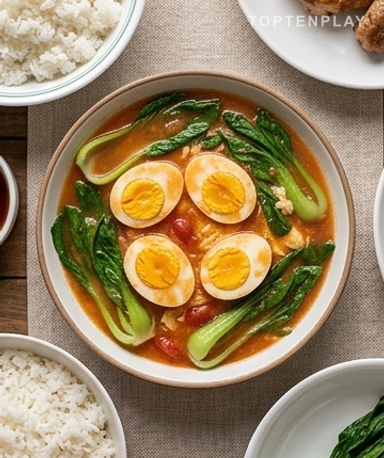
Sarciadong Pechay at Itlog served hot with white rice: a generous egg tomato sauce and melting green cabbage leaves.

The sauce has that rosy orange tint you only get with fresh tomatoes cooked long enough with onions. The hard-boiled eggs, cut in half, float in this liquid base looking quite satisfied. The pechay leaves have wilted just enough — they remain an almost jade green, slightly translucent at the edges. You lift the spoon and strands of beaten egg set in the sauce form an irregular lace. It smells of sautéed garlic, fish sauce at the back of the throat, and something fresh from the cabbage.

Why you’ll love this recipe

Ingredients you already have : Eggs, tomatoes, onion, garlic, fish sauce — if your kitchen is even slightly equipped for Asian cooking, you probably have nothing to buy. It’s the kind of dish you make on an evening when the fridge looks empty but isn’t really.
Two eggs are better than one : Hard-boiled eggs provide texture and volume. The beaten eggs, meanwhile, mingle with the sauce and make it slightly thick, almost silky. It’s a simple trick that really changes the texture of the dish — without it, the sauce remains too thin.
Nourishing without being heavy : No meat, no frying. The dish is satisfying thanks to the eggs, but you don’t leave the table feeling like you’ve eaten a concrete block. Ideal for nights when you want to eat well without overdoing it.
The cabbage stays alive : The pechay joins the pot at the very end, for two minutes max. The leaves keep their green color and a slight crunch — nothing like a vegetable forgotten for too long in a stew pot.

Ingredient Notes

Ingredients

Advertisement:

Everything needed for this Filipino dish: eggs, fresh pechay cabbage, ripe tomatoes, and a touch of fish sauce.

  • Pechay (bok choy) : Pechay is the Filipino version of bok choy, with firm white stems and large dark green leaves. In Asian grocery stores, classic bok choy is exactly the same. Choose some with tightly packed leaves, not yellowed, and firm stems that snap when you bend them. If you really can’t find anything, fresh spinach will do — but they cook even faster, thirty seconds is enough.
  • Eggs — both kinds : The recipe uses twelve hard-boiled eggs for the body of the dish, and three beaten eggs drizzled into the hot sauce. It’s the beaten egg that creates the silky little threads in the sauce — don’t pour everything at once or you’ll get a big scrambled omelet. Pour slowly, in a circle, and let it set for a few seconds before stirring.
  • Ripe tomatoes : Truly ripe tomatoes. Not hard supermarket tomatoes that release bland, tasteless water — Roma or plum tomatoes left at room temperature. To the touch, they should yield slightly under your fingers. They should almost crush themselves under the spoon after five minutes of cooking, and that’s what makes the sauce.
  • Fish sauce (patis) : This is the liquid salt of this recipe, with an umami depth that ordinary salt doesn’t provide. Filipino patis is a bit milder than the Thai version, but Tiparos or Tra Chang work very well. One tablespoon, no more — the idea is to salt with finesse, not to make it smell like fish.

The tomato base: where it all happens

Start by sweating the onion in a bit of oil — it should become translucent, almost glassy, before adding the garlic. The garlic browns in less than a minute, becoming fragrant and slightly golden like light caramel. That’s when you add the tomatoes. Don’t rush them, let them cook slowly over medium heat, stirring occasionally. In five to seven minutes, they collapse, lose their shape, and their juices mix with the oil to form the start of something. Add the fish sauce and some black pepper, then pour in the water. You’ll get a light sauce, not thick — that’s intentional. This isn’t a ragù, it’s a fragrant broth.

The tomato base: where it all happens
Pouring the beaten eggs in a drizzle into the simmering sauce to achieve a silky and well-bound texture.

Pouring the eggs without messing up

Once the sauce is simmering, take your beaten eggs and pour them in a slow drizzle, describing a circle over the pot. Not all at once. The egg must touch the hot liquid in small amounts, setting into translucent threads before you stir gently. Wait ten seconds. Only then, run a spatula through the sauce to disperse those threads. If you pour too fast, everything coagulates in the same place and you end up with a floating omelet — still edible, but not what we’re looking for. Patience here makes all the difference between a silky sauce and a failed one.

Advertisement:

The pechay arrives last — and for a reason

Add the pechay when everything else is almost ready. The leaves wither in one minute, the stems in two. They go from a dense bright green to a slightly darkened translucent green — that’s the signal. Remove from the heat as soon as the stems are just tender under the fork but still a bit firm. Then add the hard-boiled eggs and stir gently so as not to break them — they deserve to stay whole on the plate. One last salt check if needed, and the dish is ready.

The pechay arrives last — and for a reason
The pechay cabbage joins the egg tomato sauce to soften in just a few minutes.

Tips & Tricks
  • Cook your hard-boiled eggs in advance, even the day before. Keeping a few hard-boiled eggs in the fridge is a habit that will save you more often than you think — they go into a dozen quick dishes.
  • Do not cut the tomato cooking time short. They are what make the sauce, not the water. As long as they keep their shape, the sauce doesn’t have depth yet. Wait until they collapse and stick slightly to the bottom — then you can add the water.
  • Absolutely serve with white rice. The sauce is light and slightly salty, it needs the rice for balance. Without it, the dish seems incomplete — with it, every spoonful makes sense.
Close-up
The glossy sauce coats the sliced hard-boiled egg, blending sweetness and acidity in every bite.
FAQs

Can I prepare this dish in advance?

Advertisement:

You can cook the hard-boiled eggs the day before and keep them in the fridge — it saves time. However, the sauce and pechay are ideally prepared at the last moment: the cabbage softens too much if it stays in the hot sauce for long and loses its bright green color.

How to store leftovers and for how long?

Keep the dish in an airtight container in the refrigerator for up to 2 days. Reheat gently over low heat with a splash of water to loosen the sauce. The pechay leaves will be softer upon reheating, which is normal.

Advertisement:

What can I substitute for pechay if I can’t find any?

Classic bok choy is identical — it’s literally the same plant. Otherwise, fresh spinach works well but cooks even faster (30 seconds is enough). Baby pak choi or Swiss chard can also work.

My beaten eggs formed an omelet in the sauce — what happened?

Advertisement:

You poured them too quickly or all at once. You need to pour in a slow drizzle in a circle, then wait 10 seconds before stirring gently. The gradual contact with the hot liquid forms the silky threads characteristic of the dish.

Can I add meat?

Yes, it’s a very flexible recipe. Shredded chicken, shrimp, or firm tofu fit in well. Sauté them after the onion and before the tomatoes so they are well cooked.

Advertisement:

I don’t have fish sauce — what can I replace it with?

Light soy sauce is the best alternative, in the same quantity. It gives the same salty and umami base, with a slightly darker color in the sauce. Ordinary salt also works, but you lose the umami depth.

Sarciadong Pechay at Itlog

Sarciadong Pechay at Itlog

Easy
Filipino
Main Course
Advertisement:
Prep Time
15 minutes
Cook Time
20 minutes
Total Time
35 minutes
Servings
4 servings

A comforting Filipino dish made with hard-boiled eggs, green cabbage, and a light tomato sauce thickened with beaten egg. Quick, budget-friendly, and ready in 35 minutes.

Ingredients

  • 12 eggs (to be hard-boiled)
  • 3 eggs (to be beaten for the sauce)
  • 300 g pechay (bok choy), leaves and stems separated
  • 300 g ripe tomatoes, roughly chopped (approx. 3 medium tomatoes)
  • 1 medium onion, sliced (approx. 120 g)
  • 4 cloves garlic, minced
  • 2 tbsp fish sauce (patis or nuoc-mâm)
  • 240 ml water
  • 2 tbsp neutral oil
  • 1 tsp chicken bouillon granules (e.g., Maggi)
  • ½ tsp ground black pepper

Instructions

  1. 1Place 12 eggs in a pot of cold water, bring to a boil and cook for 11 minutes. Cool under cold water, then peel and set aside.
  2. 2Beat the remaining 3 eggs in a bowl with a fork until well mixed. Set aside.
  3. 3Heat the oil in a wok or large skillet over medium heat. Sauté the onion for 1 minute, then add the garlic and cook for another minute until lightly browned.
  4. 4Add the tomatoes. Cook for 5 to 7 minutes, crushing regularly with a spatula, until they collapse and form a sauce base.
  5. 5Stir in the fish sauce and pepper. Pour in the water, bring to a simmer, and let cook for 2 minutes.
  6. 6Pour the beaten eggs in a slow drizzle in a circle over the simmering sauce. Wait 10 seconds, then stir gently to form threads in the sauce.
  7. 7Add the pechay stems, cook for 1 minute, then add the leaves. Let wither for 1 to 2 minutes.
  8. 8Season with bouillon granules. Add the whole hard-boiled eggs, mix gently, and cook for another 1 minute. Serve immediately with white rice.

Notes

• Hard-boiled eggs can be cooked the day before and kept in the refrigerator — this reduces prep time to 5 minutes at dinner time.

• The dish keeps for 2 days in the fridge in an airtight container. To reheat, add 2 to 3 spoons of water to the pan to loosen the sauce.

Advertisement:

• For a heartier version, add 200 g of diced chicken breast, sautéed before adding the tomatoes.

Nutrition Facts (per serving, estimated)

340 kcalCalories 23 gProtein 9 gCarbs 24 gFat

Advertisement:
Share it!

Thanks for your SHARES!

You might like this

Add a comment:

Latest posts

Build-Your-Own Japanese Bowls β€” Tsukurioki Meal Prep

Vegetable Salad and Carrot Tartare, Chef Style

Homemade Rosemary Tea

Cheesy Pizzettes with Mushrooms and Peppers

Tomato Carrot Lemon Juice

Creamy Cancoillotte Risotto with Crispy Smoked Sausage

Walking Taco Casserole

Homemade Hamburger Steaks

Homemade Oven-Baked Chicken Nuggets

Gua Bao with Marinated Chicken and Crunchy Vegetables

Loading...