📌 Revisited Tournedos Rossini: the unexpected fusion between French gastronomy and oriental flavors with honey and cumin
Posted 30 December 2025 by: Admin
Preparation Of The Golden Kadaif Nests
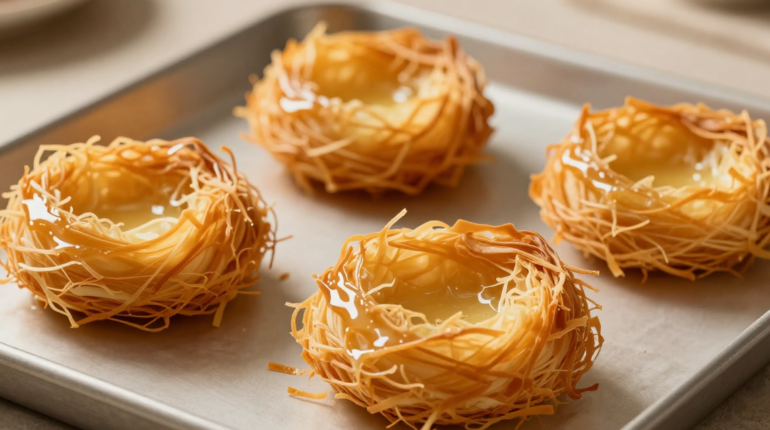
The secret of this oriental version of the tournedos Rossini lies in a bold technical element: the kadaif pastry nests, those pastry threads so fine they evoke crunchy angel hair. The preparation begins with a delicate but essential gesture: rolling a small amount of this filamentous pastry onto itself to form four perfectly structured nests.
These golden cocoons require special attention. Once arranged on a generously buttered baking sheet, each nest receives a meticulous brushing of clarified butter, applied with a brush to guarantee uniform coloring. This step determines the visual success of the final dish: clarified butter, freed from its impurities, allows for cooking without burning and an incomparable crunchy texture.
Baking in the oven at 180°C for ten minutes transforms these fragile structures into golden and crunchy cases. The oven must be preheated to immediately seize the pastry and develop that subtle caramelization that will make all the difference. Once golden, the nests are set aside at room temperature, maintaining their crunchiness until the final plating.
This oriental pastry technique, traditionally reserved for desserts, finds a bold savory application here that announces the culinary fusion to come.
The Perfect Cooking Of The Tournedos
While the kadaif nests rest in their golden coats, the skillet takes the stage for the most delicate operation: cooking the tournedos. A drizzle of olive oil heated to the right point welcomes a tablespoon of butter, this essential fatty duo that guarantees both immediate searing and the development of aromas.
Seasoning occurs just before cooking: salt and pepper applied directly to the meat, never in the fat. This sequence respects a fundamental principle of French cuisine: spices must adhere to the surface to create that savory crust sought by chefs. Two to three minutes per side are enough to obtain a medium-rare (rosé) cook, ideal for noble cuts that lose their tenderness beyond that.
The professional tip comes after cooking: the tournedos are placed between two stacked deep plates. This ancestral technique creates a micro-environment that maintains temperature while allowing the fibers to relax. The meat juices, trapped in this resting chamber, do not escape and restore all their flavor during tasting.
This strategic pause frees the cook for the next crucial step: transforming the caramelized juices remaining in the pan into a sauce with oriental accents.
The Elaboration Of The Oriental Spice Sauce
The smoking pan, still marked by the cooking of the meats, holds a treasure: the caramelized juices that will form the aromatic base of the sauce. Deglazing is done with the freshly squeezed juice of three oranges, whose natural acidity immediately detaches the precious brown deposits stuck to the bottom. This technical gesture transforms residues into a flavor concentrate.
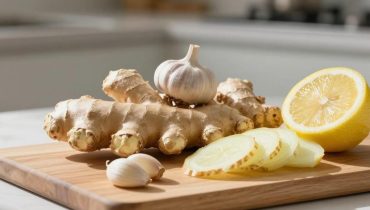
The oriental alchemy then begins: honey, cumin, and ginger join the boiling amber liquid. These three ingredients completely overturn the orthodoxy of the classic Rossini. Honey brings a sweetness that coats the bitterness of the cumin, while ginger introduces that pungent note characteristic of Maghreb and Middle Eastern cuisines. Reducing by half concentrates these scents until a unique taste balance is created.
The incorporation of dehydrated veal stock structures this preparation, giving it the umami depth essential for a sauce worthy of a high gastronomy dish. Then, off the heat, comes the butter mounting: this final emulsion binds all the elements and brings the silky smoothness expected of a great French sauce.
This bold fusion between classic technique and oriental aromatics produces a singular creation, ready to coat slices of foie gras whose cutting now demands full attention.
The Spectacular Plating Of The Signature Dish
This fragrant sauce now awaits its main protagonists. The foie gras, the centerpiece of this revisited Rossini, must be sliced with precision: four escalopes 0.5 to 1 centimeter thick, not too thin to prevent them from melting instantly on contact with the hot meat, nor too thick to guarantee a harmonious tasting. Each slice is placed delicately on its still-warm tournedos, creating that thermal contrast that slightly melts the edges of the foie gras.
The architecture of the dish is then built upwards: the solid base of the rosé tournedos, topped with the creamy richness of the foie gras, itself crowned by a golden and crunchy kadaif nest. This vertical layering is not just aesthetic: it orchestrates a succession of textures with each bite. The airy crunch of the oriental pastry gives way under the fork, revealing the softness of the foie gras before reaching the tender firmness of the noble meat.
The oriental spice sauce generously coats the whole or is presented on the side, according to the chef’s preference. Its amber reflections contrast with the ivory beige of the kadaif, creating a gastronomic tableau where each element visually dialogues with the others. This final staging materializes the encounter between two culinary traditions that everything seemed to oppose, now united on the same plate.