📌 Quebec meatball stew: how to succeed in making moist meatballs that absorb all the flavor of the sauce
Posted 5 February 2026 by: Admin
A Treasure Of Quebec Family Cuisine
In Quebec households, certain recipes transcend their simple culinary status to become true symbols of tradition. Meatball stew is among those heritage dishes that embody the very essence of family cooking: generous, comforting, and deeply rooted in daily life. Far from gastronomic artifice, this preparation relies on the authenticity and simplicity of ingredients to create an experience that “warms both the body and the heart.”
This emblematic dish finds its privileged place during family gatherings, when the desire for a nourishing meal combines with the need to rediscover those reassuring flavors that recall childhood. The moist meatballs, enveloped in their velvety sauce, immediately evoke that home cooking passed down from generation to generation, the kind that does not seek to impress but to bring people together.
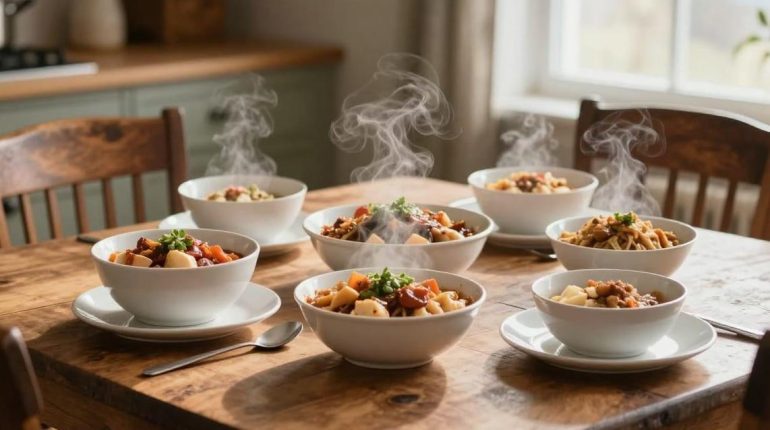
The strength of this stew lies in its ability to transform simple ingredients into a warm dish that gathers everyone around the table. Served steaming on plates, it embodies that typically Quebecois generosity where every bite tells a story of sharing and conviviality. Behind this apparent simplicity lies a precise know-how, where each step contributes to creating that characteristic texture.
The Art Of The Perfect Meatball
The success of this dish rests above all on the quality of the meatballs, whose preparation requires special attention. The composition remains surprisingly simple: 500 grams of ground beef form the base, enhanced by a small finely chopped onion, an egg to bind everything together, and two tablespoons of breadcrumbs. Salt, pepper, and chopped parsley complete this balanced combination.
The secret to a truly moist meatball lies in the delicacy of the mixing. Contrary to the instinct to knead vigorously, the meat must instead be handled with lightness. Excessive working of the preparation would make the meatballs dense and compact, whereas the goal is that tender texture that melts in the mouth. Moistened hands facilitate shaping without the meat sticking to the fingers, allowing for the formation of regular walnut-sized portions.
The browning stage is a crucial moment. In a very hot pan with a drizzle of oil, the meatballs brown on all sides for about five minutes. This operation creates a light golden crust that seals in the flavors while keeping the center pink. The meatballs should not cook entirely at this stage: they will finish cooking in the sauce, where they will soak up all the aromas of the broth to reach that characteristic tenderness for which the dish is famous.
The Secret Of A Velvety Sauce
Once the meatballs are browned and set aside, the preparation of this sauce begins, which will transform a simple meat dish into a comforting stew. The process relies on a classic French technique: the roux. In a saucepan, 25 grams of butter melt over medium heat before welcoming two tablespoons of flour. This mixture, stirred constantly for a minute, takes on a slightly golden hue and gives off a subtle nutty scent.
Incorporating the broth is the delicate moment. The 600 milliliters of hot liquid must be poured in gradually while whisking vigorously. This method prevents the formation of lumps that would compromise the final texture. The whisk must make regular movements, reaching the corners of the saucepan where the flour might clump. In a few minutes, the preparation transforms: what seemed liquid gradually thickens to become a smooth and velvety sauce.
This creamy base offers the characteristic smoothness of Quebec stew. Unlike excessively thick sauces, it retains a fluidity that allows it to coat each meatball without weighing it down. A final adjustment of salt and pepper refines the balance of flavors. The sauce now awaits the meatballs which, by simmering in it, will finish their cooking while releasing their juices, thus creating that perfect harmony between tender meat and savory gravy.
Simmering And The Magic Of Time
The meatballs now return to the saucepan, plunged into this sauce which will become their protective envelope. The heat is lowered to a delicate simmer. High heat would break the meatballs and toughen the meat; conversely, this gentle heat for 25 minutes gradually transforms the texture. The lid, placed askew to let steam escape, maintains moisture while allowing the sauce to reduce slightly.
During this simmering, an alchemy takes place. The meatballs, already browned on the surface, finish cooking to the core without drying out. They absorb the aromas of the broth while their own juices enrich the sauce. This mutual impregnation creates a gustatory symbiosis impossible to reproduce with fast cooking. The meat becomes extremely moist, almost melting, while the sauce naturally thickens to become coating.
After 40 minutes of total cooking, the stew reveals its character. The meatballs hold together perfectly without crumbling, coated in a velvety gravy that has captured the essence of the dish. A generous amount of fresh parsley, chopped at the last moment, brings a touch of freshness that wakes up the whole dish. Served directly in shallow bowls with boiled potatoes or crusty bread for dipping, this traditional stew proves that no sophistication surpasses the accuracy of a recipe designed to nourish and comfort.