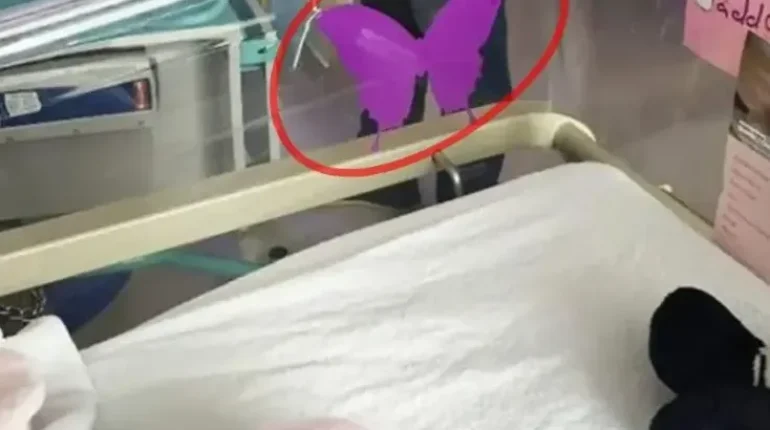
📌 Purple butterfly stickers on hospital cribs: The symbol helping parents who lost a twin
Posted 13 December 2025 by: Admin
The Heartbreaking Reality Behind The Purple Butterfly
When Millie Smith and Lewis Cann discovered they were expecting twins, joy quickly turned to dread. During a routine scan, their doctor’s silence said everything—one of their daughters had anencephaly, a fatal birth defect. The CDC reports that approximately 1 in 4,600 newborns are born with this condition, and almost all die shortly after birth. Yet the couple chose to continue the high-risk pregnancy, determined to give their child a name and a life, however brief.
On April 30, at just 30 weeks, Smith delivered identical twins Skye and Callie via emergency C-section. Against all odds, both babies cried. “When the girls were born, they both cried. This was a huge moment, as we were told that Skye would not make a noise or move,” Smith recalled. The hospital provided them with a Daisy Room, a sacred space where bereaved parents spend time with their infant. For three precious hours, the family held Skye, cuddling her until she passed away.
While Callie fought for survival in the NICU, Smith faced something equally devastating: the erasure of her daughter’s existence. As weeks passed, colleagues and visitors forgot about Skye entirely. The silence surrounding her loss proved as painful as the loss itself, forcing Smith to navigate her grief alone while watching other families celebrate their healthy twins—unaware of her heartbreak.
The Devastating Comment That Sparked A Movement
Days blurred into weeks as Callie recovered in the NICU alongside other families with premature twins. Most nurses knew Skye’s story, but as time passed, the silence became deafening. “After about four weeks, everyone acted as though nothing had happened,” Smith recalled, her daughter’s name simply erased from daily conversation. Around her, other parents navigated their own struggles, unaware of the invisible wound she carried.
Then came the moment that nearly shattered her completely. An exhausted mother, watching her own newborn twins, told Smith she was “so lucky” not to have two infants to manage. The comment, innocent and even humorous, landed like a knife. Smith couldn’t explain. She couldn’t tell this stranger that she had two daughters—that one had only lived three hours. “The comment nearly broke me. I ran out of the room in tears and they had no idea why,” Smith said. “I didn’t have the heart to tell them what had happened. A simple sticker would have avoided that entire situation.”
In that moment of anguish, clarity emerged. Smith realized bereaved parents navigated a minefield of misunderstanding with no warning system, no visible marker to signal their loss to staff and visitors. The gap in communication protocols left grieving families vulnerable to casual remarks that reopened wounds repeatedly. She knew then that Skye’s legacy couldn’t be silence—it had to be a tangible solution that protected other parents from this same pain.
The Purple Butterfly Symbol: Design And Meaning
From that realization emerged something beautifully intentional. Smith didn’t simply create a poster—she engineered a solution that would speak silently but powerfully to everyone who encountered it. The purple butterfly sticker became her answer, a visual language for grief that required no explanation.
Every element carried purpose. Butterflies symbolized transformation and freedom, representing the babies who had “flown away,” as Smith described it. She chose purple deliberately, recognizing that loss transcends gender. “I felt it was fitting to remember the babies that flew away, the color purple because it is suitable for both boys or girls,” Smith explained. A single sticker placed on an incubator would immediately signal to staff and visitors that this family had experienced the loss of one or more babies in a set of multiples—eliminating the need for painful explanations.
The sticker transformed the NICU environment from a space of institutional silence into one of recognition and respect. Parents no longer bore the burden of disclosure. Visitors would understand at a glance. Medical staff would adjust their approach accordingly. What began as a mother’s desperate need for protection evolved into a practical protocol that acknowledged invisible grief. The purple butterfly became a bridge between private heartbreak and public acknowledgment, allowing families to honor their lost children without repeatedly reliving their loss through conversation.
Skye’s Legacy: A Global Initiative Supporting Grieving Families
What Smith built from her heartbreak transcended the confines of a single hospital ward. The purple butterfly initiative gained momentum as word spread, eventually expanding far beyond the UK’s shores. The Skye High Foundation emerged to formalize and amplify Smith’s vision, establishing the purple butterfly protocol in hospitals across multiple nations. What began as one mother’s desperate measure became a standardized practice of compassion, recognized by medical professionals worldwide as an essential tool for honoring infant loss and protecting bereaved families.
Seven years after that devastating April day, Callie thrives—a vibrant seven-year-old full of life and joy. Yet Skye’s presence remains woven through her sister’s existence and countless others’ lives. Purple butterfly merchandise and dedicated support programs now serve families navigating similar losses, transforming grief into connection. The initiative provides what hospitals had previously failed to offer: institutional acknowledgment that these losses matter, that these children existed, and that their parents’ pain deserves respect.
Smith’s mission continues with quiet determination. “Ultimately I will never be able to stop this from happening, but the more support groups we can set up and put things in place like the stickers the better it will be,” she reflects. Her work demonstrates how one family’s private tragedy can reshape public systems, proving that small gestures—a sticker, a symbol, a protocol—possess extraordinary power to ease suffering. What Skye could not achieve in her three hours of life, she achieved through her absence: creating spaces where bereaved parents no longer suffer in silence.