📌 Prickly lettuce: how this wild plant from your garden boosts immunity, digestion, and bone health thanks to its vitamins A, C, K and its natural soothing latex
Posted 26 February 2026 by: Admin
Prickly Wild Lettuce: The Misunderstood Plant That Thrives Before Your Eyes
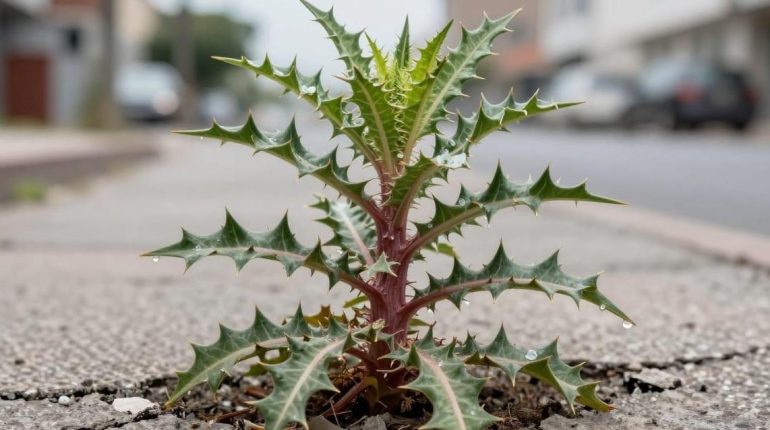
This reddish stem that rises up to 1.80 m along cracked sidewalks, this weed with leaves bristling with prickles that you mechanically pull from your garden, holds a secret that few suspect. Lactuca serriola, the prickly wild lettuce, shares its genetic heritage with the cultivated lettuce you buy at the supermarket — but unlike its domesticated cousin, it contains active compounds documented for centuries by traditional herbalists.
Recognizable by its milky sap that beads at the slightest break, this plant colonizes vacant lots, roadsides, and neglected urban spaces with remarkable efficiency. Its adaptation is such that its upper leaves orient themselves along a north-south axis to minimize exposure to the midday sun, earning it the nickname “compass plant” among botanists.
Native to Eurasia and North Africa, it has conquered all continents, thriving where other plants fail. This exceptional resilience testifies to a biochemical richness that contemporary studies are only beginning to reveal. While millions of euros are invested in the research of new food supplements, this free resource grows within reach, ignored by the majority.
A transformation of perception is necessary: what we label as a nuisance harbors nutritional and therapeutic properties that our ancestors exploited with wisdom. Modern research today validates their empirical intuitions.
Nutritional Profile: When the “Weed” Surpasses Cultivated Vegetables
Beyond this remarkable adaptation to the urban environment, the young spring leaves of prickly lettuce reveal a nutritional density that rivals leafy greens marketed as superfoods.
Analyses confirm an exceptional concentration of essential vitamins: vitamin A in the form of beta-carotene supports eye health and immune function, vitamin C acts as a cell-protecting antioxidant, while vitamin K participates in bone health and normal blood clotting. These bioavailable micronutrients are accompanied by structural minerals — calcium, magnesium, iron — essential for skeletal strength, muscle function, and energy metabolism.
The texture of the tender leaves harvested before flowering offers a subtle bitterness, comparable to that of endive or arugula. This characteristic flavor, far from being a flaw, signals the presence of active phytochemical compounds that cultivated varieties have gradually lost during agricultural selection favoring sweetness.
Each handful of these wild shoots also provides fiber that facilitates digestion and regulates blood sugar. While consumers spend considerable sums on imported green powders, this free and local resource thrives just a few meters from their door.
But the true singularity of Lactuca serriola lies in its milky sap, whose properties go far beyond simple nutritional intake.
Lactucarium: The Milky Sap With Relaxing Properties Studied In The Laboratory
When a stem or leaf of prickly lettuce is broken, a milky white latex flows out immediately. This substance, called lactucarium, concentrates biochemical compounds that traditional herbalists have exploited for centuries for their calming effects.
Analysis reveals the presence of sesquiterpene lactones, notably lactucin and lactucopicrin, molecules responsible for the characteristic bitterness. Studies conducted on animal models have demonstrated that these compounds produce measurable relaxing effects, comparable in intensity to some over-the-counter options, without inducing the addiction risks associated with more powerful pharmaceutical sedatives.
Ancestral practices document the use of this sap to relieve occasional tension, promote natural sleep, and soothe mental agitation. This modern validation by contemporary research confirms what traditions from several continents transmitted empirically: lactucarium acts as a gentle support to the nervous system.
A clarification is necessary, however: Lactuca serriola contains lower concentrations than its cousin Lactuca virosa, the wild lettuce reputed to be more powerful. Effects vary according to the harvest period, the maturity of the plant, and individual sensitivity — which is why experts recommend a progressive and informed approach.
This scientific understanding of the mechanisms of action opens the way to reasoned use, provided that harvesting protocols and essential precautions are mastered.
Practical Guide: Harvesting, Preparation, and Safe Integration
This understanding of active properties now requires concrete mastery of harvesting techniques to avoid any confusion with toxic species.
Identification begins with three non-negotiable criteria: midribs on the underside bristling with fine prickles, a milky white latex flowing at the slightest break, and pale yellow flower heads appearing in summer. These markers distinguish Lactuca serriola from potentially dangerous look-alikes.
The optimal calendar concentrates the harvest in spring, before the flowers rise. The basal leaves, still tender and not very bitter, then offer the best nutritional ratio. After flowering, the content of bitter compounds explodes, making consumption less pleasant.
Culinary preparation varies according to maturity: young shoots are integrated raw into mixed salads (the bitterness is tempered with arugula and lamb’s lettuce), while developed leaves benefit from being blanched for 2 minutes or sautéed in olive oil with garlic and lemon. This quick cooking preserves nutrients while softening the taste.
Three precautions frame the use: start with a handful to test digestive tolerance, avoid any consumption during pregnancy or breastfeeding, and consult a health professional in case of sedative treatment (risk of interaction). People on anticoagulants must also remain vigilant due to the high vitamin K content.
This free resource, correctly identified and prepared, transforms vacant lots into a nutritional pantry — provided that these protocols validated by experts in wild edible plants are scrupulously respected.