📌 Poultry Sausages & Mustard Roasted Potatoes
Posted 15 April 2026 by: Admin
We often think this dish is bland. A cafeteria staple, vaguely sad, something you make when you run out of ideas. It’s exactly the opposite. Done right, this dish of poultry sausages and mustard-roasted potatoes is the kind of thing guests ask you to make again.
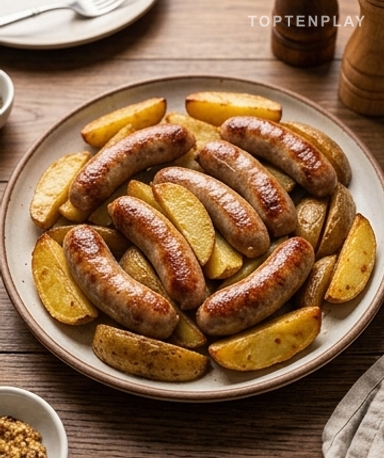
Imagine the tray coming out of the oven: the potatoes have that light caramel color, almost amber on the edges, with a crust that cracks under the fork before giving way to a melting interior. The sausages have slightly burst on top, releasing juices that have caramelized in the mustard marinade. The smell in the kitchen is that mix of heated mustard that tingles the nose and browning potato skin—the smell of home, of a meal that’s going to last.
Why you’ll love this recipe
Ingredient Notes
All ingredients together: poultry sausages, potatoes, mustard, onion, and herbes de Provence.
- Poultry sausages : Get chicken or turkey sausages, those simplest ones you can find. Herbed or slightly smoked versions add a real plus. Avoid sausages that are too thin as they will dry out during cooking—you need a little fat to keep them juicy.
- Potatoes : The variety changes everything. For a crispy result, choose Charlotte or Roseval—they hold up well during cooking without falling apart. Floury potatoes like Bintje are too soft for roasting. Cut them into thick wedges: if too thin, they dry out before browning.
- Mustard : Use a classic Dijon mustard, preferably strong. Mild mustard gives the dish less personality. If you want something more complex, mix half Dijon and half whole-grain mustard—the little whole seeds pop in the mouth and it’s really good.
- Olive oil : No need to bring out the premium bottle. Ordinary olive oil works just fine here—it mainly serves as a vehicle for the marinade and aids in browning. The important thing is not to use too little, otherwise the potatoes will stick and won’t brown correctly.
Why I never skip drying the potatoes
It’s the detail everyone forgets that changes the final result. After cutting the potatoes into wedges, you must rinse them in cold water to remove surface starch, then dry them thoroughly with a towel. Truly dry, not just a vague shake. Residual moisture creates steam in the oven, and steam is the enemy of crispiness. You’ll feel the difference as soon as you touch them: well-dried potatoes have a slightly powdery, almost velvety surface under your fingers. That’s when they’re ready for the marinade.
The two-minute marinade—and it’s really good
In a large bowl, mix the mustard, olive oil, salt, pepper, and if you have some on hand, a pinch of herbes de Provence. Add the dried potatoes and sliced onion, and mix with your hands. Really with your hands—it’s more effective than a spoon, you coat every surface uniformly. The smell of raw mustard at this stage is almost aggressive, it stings the nose. This is normal and a good sign. During cooking, this aggressiveness will mellow into something nutty and deep.
The part everyone misses: spacing on the tray
The potatoes must not touch each other. It’s counter-intuitive when you see the quantity and the size of your tray, but it’s non-negotiable. If they are crowded, they steam and soften. Spaced out, heat circulates around each piece and you get a crust on all sides. Place the sausages on top or between the potato wedges. Slide the tray into the oven preheated to 200°C—you should hear a slight sizzle in the first few seconds, a sign the tray was hot. Halfway through cooking, about twenty-five minutes, flip the potatoes with a spatula. They should already have a beautiful honey color on the bottom side.
How to know it’s truly ready
No blind timers. Look at the color—a deep golden brown, not pale yellow, not black. Poke the thickest potato wedge with the tip of a knife: it should glide through without resistance, like soft butter. The sausages should have slightly wrinkled skin and dark caramelization spots where they touched the tray. If you want to check the sausages, cut one in half—the inside should be entirely opaque with no pink traces. Serve immediately, perhaps with a small spoonful of mustard on the side for those who like it.
Tips & Tricks
- Preheat your tray before placing the potatoes on it—put it in the oven while it’s heating up. When the potatoes touch it, the contact starts caramelization immediately instead of waiting for the heat to rise.
- For a more fragrant version, add two or three whole unpeeled garlic cloves directly onto the tray. They will confit in their skin during cooking and you can squeeze them directly onto your plate—a sweet, soft paste that spreads like butter.
- Don’t cut the onion too thin. Thick half-moons withstand the heat better and become slightly caramelized with crispy edges. Sliced too thin, the onion burns before the potatoes are cooked.
Can this dish be prepared in advance?
You can prepare the marinade and coat the potatoes the day before, then store them in the refrigerator in a bowl covered with plastic wrap. Take them out 15 minutes before baking so they aren’t cold in the center. Add the sausages directly to the tray at the time of cooking.
How to store and reheat leftovers?
The dish can be kept for 2 to 3 days in the refrigerator in an airtight container. To reheat, forget the microwave as it makes everything soggy—pan-fry over high heat with a drizzle of olive oil for 5 to 7 minutes. The crust returns almost as well as when just out of the oven.
My potatoes aren’t crispy, what happened?
Three possible causes: they weren’t dry enough before the marinade, they were too crowded on the tray (steam cooked them), or the oven wasn’t hot enough. It really needs at least 200°C and a non-overloaded tray.
Can I use other types of sausages?
Absolutely. Smoked turkey sausages bring more depth than fresh chicken sausages. Poultry merguez also work very well and give a spicy touch that pairs perfectly with mustard.
Can I add vegetables to complete the dish?
Yes, it’s actually recommended. Peppers, thick zucchini slices, carrot sticks, or red onion wedges roast very well at the same temperature. Add them directly into the marinade with the potatoes.
Which mustard should I choose for the best result?
A strong Dijon mustard is the ideal base—it holds up well during cooking and adds character without masking other flavors. For more texture, mix equal parts Dijon and whole-grain mustard.
Poultry Sausages & Mustard Roasted Potatoes
French
Main course
A generous and fuss-free oven dish: juicy poultry sausages and crispy potatoes coated in a mustard marinade. Ready in an hour, a guaranteed crowd-pleaser.
Ingredients
- 4 (about 400g) poultry sausages (chicken or turkey)
- 900g potatoes (Charlotte or Roseval type)
- 1 (about 80g) yellow onion
- 2 tbsp (40g) strong Dijon mustard
- 2 tbsp (30ml) olive oil
- 2 whole unpeeled garlic cloves
- 1 tsp herbes de Provence
- 1 tsp salt
- ½ tsp ground black pepper
Instructions
- 1Preheat the oven to 200°C (fan oven) leaving the baking sheet inside.
- 2Peel the potatoes and cut them into thick wedges. Rinse with cold water, then dry thoroughly with a towel.
- 3Slice the onion into thick half-moons.
- 4In a large bowl, mix mustard, olive oil, salt, pepper, and herbes de Provence. Add the potatoes, onion, and whole garlic cloves. Mix by hand to coat well.
- 5Remove the hot tray from the oven. Spread the potatoes in a single, well-spaced layer. Arrange the sausages between the wedges.
- 6Bake for 45 minutes. Halfway through, flip the potatoes with a spatula to brown evenly.
- 7Serve straight from the oven, with caramel-colored potatoes and lightly caramelized sausages.
Notes
• Storage: 2 to 3 days in the refrigerator. Reheat in a pan over high heat to regain crispiness.
• Vegetable variant: add peppers, zucchini, or carrots directly to the marinade—they cook at the same temperature.
• Prep ahead: marinated potatoes can rest overnight in the fridge. Add sausages just before baking.
Nutrition Facts (per serving, estimated)
| 490 kcalCalories | 22gProtein | 42gCarbs | 24gFat |