Octopus is the recipe everyone thinks is reserved for Michelin-starred chefs. Too technical, too risky, and if you mess it up, it’s like rubber. Except that with a Dutch oven and some time on your hands, octopus is actually one of the most forgiving dishes there is—the one that makes the biggest impact for the least effort.
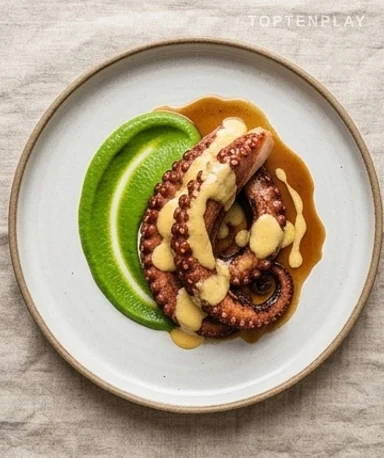
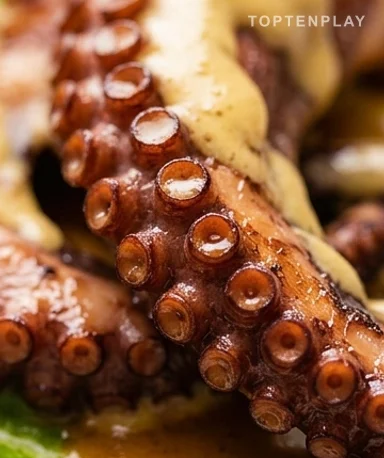
On the plate, it’s a spectacle. The tentacles shine, slightly caramelized in places, with that deep burgundy color that only comes after a long smothered cooking. The arugula velvet—grass-green, almost electric—provides a sharp contrast. And the sabayon sits like an ivory, glossy cloak, with the floral acidity of elderflower vinegar arriving at the finish. It smells of the sea, fresh grass, and a cooking base that has concentrated for hours.
Why you’ll love this recipe
Ingredient Notes
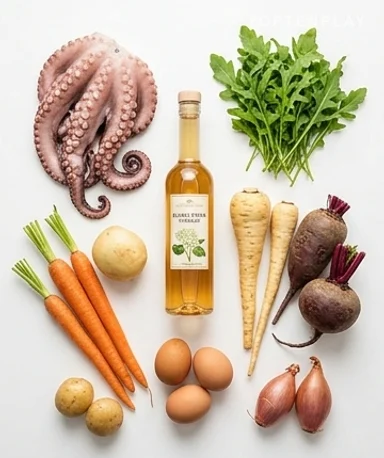
Fresh octopus, arugula, elderflower vinegar, and root vegetables: simple products for a gourmet result.
- The octopus : Buy it frozen and already cleaned if possible—it saves you 20 minutes of work and the final result is strictly identical. For 8 people, count at least 2 kg of raw octopus: it shrinks enormously during cooking. If you buy fresh from the fishmonger, ask them to tenderize it; some do it very well.
- Arugula : Not the very mild arugula from vacuum-sealed plastic bags. Get the kind that stings the throat a bit, loose from the greengrocer or market—it will give character to the velvet. Thin, mild leaves disappear completely in the blender without leaving a trace.
- Elderflower vinegar : This is what signs the dish. It can be found in delis or easily online. If you really can’t find it, a quality apple cider vinegar with a few drops of orange blossom water will do the trick—it’s not identical, but it holds its own.
- Root vegetables : Carrots, parsnips, raw beets, celeriac—choose based on what’s available. They flavor the braising liquid and then serve to compose the root juice. Cut them into large chunks; no precision is needed here.
- Eggs for the sabayon : Use fresh, high-quality eggs—a fresh egg has a well-rounded, bright orange yolk that holds its shape. Take them out 30 minutes before working with them: at room temperature, the yolks rise much better in a bain-marie and you avoid lumps.
Take the octopus out the day before and let it thaw slowly
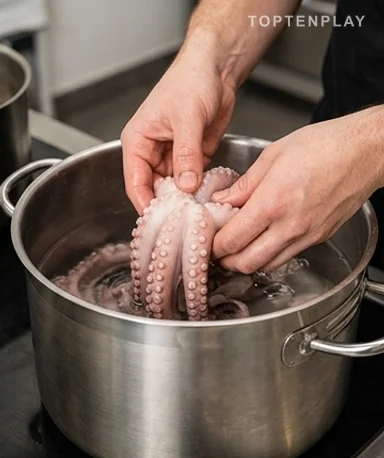
The first thing to do is thaw your octopus in the refrigerator the night before. Not under hot water, not in the microwave—slowly, in the cold. The next day, rinse it, drain it, and dry it with paper towels. It must be truly dry before going into the pot, otherwise it will boil in its own water rather than braise. When you touch it, the tentacles already have that slightly elastic texture, a bit like thick silicone. That will change.
Brown it without touching for three minutes
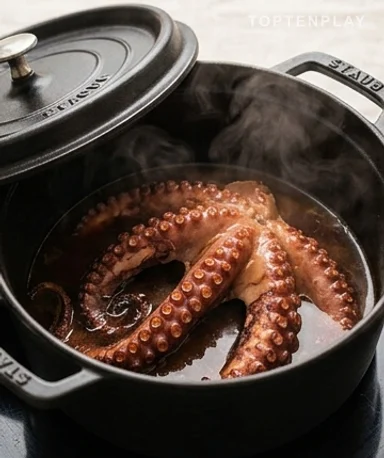
In your very hot pot with a drizzle of olive oil, place the octopus and do not touch it again. You’ll hear a loud crackling at first, almost aggressive, then it calms down—that’s exactly what we want. Flip it only once: the parts in contact should be deep bronze, like a light caramel about to turn. Then add the roughly chopped root vegetables, a glass of water, cover tightly, and immediately lower the heat to minimum. From there, one hour and thirty minutes without touching. The sweet, briny smell that will fill your kitchen after an hour is the sign that everything is going well.
Plunge the arugula into ice water right out of the pan
When it’s almost time to plate, blanch the arugula for 90 seconds in boiling salted water, then immediately plunge it into a large bowl of water and ice cubes. This thermal shock sets the color—without it, the velvet turns a dull olive green in two minutes. Drain, squeeze hard with your hands to remove all water, then blend with a drizzle of olive oil, salt, and if needed a spoonful of the octopus cooking liquid to thin it. The result should be smooth, dense, and almost glossy. Taste it: arugula can be bitter, so the seasoning must balance that.
Whisk without stopping until you see the ribbon
Traditional sabayon is made with white wine, replaced here with vegetable broth reduced with elderflower vinegar—and with this floral vinegar, frankly, you’re not missing anything. Whisk four yolks with 10 cl of hot broth and two tablespoons of elderflower vinegar in a bowl over a simmering bain-marie. Whisk without stopping. The foam starts liquid, then becomes creamy, then gains volume and leaves a thick ribbon when you lift the whisk—that’s when you must immediately remove it from the heat. If you continue, the eggs coagulate and you’ll get elderflower-scented scrambled eggs, which is not the desired effect.
Don’t coat everything—leave some green visible
Cut the tentacles into generous sections. A nice spoonful of arugula velvet at the bottom of the plate, the octopus placed on top, a few drops of reduced root juice with a spoon, and the sabayon cloak just before taking it to the table. The key to plating is not to cover everything—the green-ivory-burgundy contrast is precisely what makes your guests take out their phones before even tasting.
Tips & Tricks
- Let the octopus rest for 10 minutes in the pot off the heat before cutting—the fibers relax and the tentacles slice cleanly instead of tearing.
- Collect the braising liquid and reduce it over high heat for 10 minutes while you whip the sabayon—it thickens, concentrates, and advantageously replaces the root juice if you didn’t have time to prepare it separately.
- Do not salt the octopus before or during cooking: it naturally contains a lot of salt. Wait until you’ve tasted the juice to decide if you need to add any.
- If you’re cooking for 8 people, prepare the velvet and reduce the juice the day before. Reheat them gently on the day. Only the sabayon is made at the last minute—but 8 minutes goes by fast.
Can I use fresh octopus instead of frozen?
Yes, but frozen has the advantage of being already tenderized by the freezing cycle. With fresh octopus, ask your fishmonger to tenderize it or beat it yourself, and allow for 20 to 30 minutes more cooking time to achieve the same tenderness.
How do I know if the octopus is cooked correctly?
Pierce a tentacle with the tip of a knife: it should go in without resistance, like soft butter. If you still feel elasticity, cover and leave for another 15 minutes. With low-heat cooking in a closed pot, it’s very hard to overcook it.
I can’t find elderflower vinegar. What can I use instead?
A good quality apple cider vinegar works very well, with a few drops of orange blossom water to mimic the floral note. A light white wine vinegar also works—the acidity will be different but the sabayon will hold perfectly.
Can I prepare everything the day before to be stress-free?
Yes, and it’s even recommended. Braised octopus reheats very well in its juice over low heat, and the arugula velvet keeps for 24h refrigerated if covered with plastic wrap touching the surface. Only the sabayon must be made at the last minute—but 8 minutes goes by fast.
What kind of pot should I use, and can I do without one?
A cast-iron Dutch oven is ideal: it retains steam and distributes heat evenly. Alternatively, a large heavy-bottomed pot with a tight-fitting lid works. The essential part is that the lid seals well so the octopus cooks in its own moisture.
Can I adapt the quantities for 4 people?
Yes, simply halve all quantities. The braising time remains the same—1h30 on minimum heat. However, the sabayon whipping time may be slightly shorter with only two yolks; stay attentive to the ribbon stage.
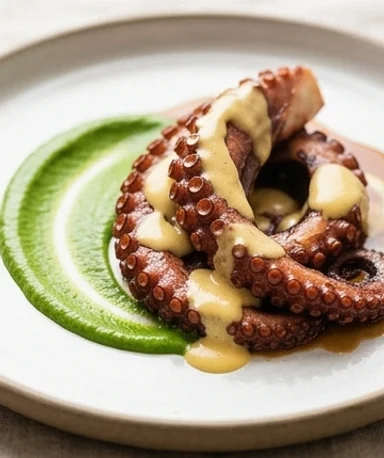
Pot-Roasted Octopus, Arugula Velvet, and Elderflower Vinegar Sabayon
French
Main Course
Octopus slowly braised in a Dutch oven until perfectly tender, served over a vibrant arugula velvet and topped with a floral elderflower vinegar sabayon. A gourmet dish that is much more accessible than it looks.
Ingredients
- 2 kg cleaned frozen octopus, thawed overnight in the refrigerator
- 3 tbsp olive oil (for searing)
- 2 (about 200g) carrots, peeled and cut into large chunks
- 1 (about 150g) parsnip, peeled and cut into large chunks
- 1 small (150g) raw beet, peeled and cut into wedges
- 150g celeriac, cut into large cubes
- 1 (100g) onion, roughly chopped
- 3 garlic cloves, crushed
- 2 sprigs fresh thyme
- 1 bay leaf
- 200 ml water
- 200g fresh arugula (peppery leaves preferred)
- 4 tbsp olive oil (for the velvet)
- 4 egg yolks, at room temperature
- 100 ml vegetable broth, reduced and concentrated
- 2 tbsp elderflower vinegar
- salt and freshly ground black pepper
Instructions
- 1Rinse the thawed octopus and dry it thoroughly with paper towels—it must be completely dry before searing.
- 2Heat a pot over high heat with the olive oil. Place the octopus in and sear for 3 minutes without touching, then flip only once: the surfaces should be dark bronze.
- 3Add the carrots, parsnip, beet, celeriac, onion, garlic, thyme, bay leaf, and 200 ml of water. Cover tightly and immediately lower the heat to minimum. Braise for 1h30 without opening.
- 4Remove the octopus and let it rest for 10 minutes on a cutting board. Strain the cooking liquid and reduce it over high heat for 10 minutes until syrupy.
- 5Blanch the arugula for 90 seconds in a large pot of boiling salted water, then immediately plunge it into a bowl of ice water. Drain and squeeze hard to remove all water.
- 6Blend the arugula with 4 tbsp of olive oil, a pinch of salt, and if needed 1 tbsp of cooking liquid, until you obtain a perfectly smooth and glossy velvet. Adjust seasoning.
- 7Make the sabayon: whisk the egg yolks continuously with the hot vegetable broth and elderflower vinegar in a bowl over a simmering bain-marie for about 8 minutes, until it reaches the ribbon stage. Remove from heat immediately.
- 8Slice the tentacles into generous sections. Plate: arugula velvet on the bottom, octopus on top, a few drops of reduced root juice, and a cloak of sabayon just before serving.
Notes
• Advance preparation: the braised octopus and arugula velvet can be prepared the day before. Reheat the octopus gently in its juice, and the velvet over very low heat while stirring. The sabayon is always made at the last minute.
• Storage: cooked octopus in its juice keeps for 2 days in the refrigerator. The arugula velvet keeps for 24h with plastic wrap pressed against the surface to prevent oxidation.
• If you cannot find elderflower vinegar, replace it with quality cider vinegar and a few drops of orange blossom water.
Nutrition Facts (per serving, estimated)
| 285 kcalCalories | 36gProtein | 6gCarbs | 12gFat |