📌 Pineapple Upside-Down Cake
Posted 31 March 2026 by: Admin
Pineapple upside-down cake is one of the rare desserts that justifies owning a cake pan. Not for big occasions — but for a Tuesday night when you crave something real. The kind of thing your grandmother used to make without trying to impress anyone, yet it impressed everyone anyway.
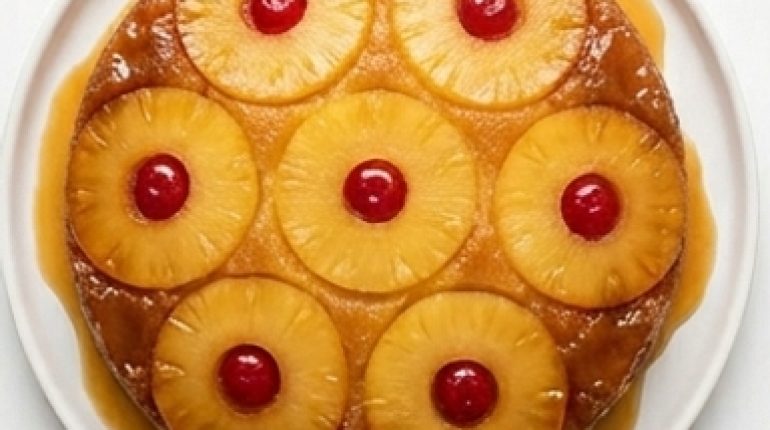
The first thing that hits you is the color. A deep amber, leaning towards russet, with the pineapple slices slightly translucent under the caramel layer — as if they were swimming in warm honey. When you press gently on the top of the cake, it barely yields under your finger, springy and melt-in-the-mouth. The scent rising is sweet without being cloying: slightly bold caramel, vanilla, and that fruity, tangy undertone of pineapple that balances everything out. The glacé cherries add pops of bright red color amidst all that amber light.
Why you’ll love this recipe
Ingredient Notes
All the pineapple upside-down cake ingredients gathered — nothing complicated, but the result is spectacular.
- Canned pineapple : Fresh pineapple is great at the market. Canned is perfect here — the slices are uniform, already tender, and you keep the juice for the batter. Choose ‘in natural juice’ rather than heavy syrup if you want to keep things balanced and not too sweet.
- Sugar for the caramel : Classic white sugar, nothing special. Dry caramel (without water) sets faster and gives a bolder, more fragrant result. If you’ve failed before, try with a tablespoon of water to have more control over the temperature rise.
- Softened butter : Softened means out for at least 30 minutes, not melted, not hard. If you press it with your finger, it should sink in without resistance. Butter that is still cold will give a grainy batter and a less melting crumb. This is the only real point of vigilance in this recipe.
- Glacé cherries : Not essential, but they are part of the tradition. They fit into the central hole of each slice and add a bright red dot to the amber caramel. You can find them in jars in the baking aisle of most supermarkets.
Take the butter out 30 minutes before starting
This is the only real prerequisite for this recipe, and we always forget it. Softened butter creams with the sugar and gives a tight, tender crumb that doesn’t crumble. If you forget and it comes out of the fridge hard, the batter will be dense and less pleasant. Thirty minutes at room temperature is enough. Use the time to measure your flour, get your eggs out, open the pineapple can, and prepare your pan — once the caramel starts, you won’t have time to look for anything.
Do not take your eyes off the caramel, even for thirty seconds
Pour the sugar into a heavy-bottomed saucepan, turn on medium heat, and wait. Do not stir — it would crystallize the sugar and you would get impossible-to-fix white lumps. However, watch it closely. The edges start to melt and brown first. Then, you can gently tilt the pan to homogenize the melting. The target color is a light amber, exactly like acacia honey — shiny, bright. Not dark brown. As soon as it’s there, pour directly into the pan without hesitation and tilt quickly to distribute before it sets.
Arrange the fruit while the caramel is still soft
Drain your pineapple slices and place them immediately on the still-hot caramel. One slice in the center, the others around it, adjusting them according to the pan size. The glacé cherries go in the holes. It’s not surgery — if a slice overlaps slightly, no one will know once the cake is flipped. Keep two to three tablespoons of the juice from the can in a bowl: it will flavor the batter and give it a particular melt-in-the-mouth texture you can’t get otherwise.
Pour the batter without disturbing the fruit
Cream the softened butter and sugar together until the mixture pales and becomes light, almost fluffy. Add the eggs one by one — not all together, otherwise the batter splits and becomes lumpy. Flour, baking powder, salt, vanilla sugar. The pineapple juice goes in last to loosen the whole thing. The final texture looks like a thick, smooth cream. Pour it over the fruit with a spatula starting from the center, gently, so as not to move the slices. Smooth the surface without pressing too hard.
Don’t touch anything else for 40 minutes
180°C, preferably conventional heat — fan heat sometimes dries out the top too quickly. Bake and let it do its thing. After 35 minutes, insert a knife in the center: it should come out clean. The top should be golden, well-risen, with the edges starting to pull away slightly. Let rest for 8 to 10 minutes before unmolding — no more, no less. This short rest allows the caramel to stabilize slightly without setting completely. Run a thin knife along the edges, place a large inverted plate over the pan, and flip with a decisive and quick motion.
Tips & Tricks
- If your caramel sets before you finish placing all the fruit, place the pan on very low heat for 10 seconds — it will soften without cooking further, and you can reposition what moved
- A 22 to 24 cm pan is the ideal size. Too small and the batter might overflow during baking, too large and the cake will be too flat and dry out faster
- The cake keeps very well in the fridge for 2 to 3 days well wrapped — 20 seconds in the microwave and it regains all its softness as if it were the first day
Can I use fresh pineapple instead of canned?
Yes, but the pineapple must be very ripe and sweet. Fresh pineapple contains an enzyme (bromelain) that can prevent the yeast from working well and make the batter slightly denser. If you use fresh pineapple, prepare a bit of pineapple juice separately (or replace it with milk) to flavor the batter.
My caramel burnt and became bitter — how do I avoid this?
Dry caramel goes very fast: as soon as it reaches a light amber color (like acacia honey), remove from the heat immediately. The residual heat of the pan continues to cook it for a few seconds. If you are a beginner, add a tablespoon of water to the sugar before heating — the temperature rise will be more gradual and easier to control.
Can the cake be prepared in advance?
Absolutely, it’s actually recommended. Prepared the day before and kept in the refrigerator, the caramel slightly rehydrates in contact with the pineapple and the cake becomes even tastier. Reheat each slice for 20 seconds in the microwave before serving to regain the freshness of the first day.
How do I prevent the cake from sticking to the pan when unmolding?
Two things: use a non-stick pan or grease the bottom generously before pouring the caramel. Then, respect the resting time of 8 to 10 minutes after taking it out of the oven — not too early (the caramel is still liquid and might run everywhere), nor too late (it cools and sticks to the bottom). Always run a thin knife along the edges before flipping.
Can I freeze this cake?
Yes, it freezes well, cut into individual portions in airtight bags. Thaw at room temperature for 2 hours or in the refrigerator overnight. The texture remains okay, although the caramel loses a bit of its shine.
What pan size should I use?
A round 22 to 24 cm pan is ideal for this amount of batter. Too small, the batter might overflow while rising. Too large, the cake will be too thin and cook too quickly, drying out. A high-sided pan (at least 5 cm) is preferable.
Pineapple Upside-Down Cake
French
Dessert
A moist and caramelized classic that always impresses when unmolded. Simple to make with pantry staples.
Ingredients
- 100g white sugar (for the caramel)
- 1 can (approx. 430g) pineapple slices in natural juice
- 8 to 10 glacé cherries
- 150g flour
- 120g white sugar (for the batter)
- 100g softened butter (taken out 30 min in advance)
- 3 eggs
- 1 sachet (11g) baking powder
- 1 sachet (8g) vanilla sugar
- 3 tablespoons pineapple juice (reserved from the can)
- 1 pinch salt
Instructions
- 1Preheat the oven to 180°C (conventional heat). Drain the pineapples, reserving 3 tablespoons of juice.
- 2Pour the 100g of sugar into a heavy-bottomed saucepan and melt over medium heat without stirring until you get a light amber caramel.
- 3Immediately pour the caramel into the bottom of a 22-24 cm round cake pan and tilt to spread it evenly.
- 4Arrange the pineapple slices on the still-soft caramel. Place a glacé cherry in the center of each slice.
- 5In a bowl, cream the softened butter with the 120g of sugar until the mixture whitens. Beat in the eggs one by one.
- 6Add the flour, baking powder, salt, and vanilla sugar. Mix, then stir in the pineapple juice to loosen the batter.
- 7Gently pour the batter over the fruit with a spatula. Smooth the surface.
- 8Bake for 35 to 40 minutes. Check for doneness with a knife: the blade should come out dry.
- 9Let rest for 8 to 10 minutes out of the oven. Run a knife along the edges, place a large plate on the pan, and flip with a quick motion.
Notes
• Storage: 1 day at room temperature under a dome, 2-3 days in the refrigerator well-wrapped. Reheat for 20 seconds in the microwave per portion.
• Variation: add 50g of shredded coconut to the batter for an exotic touch, or replace the pineapple with pear or peach slices.
• Make-ahead: the cake is even better the next day — the caramel slightly rehydrates in contact with the fruit.
Nutrition Facts (per serving, estimated)
| 315 kcalCalories | 5gProtein | 50gCarbs | 12gFat |