Mid-May, the first peas appear on the stalls. This is the exact moment this recipe makes sense — and not before. Pigeon with peas is a combination as old as French cuisine itself, the kind you used to see at grandmothers’ tables and now find in Michelin-starred restaurants.
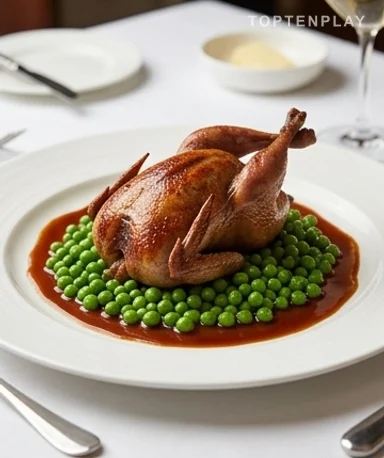
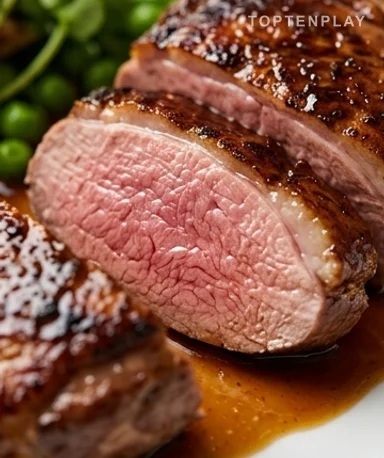
On the plate, it’s a very precise game of contrasts. The pigeon’s skin pulls toward a deep mahogany brown, as crisp as crumpled kraft paper. The sliced meat reveals a deep pink, almost ruby in the center, gently fading to amber-beige at the edges. The peas, a vivid green that hasn’t budged since shelling, bathe in a dark, glossy jus. And in the back of the kitchen, that concentrated poultry scent that has simmered for hours and sticks in the air long after the meal.
Why you’ll love this recipe
Ingredient Notes
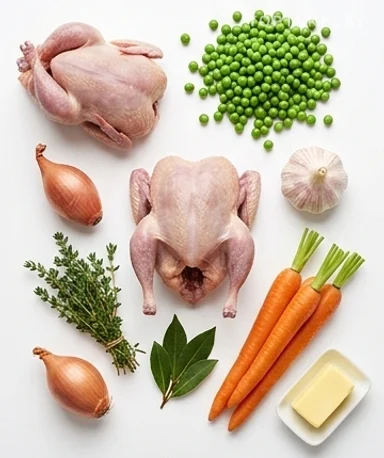
All ingredients gathered: whole pigeons, fresh shelled peas, aromatic vegetables, and herbs for a homemade broth.
- Pigeon : At the butcher or poultry shop, not in supermarkets. One 450 to 500g pigeon per person. The leg should be flexible, the skin without greenish spots. Ask for extra carcasses for the stock — most give them to you if you buy the whole birds.
- Peas : Fresh if it’s May or June, period. Otherwise Extra-Fine frozen — Bonduelle or Picard, nothing else. Canned peas are a no: they have the texture of a purée even before being cooked.
- Reduced poultry stock : Ideally made with roasted pigeon carcasses. If you don’t have time, take a good quality commercial veal stock and reduce it by half before using. A stock that is too liquid will yield a sauce without body or hold.
- Shallots : Two or three, finely sliced. They melt in the butter and bridge the gap between the jus and the vegetables. No onion here — too overpowering for meat as delicate as pigeon.
- Butter : To emulsify the sauce, it must come out of the fridge at the last moment, cut into small cold cubes. Warm butter won’t bind — it would separate immediately and you’d get a greasy, broken sauce.
Start the stock in the morning — it manages itself
The stock is the base of everything. Roast the pigeon carcasses in the oven at 200°C until they are well colored, almost brown, with that smell of caramelized meat starting to fill the room. Cover with cold water, add a carrot, a celery stalk, a few peppercorns, and a bay leaf. Let simmer for two hours. Then strain, return to medium heat, and reduce until you get a syrupy stock, slightly sticky on the edges of the pan — it should coat a spoon without running off immediately. Do not salt during reduction. You don’t yet know what concentration you’ll finish with.
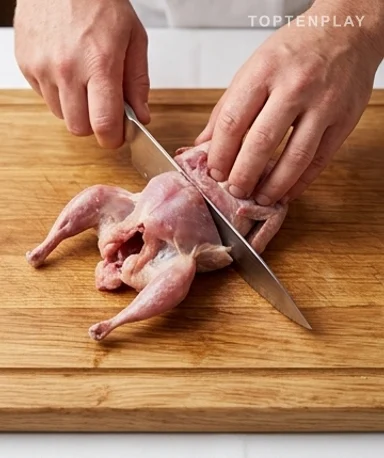
Take the pigeons out of the fridge an hour before
A cold pigeon in a hot pan cooks poorly. The outside burns before the inside has time to catch up. Take them out, dry them carefully with paper towels — the skin must be truly dry to the touch, almost tight. Salt generously on all sides at that moment, including the inside. The pepper, however, goes on just before the pan.
Sear over high heat and don’t open the oven for 8 minutes
Inox or cast iron pan, heated until white-hot with a drizzle of neutral oil. Place pigeons breast-side down first — an immediate, sharp, almost aggressive sizzle. That’s a good sign. Two minutes on each side to color, then turn on the back and transfer to a 200°C oven for exactly 8 minutes. No temptation to open. Upon exiting, the skin has the color of a light amber caramel, uniform over the entire surface. Rest the pigeons on a rack and let them rest for as long as they cooked — this is when the fibers relax and the juices redistribute toward the center.
Peas deserve 4 minutes — not one more
While the pigeons are resting, melt the shallots in butter over low heat. Translucent, melting, without coloring. Add the peas directly — fresh or still frozen, it doesn’t matter, the heat does it all. Four minutes over medium heat with a good ladle of stock. They must stay firm to the bite, with a green that holds. Off the heat, whisk in the cold butter cubes by swirling the pan — the jus gains brilliance, a slight viscosity that holds everything together. Taste, adjust salt. Slice the pigeons, plate, glaze.
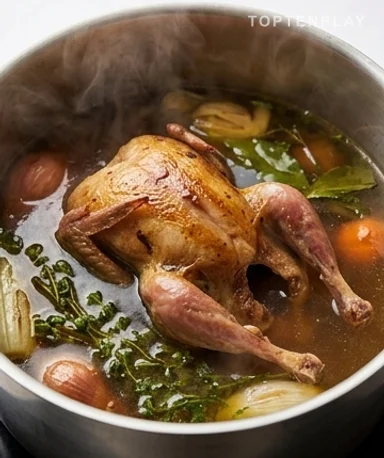
Tips & Tricks
- If you have a cooking probe, aim for 54°C at the core of the pigeon upon leaving the oven. At this temperature, the meat is still beautifully rosy — a few more degrees and it starts to dry out and lose all its appeal.
- Never salt the stock at the start of reduction. If you season it too early and it reduces by half, you end up with an inedible sauce. Always salt at the end, when the consistency is there.
- The stock can be made the day before and kept in the fridge. The fat rises to the surface and sets overnight — remove it before reheating; this lightens the sauce without losing the flavor.
Can I replace pigeon with another poultry?
Guinea fowl is the best substitute — same firm texture, same tendency to dry out if overcooked. Quail also works, but reduce the oven time to 5-6 minutes as they are smaller. Farmhouse chicken can work in a pinch, but the result is much less interesting: the meat is more neutral and the jus less robust.
How do I know if the pigeon is cooked to the right temperature?
With a meat probe, you aim for 54°C at the core for a rosy finish. Without a probe, press lightly on the breast with your finger: it should offer slight resistance but not be hard. If it bounces like rubber, it’s overcooked — the meat will be dry and cannot be saved.
Can I use frozen peas?
Yes, provided you get Extra-Fine ones — Bonduelle or Picard. Do not thaw them before putting them in the pan; add them directly frozen into the hot butter. They go from frozen to cooked in 4-5 minutes and keep their texture. Canned peas should be avoided: their soft texture cannot withstand cooking.
Can I prepare the stock in advance?
It’s even recommended. The stock keeps for 48 hours in the fridge and freezes perfectly in 200ml portions. The night before, once cooled, the fat rises and sets on the surface — remove it before reheating to lighten the sauce and clarify the flavor.
Where to buy pigeon?
At a butcher or a poultry specialist, not in a supermarket. Some covered markets offer them depending on the season. Order them in advance if possible and ask to keep the extra carcasses for the stock — most will gladly accept.
What is the most common mistake with this dish?
Cooking the pigeon for too long. This is by far the number one mistake. Past 60°C at the core, the meat turns gray, dry, and lose all its appeal. Pigeon should be eaten rosy — if it’s your first time and you’re worried, start with 7 minutes in the oven instead of 8 and probe before extending.
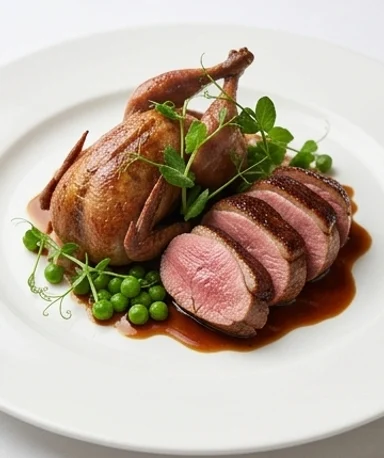
Pigeon with Peas like a Michelin-starred chef
French
Main course
Four rosy roasted pigeons, tender seasonal peas in a robust jus whisked with butter. A classic of French cuisine that impresses without requiring hours of active work.
Ingredients
- 4 whole pigeons (450-500g each), carcasses reserved
- 600g fresh shelled peas (or 400g frozen Extra-Fine)
- 3 shallots, finely sliced
- 80g unsalted butter (50g for the peas + 30g cold for mounting the sauce)
- 2 tbsp neutral oil (sunflower or grapeseed)
- 1 medium carrot (100g), cut into chunks
- 1 celery stalk
- 1 bay leaf
- 3 fresh thyme sprigs
- 1 tsp black peppercorns
- 1,2L cold water (for the stock)
- Fine salt and freshly ground black pepper
Instructions
- 1Preheat the oven to 200°C. Arrange the pigeon carcasses on a tray and roast for 20-25 min until brown.
- 2Transfer carcasses to a large pot. Cover with 1,2L cold water, add carrot, celery, bay leaf, thyme, and peppercorns.
- 3Bring to a boil, skim, then simmer over low heat for 2 hours. Strain the stock and return to the heat.
- 4Reduce the stock over medium heat until you have about 300ml of syrupy liquid that lightly coats a spoon. Set aside off the heat.
- 5Take pigeons out of the fridge 1 hour before cooking. Dry carefully with paper towels, salt generously on all sides.
- 6Heat a pan over very high heat with oil. Sear pigeons breast-side down for 2 minutes, then 2 minutes on the other side for uniform coloring.
- 7Turn pigeons onto their backs and bake at 200°C for 8 minutes. Do not open the oven.
- 8Remove pigeons, place on a rack, and let rest for 8 minutes at room temperature.
- 9During resting, melt 50g of butter in a pan over low heat. Sauté shallots for 3-4 min until translucent.
- 10Add peas and pour in 150ml of hot stock. Cook over medium heat for 4 minutes: peas should remain firm and green.
- 11Off the heat, stir in 30g of cold diced butter by swirling the pan. Adjust seasoning.
- 12Slice each pigeon in half lengthwise. Plate the halves, topping with peas and jus.
Notes
• The stock can be prepared the day before and kept for 48h in the fridge or frozen in portions. Solidified fat on the surface is easily removed before reheating.
• If you cannot find extra carcasses, use store-bought veal stock reduced by half — the result will be slightly less robust but perfectly fine.
• Leftovers keep for 24h in the fridge, but rosy meat loses quality upon reheating: better to adapt quantities to what you eat the same day.
Nutrition Facts (per serving, estimated)
| 580 kcalCalories | 50gProtein | 15gCarbs | 34gFat |