That smell drifting through the house—garlic, rosemary, warm beef—it’s the one that lets you know something great is happening in the oven. A boneless rib roast is the cut of meat that impresses without actually requiring hours of technique. Just quality beef, a good rub, and the patience not to open the oven door every five minutes.
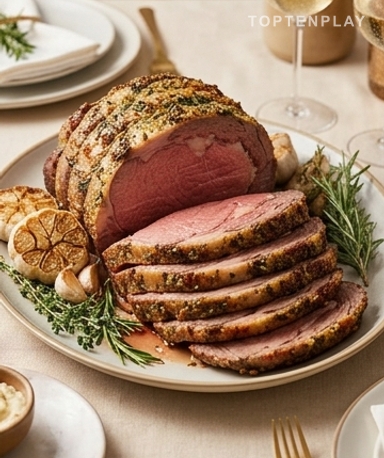
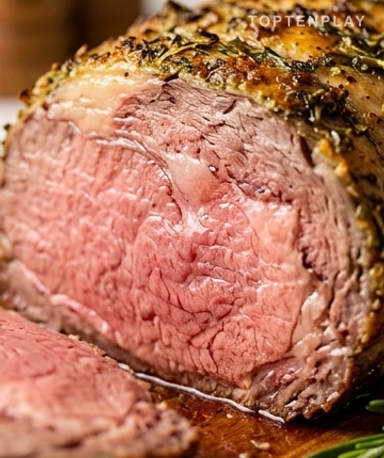
The crust is a deep caramel-brown, almost chocolatey in spots where the garlic and smoked paprika have caramelized against the oven’s heat. Inside, the slice reveals a gradient from bright pink in the center to lighter edges, and the ribeye fibers are so tender they barely yield under the knife. A thin film of juices glistens on the cut surface. The aroma blends slightly toasted rosemary on the surface with beef fat that has slowly melted in its own heat.
Why you’ll love this recipe
Ingredient Notes
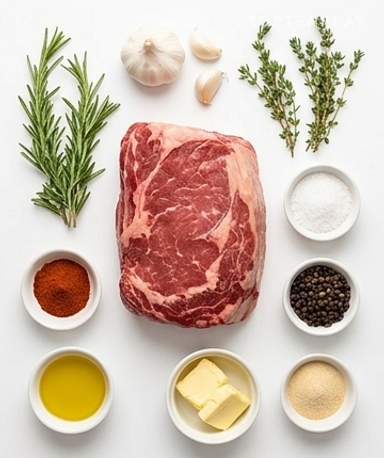
Fresh herbs, garlic, spices, and butter: the aromatic base that will elevate this beautiful beef roast.
- Boneless Rib Roast (1.8–2.3 kg) : Look for a well-marbled piece—those thin veins of white fat in the flesh are what melt during cooking and make the meat juicy. Ask your butcher for a ‘rolled ribeye’ or ‘boneless prime rib’. Avoid pieces that are too lean, as they will dry out.
- Fresh Rosemary : Dried rosemary doesn’t do the same thing here. Finely chopped fresh rosemary releases its oils into the rub and sticks to the meat’s surface. If you really only have dried, use half the amount.
- Smoked Paprika : Marked as optional in many recipes, but it’s what gives that deep red-brown tint to the crust and a slight smoky note on the palate. Regular sweet paprika won’t have the same effect.
- Softened Butter : It goes into the rub with the olive oil and helps the crust brown evenly. Take it out of the fridge an hour before—it should mash easily with a fork, not be completely melted.
- Garlic (4 cloves) : Finely minced by hand, not through a garlic press. The press releases too much juice and the garlic risks burning on the surface during the high-temperature phase. Finely chopped, it caramelizes properly.
Why take the meat out of the fridge an hour before (and not just 10 minutes)
Cold meat in a hot oven cooks unevenly—the edges cook fast while the center stays cold, like a block of ice melting from the outside. An hour at room temperature allows the whole piece to start from the same baseline. Place the roast on a board, cover lightly with a clean cloth. Touch the surface after an hour: it won’t be cold to the touch anymore, but cool and slightly damp. Many skip this step out of impatience, and they pay for it—a center that is still too raw when the outside is already perfect.
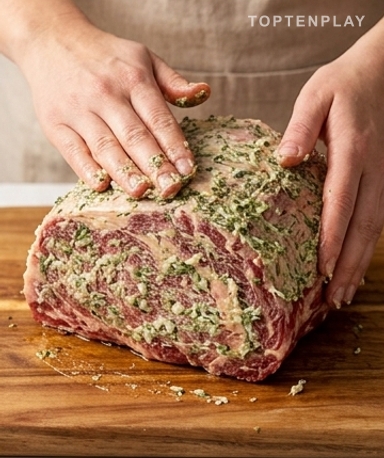
The rub: by hand, not with a brush
In a bowl, mix the olive oil, softened butter, minced garlic, salt, pepper, rosemary, thyme, smoked paprika, and onion powder. You’ll get a thick, grainy paste that immediately smells of Mediterranean herbs and raw garlic. Use your hands. Really. A brush leaves a layer that is too thin and uniform; your fingers massage the mixture into the natural crevices of the meat and ensure real adhesion. Cover every single side—top, bottom, both sides—until the surface is entirely coated in this dark paste.
The part everyone misses: the temperature ramp-up
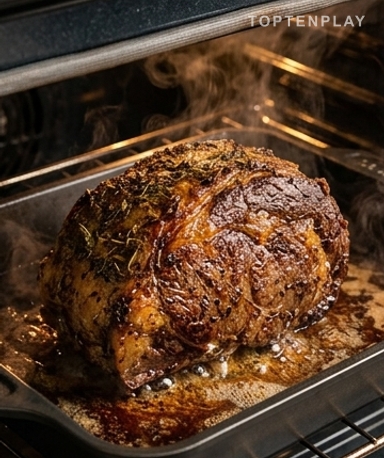
The oven starts at 230°C. Very hot, by design. The first 15 minutes at this temperature create the crust—that Maillard reaction which produces the dark caramel-brown color and roasted aromas we absolutely want to keep. Then, lower to 160°C and let the gentle heat finish the job without burning the herbs. A meat thermometer inserted into the center will tell you exactly where you are: 52–55°C for rare/medium-rare, 60°C for medium. Don’t trust time alone—ovens vary, cuts of meat vary, sizes vary.
Resting: the step everyone sabotages with impatience
Remove the roast from the oven and resist. Cover it with a sheet of foil and let it rest for 15 to 20 minutes on the board. During this time, the muscle fibers relax and the juices redistribute throughout the piece. If you slice too early, those juices escape onto the board and you lose exactly what makes the meat juicy. The crust stays crispy even under the foil. When you start slicing, the knife enters the flesh with a slight velvety resistance—neither rubbery nor soft—it’s the sign that the cook is perfect.
Tips & Tricks
- Use a probe thermometer—it is the only truly indispensable tool for this dish. 52°C at the center for rare/medium-rare, 60°C for medium. Times listed in any recipe are indicative, not guarantees.
- If you want pan juices, add a half-glass of beef broth to the bottom of the pan after the high-temperature phase. This prevents the drippings from burning and gives you a base for a simple sauce to spoon over.
- Prepare your rub the day before and rub the meat in the evening. A night in the fridge with the rub allows the flavors to penetrate deeper into the meat. Still take it out an hour before cooking—the two steps don’t cancel each other out.
How do I know if the roast is done without a thermometer?
Without a thermometer, it’s hard to be precise. As a general rule, allow 15 minutes per 500g after the initial 230°C phase, but ovens vary enormously. If you make this dish often, a probe thermometer costs less than 15€ and changes everything—it’s the only tool that gives you certainty.
Can I prepare the roast in advance?
Yes, and it’s actually recommended. Apply the rub the night before and leave the roast in the refrigerator overnight—the flavors will penetrate deeper into the meat. On the big day, take it out 1 hour before cooking as usual.
How to reheat leftovers without drying them out?
Place the slices in a dish with a splash of beef broth, cover with foil, and reheat at 120°C for 10 to 15 minutes. Avoid the microwave—it destroys the texture and makes the meat rubbery. Leftovers keep for 3 to 4 days in the refrigerator in an airtight container.
Should I baste the roast during cooking?
No. Ribeye is a cut well-marbled enough to be self-sufficient. Opening the oven regularly drops the temperature and extends the cooking time. Leave the oven alone after lowering to 160°C.
What cut should I use if I can’t find boneless rib roast?
A rolled striploin roast is the closest substitute. A rolled chuck roast also works, but requires longer cooking at a lower temperature (140°C) to be tender. Avoid tenderloin for this recipe—it’s too lean and dries out with this type of cooking.
What side dishes go well with this roast?
Roasted potatoes cooked in the oven at the same time as the roast (after lowering to 160°C) are the classic side. Homemade mash, caramelized root vegetables, or simple green beans sautéed with garlic work very well. Use the pan drippings to drizzle directly over the slices.
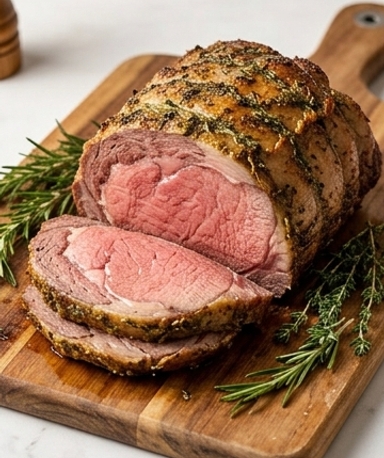
Oven-Roasted Boneless Rib Roast with Garlic and Fresh Herb Crust
American
Main course
A generous beef roast with a crust scented with garlic, rosemary, and thyme, cooked at high temperature for a beautiful caramelization and then slowly until a juicy pink center.
Ingredients
- 1.8–2.3 kg boneless rib roast (rolled striploin)
- 30 ml (2 tbsp) olive oil
- 30 g (2 tbsp) unsalted butter, softened
- 4 cloves garlic, finely minced
- 10 g (2 tsp) kosher salt (or fine salt)
- 3 g (1 tsp) freshly ground black pepper
- 5 g (1 tbsp) fresh rosemary, finely chopped
- 5 g (1 tbsp) fresh thyme, leaves removed
- 3 g (1 tsp) smoked paprika
- 3 g (1 tsp) onion powder
Instructions
- 1Remove the roast from the refrigerator 1 hour before cooking and let it rest at room temperature, lightly covered with a cloth.
- 2Preheat the oven to 230°C (fan or conventional).
- 3In a bowl, mix the olive oil, softened butter, minced garlic, salt, pepper, rosemary, thyme, smoked paprika, and onion powder until a homogeneous paste is formed.
- 4Generously rub the mixture over all sides of the roast, massaging well to make the paste adhere.
- 5Place the roast in a baking dish, fat side up, and bake at 230°C for 15 minutes to form the crust.
- 6Lower the temperature to 160°C and continue cooking for 1h to 1h15 depending on the size of the roast and the desired doneness.
- 7Check the internal temperature with a probe: 52–55°C for rare/medium-rare, 58–60°C for medium.
- 8Remove the roast from the oven, cover with aluminum foil, and let it rest for 15 to 20 minutes before slicing and serving.
Notes
• Make ahead: apply the rub the day before and leave the roast in the fridge overnight. The flavors will penetrate deeper. Take out 1 hour before cooking as usual.
• Storage: leftovers keep for 3 to 4 days in the refrigerator in an airtight container. Reheat at 120°C with a splash of beef broth in the bottom of the dish, covered with foil.
• Pan juices: add 120 ml of beef broth to the bottom of the dish after the initial 230°C phase to collect a natural sauce to drizzle over the slices.
Nutrition Facts (per serving, estimated)
| 500 kcalCalories | 48gProtein | 2gCarbs | 34gFat |