There are desserts we forget because they seem too simple. And then, one Sunday, we make them again — and wonder why we ever stopped. This orange semolina cake is one of those.
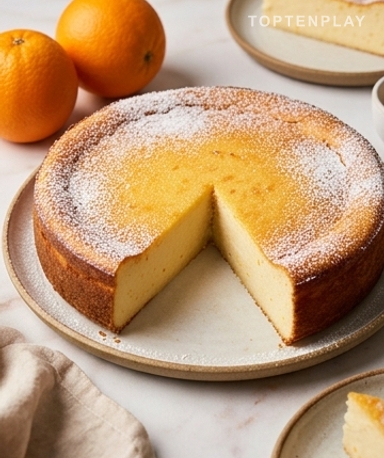
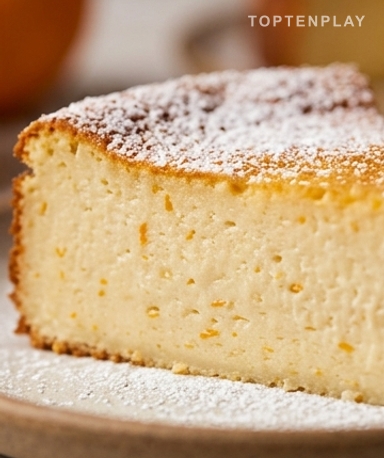
Sitting on the table, it doesn’t look like much. A slightly domed surface, ivory cream in color, with a few Flecks of orange zest peaking through here and there. You slice into it. The blade sinks in without resistance into a texture that holds — not firm, not soft — somewhere between a flan and a cake. And then the scent that rises, that mixture of vanilla milk and lightly sweetened citrus, reminds you of something. A childhood kitchen, perhaps. Or just a Sunday where you decided to slow down.
Why you’ll love this recipe
Ingredient Notes
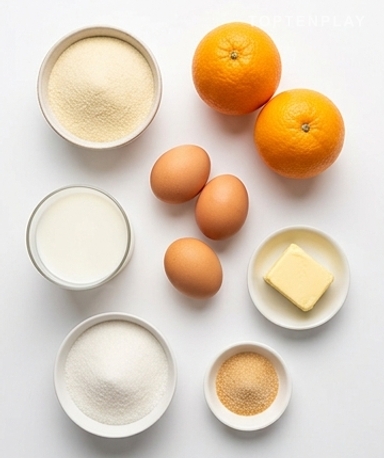
A few pantry ingredients — fine semolina, fresh oranges, eggs, and milk — for a dessert that really impresses.
- Fine semolina : It really must be the fine kind — not medium, not coarse. It melts into the hot milk and creates a smooth, almost creamy texture. With coarser semolina, you get something grainy that resembles sweet polenta. Not unpleasant, but it’s a different dessert.
- Fresh oranges : Two oranges, and we use everything: the zest and the juice. Use untreated oranges if possible — especially for the zest, as that’s where the essential oils that give the fragrance are concentrated. Bottled juice won’t do the job. A basic supermarket orange works very well as long as it’s fresh.
- Whole milk : Whole milk provides creaminess. Semi-skimmed works too, but the result will be slightly less creamy. This is one of the rare cases where this difference is truly felt in the final texture.
- Vanilla sugar : One packet is subtle — almost imperceptible on its own. But it rounds out the acidity of the orange and complements the regular sugar without imposing. If you don’t have any, half a teaspoon of pure vanilla extract does exactly the same job.
The milk base — don’t rush things
This is a weekend recipe, so don’t hurry. In the saucepan, the milk gently rises with the sugar, vanilla sugar, butter, and a pinch of salt. We are looking for the moment just before boiling: the surface begins to quiver, small bubbles appear on the edges, a light steam rises. No more. The butter melts leaving small shiny circles on the surface. When everything is homogeneous and hot, we’re ready. If the milk boils hard, it’s not a disaster — but a violent rise makes it boil over, and that takes an eternity to clean.
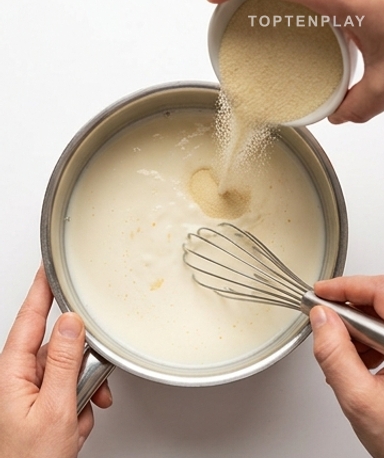
Why I pour the semolina in a steady stream
This is where it all happens. We lower the heat and pour the semolina in a thin stream with one hand, while the other whisks without stopping. All at once, lumps are guaranteed — and they won’t break down. In a stream, the semolina incorporates gradually and swells gently. In 3 to 4 minutes over low heat, the mixture goes from liquid to something thick, almost sticky, that catches slightly on the bottom if you stop stirring. You have to stay there. Then come the juice and the zest. The smell that rises at that moment — warm, slightly caramelized citrus — is quite striking.
The part everyone gets wrong: the eggs
The mixture must cool down before adding the eggs. This is non-negotiable. If the semolina is still very hot, the eggs cook on contact and you end up with white filaments in the preparation — it’s unpalatable. So we let it rest for 5 to 10 minutes off the heat. Beat the eggs separately in a bowl just to mix them; no need to whip them into a foam. Then pour them in a stream while stirring the mixture quickly. They provide hold without weighing it down — that’s what gives the cake that structure that slices cleanly but remains melting on the tongue.
Cooling — the thing we always wrongly skip
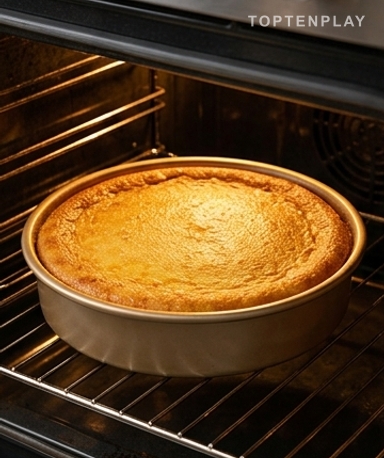
Thirty minutes in the oven at 180°C. The top takes on a golden color like light caramel, with a slight crackling around the edges of the mold. The center should remain soft when gently shaken — it will firm up as it cools, which is normal. Take the cake out, let it return to room temperature, then into the fridge for at least one hour. Two is better. Six is perfect. In the refrigerator, the texture changes completely: it becomes denser, more homogeneous, more melting. The warm cake is good. The cold cake is truly great.
Tips & Tricks
- Use fresh oranges, period. Bottled juice lacks the essential oils of the zest and you can tell in the final scent — it remains flat, without that citrus zing that makes the difference.
- For the zest, stop before the white pith. It’s bitter and ruins everything. A microplane does this perfectly in 30 seconds. Without a zester, the fine side of a classic grater works too — you just have to go slowly.
- Prepare it the day before. Really. Resting overnight in the fridge transforms the texture — firmer and more melting at the same time. That’s when it reaches its peak.
How to store the orange semolina cake?
It can be kept for up to 3 days in the refrigerator, covered with plastic wrap or in an airtight container. Do not leave it at room temperature for more than 2 hours — it contains eggs and milk.
Why does my cake stay too soft after baking?
It’s often a matter of patience. The cake comes out of the oven still soft — this is normal. It firms up as it cools, and even more so after 1 to 2 hours in the refrigerator. If after all that it’s still too runny, the semolina probably didn’t cook long enough in the milk.
How to avoid lumps in the semolina?
The key is to pour the semolina in a fine stream without stopping whisking. Never all at once. If lumps still form, a quick whisking off the heat is usually enough to dissolve them as long as the semolina is still hot.
Can I replace the oranges with another citrus fruit?
Yes, lemon works very well for a more acidic version. Tangerine gives a softer and sweeter result. You can also do half orange and half lemon for more complexity. The quantities of juice remain the same.
Can I use vegetable milk?
Yes, oat milk or soy milk give good results — they have enough body to replace whole milk. Almond milk, being lighter, may make the texture slightly less creamy but remains acceptable.
Can it be prepared in advance?
It is actually recommended. Prepared the day before and left overnight in the refrigerator, the cake is truly at its best: the texture is more melting, the orange scents more intense. It holds up very well for 24 to 48 hours in the fridge.
Orange Semolina Cake
French
Dessert
A melting and aromatic dessert, halfway between a flan and a pudding. Simple to prepare, economical, and even better when made the day before.
Ingredients
- 120g fine semolina
- 500ml whole milk
- 2 untreated oranges (juice + zest)
- 50g granulated sugar
- 2 eggs
- 1 packet (7g) vanilla sugar
- 15g butter (+ a bit for the mold)
- 1 pinch salt
- Icing sugar, flaked almonds or cinnamon for serving (optional)
Instructions
- 1Preheat the oven to 180°C. Lightly grease the mold.
- 2Wash the oranges, finely grate the zest avoiding the white pith, then squeeze the juice. Set aside.
- 3In a saucepan, heat the milk with the sugar, vanilla sugar, butter, and salt over medium heat until simmering. Do not let boil.
- 4Pour the semolina in a fine stream while whisking constantly. Cook over low heat for 3 to 4 minutes, stirring until the mixture thickens and becomes creamy.
- 5Off the heat, stir in the orange juice and zest. Mix and let cool for 8 to 10 minutes.
- 6Beat the eggs in a bowl. Pour them in a stream into the lukewarm mixture while mixing quickly.
- 7Pour the preparation into the greased mold and smooth the surface with a spatula.
- 8Bake for 30 minutes until the top is golden like light caramel. The center should remain slightly soft.
- 9Leave to cool at room temperature then refrigerate for at least 1 hour before serving.
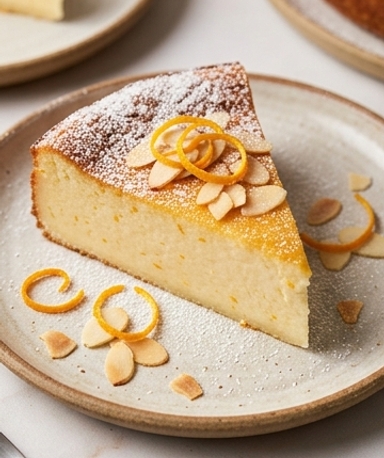
- 10When serving, sprinkle with icing sugar and decorate with some orange zest or toasted flaked almonds.
Notes
• The cake is significantly better prepared the day before — after a night in the refrigerator, the texture is more melting and the orange aromas more intense.
• Keeps for 3 days in the refrigerator, covered with plastic wrap.
• For individual portions, pour the preparation into greased ramekins and reduce the cooking time to 20-22 minutes.
Nutrition Facts (per serving, estimated)
| 180 kcalCalories | 6gProtein | 26gCarbs | 6gFat |