📌 No-Knead Artisan Bread with Rosemary and Garlic
Posted 29 March 2026 by: Admin
Everyone thinks that making your own bread requires a special technique. Arm strength, a stand mixer, years of practice. This rosemary and garlic bread proves the opposite: ten minutes of handling, a night of waiting, and you get something that looks exactly like what you’d buy at an artisan bakery.
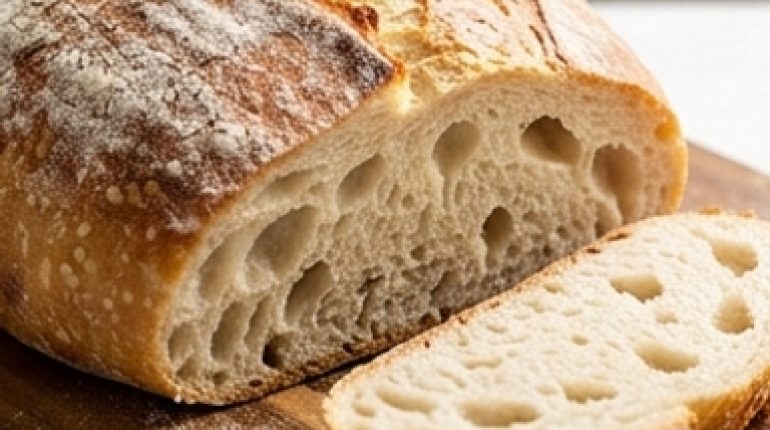
The crust is thick and crunchy, an amber brown leaning towards dark caramel — not the pale brown of a supermarket loaf, but the real deal. Underneath, the crumb is irregular, airy, slightly moist, and glossy. The scent mixes slightly toasted rosemary, garlic that has slow-cooked in the dough, and that warm yeast background that evokes a real bakery. You’ll want to cut a slice before it cools. Resist.
Why you’ll love this recipe
Ingredient Notes
Just six pantry staples are enough to get bread worthy of an artisan bakery.
- All-purpose flour : No need for special bread flour. Ordinary flour works very well for a long-fermentation dough. Just avoid self-rising flour — it will disrupt the balance of the recipe.
- Instant yeast : Only half a teaspoon, and that’s intentionally little. Less yeast plus more time equals more flavor. Instant yeast mixes directly with dry ingredients without prior rehydration — simpler than fresh yeast.
- Fresh garlic : Three cloves, finely minced. No powder, no granules — fresh garlic melts into the dough during fermentation and develops a sweet, almost candied taste without aggression. Garlic powder gives a pungent and slightly chemical aftertaste we don’t want here.
- Rosemary : Fresh or dried, both work. Fresh gives a brighter aroma with a slight lemony note. Dried is more concentrated — use half as much. In both cases, chop it roughly so the small pieces distribute well in the crumb.
Start the dough
In a large bowl, mix the flour, salt, yeast, garlic, and rosemary. All together, no special protocol. Add the warm water — about 38°C, the temperature of a child’s bath, no hotter — and the olive oil. Mix with a spoon or spatula until everything is incorporated. The dough will be sticky, lumpy, not smooth at all. That’s exactly how it should be. A smooth dough at this stage would mean too much flour, and you’d end up with a loaf dense as a brick. Cover the bowl with plastic wrap or an inverted plate and forget about it until the next day.
And now, patience
Between 12 and 18 hours at room temperature. Prepare the dough in the evening, bake the next morning — it’s the ideal rhythm. During this time, something discreet happens in the bowl: the flour proteins organize themselves without us touching anything, the gluten structures itself, and the yeast ferments slowly. The next day, the dough will have doubled in volume and its surface will be covered with small bubbles. It gives off a slightly acidic smell, a bit like pizza dough that has fermented well. That’s a good sign — that’s where the flavor is built.
The critical moment
Heat the oven to 230°C with the Dutch oven inside, lid included, for at least 30 minutes. Meanwhile, pour the dough onto a well-floured work surface. It will spread into a sticky, irregular mass — don’t try to control it. Fold the edges toward the center four or five times, flip the ball over and let it rest for 30 minutes on a sheet of parchment paper. When the Dutch oven is scorching hot, transfer the dough with the paper into the pot. Lid closed for 30 minutes, then uncovered for 15 minutes. It’s here, uncovered, that the crust goes from pale beige to that deep amber brown — and when you tap the bottom of the bread with your fingers, a clear hollow sound confirms it’s cooked.
Tips & Tricks
- Do not cut the bread hot straight out of the oven. Wait at least 20 minutes. The inside continues to cook with residual heat, and if you cut too early you will squash the crumb and lose all the airy structure we waited 12 hours to build.
- If you don’t have a cast iron Dutch oven, an oven-safe dish with a lid resistant to 230°C also works — pyrex, ceramic, whatever. What matters is the closed environment that traps steam for the first 30 minutes.
- The water temperature is the only technical point of this recipe. Above 45°C, the yeast dies and the bread won’t rise. Below 25°C, fermentation will be very slow. The wrist test is enough: lukewarm and comfortable, not hot.
Can I use fresh yeast instead of instant yeast?
Yes, but the quantities change. To replace ½ teaspoon of instant yeast, use about 1.5g of crumbled fresh yeast. Dissolve it in warm water before adding to the flour, unlike instant yeast which is mixed directly with dry ingredients.
I don’t have a cast iron Dutch oven. Can I still make this bread?
Yes. Any oven-safe dish with a lid resistant to 230°C works — pyrex dish, ceramic pot, stainless steel pot with lid. The key is to create a closed environment for the first 30 minutes to trap steam and achieve a beautiful crust.
How do I store this bread and how long does it last?
Wrapped in a clean kitchen towel at room temperature, it stays good for 2 to 3 days. Avoid airtight plastic bags which soften the crust. To reheat, 5 minutes at 180°C brings back all its crispness.
Can I leave the dough for longer, or prepare it in the refrigerator?
Yes, and it’s even recommended if you want more flavor. The dough can ferment up to 24 hours at room temperature, or up to 3 days in the refrigerator. Take it out 1 hour before baking so it comes back to temperature.
Why isn’t my crust crunchy?
Two frequent causes: the oven and the Dutch oven were not preheated enough — 30 minutes minimum at 230°C are really necessary. Or the bread was cut too early, before the internal steam could escape. Always wait at least 20 minutes after taking it out of the oven.
Can I freeze this bread?
Absolutely. Wait until it has completely cooled, slice it if you want, then freeze in an airtight bag. It keeps for up to 3 months. To thaw, put the slices directly in the toaster or the whole loaf for 10 minutes in a low oven (150°C).
No-Knead Artisan Bread with Rosemary and Garlic
Mediterranean
Baking
A rustic bread with a thick crust and airy crumb, prepared in 10 minutes of hands-on work. Long fermentation takes care of the rest.
Ingredients
- 360g (3 cups) all-purpose flour
- 355ml (1½ cups) warm water (about 38°C)
- 3 garlic cloves, finely minced
- 4g (2 tsp) chopped fresh rosemary (or 1 tsp dried rosemary)
- 5g (1 tsp) salt
- 2g (½ tsp) instant yeast
- 15ml (1 tbsp) olive oil (optional)
Instructions
- 1In a large bowl, mix the flour, salt, yeast, garlic, and rosemary.
- 2Add the warm water and olive oil. Mix with a spoon until you get a sticky and homogeneous dough — don’t try to make it smooth.
- 3Cover the bowl with plastic wrap or a plate. Let it rest for 12 to 18 hours at room temperature.
- 4Place the cast iron Dutch oven (with its lid) in the oven and preheat to 230°C for 30 minutes.
- 5Pour the dough onto a floured surface. Fold the edges toward the center 4 to 5 times, flip the ball over and let it rest for 30 minutes on parchment paper.
- 6Transfer the bread with the parchment paper into the scorching hot pot. Cover with the lid and bake for 30 minutes.
- 7Remove the lid and extend the baking for 12 to 15 minutes, until the crust is a deep amber brown.
- 8Take the bread out of the pot and let it cool for at least 20 minutes on a wire rack before cutting.
Notes
• Make ahead: the dough can ferment for up to 3 days in the refrigerator. Take it out 1 hour before baking.
• Storage: 2 to 3 days wrapped in a towel at room temperature. Can be frozen for up to 3 months once cooled.
• Variations: add 50g of pitted black olives, 30g of grated parmesan, or replace the rosemary with herbes de Provence for different flavors.
Nutrition Facts (per serving, estimated)
| 185 kcalCalories | 5gProtein | 36gCarbs | 2gFat |