📌 Mysterious everyday objects: why these ancient utensils fascinate so much on social networks
Posted 13 February 2026 by: Admin
The Enigma Of Unknown Objects: Why Our Brain Goes Into Overdrive
Why does a simple unknown object trigger such collective fascination? The answer lies in our neurological wiring. From childhood, our brain is programmed to categorize our environment. When an object refuses to fit into our mental schemas, it instantly activates our problem-solving system, generating an irrepressible curiosity.
This mechanism goes beyond simple personal questioning. Platforms like Reddit r/whatisthisthing have thousands of users mobilized to decipher these everyday enigmas. Each participant instinctively analyzes the shape, material, size, and context of use, transforming identification into a collective cognitive challenge.
This social dimension amplifies the appeal: solving together provides shared intellectual satisfaction. The mysterious object becomes a pretext for human connection, where everyone brings their expertise or hypotheses. Psychologists confirm that this collaborative quest meets a fundamental need for belonging and intellectual validation.
Social networks have transformed these isolated questions into viral phenomena. A simple snapshot of an unknown device can generate hundreds of theories in a few hours, some rational, others completely far-fetched. This collective effervescence illustrates how our brain, faced with the unknown, prefers to invent extraordinary explanations rather than accept temporary ignorance.
The Buttonhook: When An Antique Object Becomes A Modern Enigma
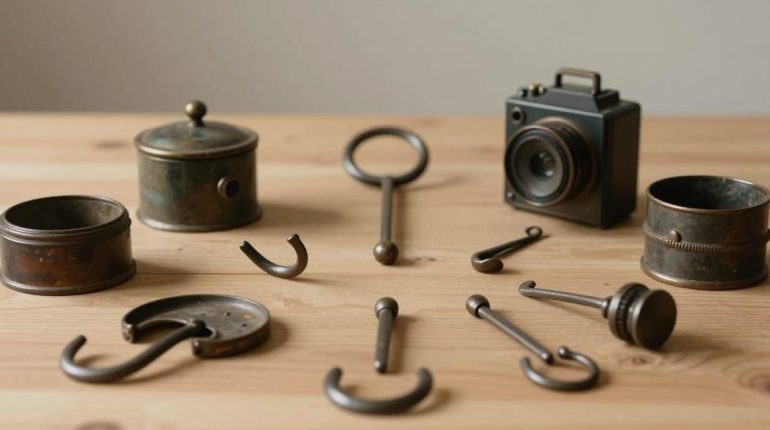
Among the objects that have ignited identification forums, a small rusty metal device with a curved hook particularly disoriented internet users. Hypotheses flew: medieval torture instrument, alien tool, or even an archaic medical accessory. The collective imagination ran wild in the face of this enigmatic shape that did not correspond to any contemporary referent.
The revelation surprised by its banality: it was a buttonhook, an essential everyday utensil before the invention of the zipper. This tool made it possible to slide small buttons into the tight eyelets of high shoes, leather gloves, or corsets, a task almost impossible to accomplish with fingers alone.
What appears today as a mysterious object was once present in every home. Victorian boots, for example, sometimes had twenty buttons that had to be fastened daily. Without this hook, getting dressed took a considerable amount of time.
This collective misunderstanding illustrates a fascinating reality: technological evolution erases the memory of objects. In a few generations, an omnipresent tool becomes totally incomprehensible. The buttonhook symbolizes these vestiges of daily life that bear witness to vanished practical constraints, made obsolete by successive innovations. Its current mystery measures the extent of the technological gap that separates us from our ancestors.
The Transparent Plastic Accessory: The Solution Was In The Kitchen
Another viral enigma: a transparent plastic object with several holes and an ergonomic handle. Speculations multiplied quickly. Unknown kitchen utensil? Accessory for artistic activities? Specialized scientific instrument? Internet users explored all leads, scrutinizing every detail to decipher its function.
The answer defied expectations: a corn stripper, designed to quickly remove kernels from the cob. This culinary gadget, however ingenious, remains invisible to those who have never faced the chore of manually stripping fresh cobs. The holes allow the kernels to slide through while the inner blade detaches them cleanly from the cob in a single movement.
Unlike the buttonhook, this tool does not belong to the past. It does indeed exist in our contemporary kitchens, but remains confined to such a specific use that many are unaware of its existence. Only lovers of fresh corn or cooks faced with large quantities of cobs discover its utility.
This case reveals a different truth: some modern objects remain mysterious not because of obsolescence, but because of ultra-specialization. In an era where most consume already stripped corn, the tool becomes superfluous. This stripper illustrates how our consumption patterns dictate the visibility of the objects around us.
The Sculpted Wooden Cylinder: When Art Meets Utility
This modern culinary specialization contrasts with an object from the past that served precisely the opposite: transforming a mundane product into a decorative work. A hollow wooden cylinder, equipped with a small handle, deeply intrigued observers. Folk musical instrument? Handcrafted candle mold? Ancestral exercise equipment? Hypotheses flew in all directions.
The truth revealed an antique butter mold, used to shape butter into decorative patterns intended to embellish tables. At a time when culinary presentation testified to social status and domestic refinement, these molds carved flowers, animals, or geometric patterns into the fat. Each family had its own designs, transforming a daily food item into an aesthetic element.
This cylinder embodied a philosophy opposite to our industrial era: valuing craftsmanship and the appearance of the simplest products. Where we seek efficiency and standardization, our ancestors invested time and care in the beauty of every domestic detail. Butter, far from being an anonymous commodity wrapped in paper, became a visual signature.
The misunderstanding of this object measures the distance traveled. We have traded handcrafted ornament for practicality, sacrificing the time necessary for daily aesthetic rituals. This mold bears witness to a time when even the most ordinary gestures deserved an artistic touch, revealing how much our priorities have shifted toward pure utility.