📌 Meatloaf at €0.70 per person: the grated carrot technique to reduce meat without losing flavor
Posted 1 March 2026 by: Admin
The Family Meatloaf: An Economical And Timeless Classic
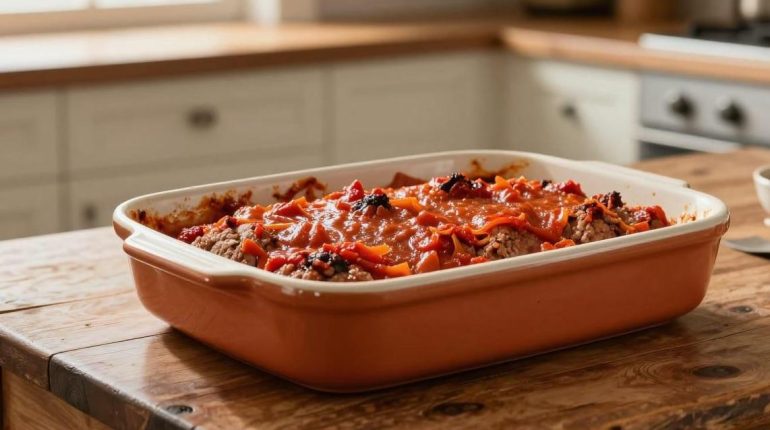
Some recipes cross decades without ever losing their relevance. Meatloaf with tomato sauce belongs to this rare category of dishes that combine financial accessibility with culinary generosity. For only €2.80, this traditional preparation feeds four people with formidable efficiency, without sacrificing flavor or satisfaction.
The strength of this dish lies in its disarming simplicity. Fifteen minutes of preparation are enough to assemble everyday ingredients: ground beef, basic vegetables, stale breadcrumbs, and plain tomato sauce. No exotic ingredients, no inaccessible techniques. Just precise gestures inherited from French family cooking, passed down from generation to generation.
What truly sets this recipe apart are the traditional tips that guarantee a moist and juicy result. The incorporation of finely grated vegetables and the protective coating of tomato sauce create a barrier against drying out, the bane of ground meat preparations. Stale bread soaked in milk acts as a natural binder, retaining moisture during the fifty-minute cooking time at 180°C.
In one hour and ten minutes from start to finish, this meatloaf transforms modest ingredients into a complete and comforting meal. A dish that proves economy rhymes perfectly with culinary quality, provided you master a few fundamental principles of texture and assembly.
The Art Of Mixing: Simple Ingredients For Maximum Tenderness
The secret to a successful meatloaf lies not in the quantity of meat, but in the intelligence of the assembly. The 500 grams of ground beef certainly constitute the protein base, but it is the complementary ingredients that transform this preparation into a truly moist dish.
Onion and carrot, grated with extreme fineness, play a decisive role. By melting during cooking, these vegetables release their moisture into the heart of the meat, creating a generous texture while allowing for a reduction in the proportion of animal flesh. This economical tip sacrifices nothing in taste: on the contrary, it enriches the aromatic palette while lowering the bill.
Stale breadcrumbs soaked in milk constitute the second pillar of this success. Far from being a simple filler, this natural binder captures and retains moisture throughout the cooking process. After two to three minutes of soaking and a vigorous mashing with a fork, this supple paste integrates perfectly into the preparation, creating a matrix that traps the juices.
The tomato sauce applied in a uniform layer before baking completes this anti-drying system. These 200 grams of plain puree form a protective barrier that preserves the tenderness of the surface, while providing that characteristic tangy note that balances the richness of the meat. Each element fulfills a precise function in this architecture of tenderness.
Preparation Technique: Precise Gestures For A Perfect Texture
The excellence of the final result depends less on the ingredients themselves than on the way they are worked. The ultra-fine grating of vegetables represents the first technical requirement: the more the carrot and onion are reduced to microscopic filaments, the more they disappear into the mass, providing moisture and flavor without creating unsightly lumps.
Soaking the stale bread also requires chronometric precision. Two to three minutes are enough for the crumb to absorb the liquid without completely falling apart. Mashing with a fork must produce a homogeneous paste, neither too liquid nor too compact, which will be evenly distributed throughout the preparation.
Manual mixing is the most delicate step. Contrary to intuition, over-kneading the meat hardens the muscle fibers and produces a rubbery texture. The hands should simply bring the elements together until a coherent mass is obtained, without overdoing it. This restraint guarantees the final tenderness.
Shaping into a compact loaf, smoothed by hand or with a spoon, promotes even cooking. The uniform coating of tomato sauce definitively seals the surface, creating that slightly caramelized crust that contrasts with the melting heart. These simple gestures, executed with precision, transform ordinary ingredients into a comforting dish with an irreproachable texture.
Mastered Cooking And Service: The Final Decisive Steps
Once the loaf is shaped and coated, the oven temperature at 180°C guarantees progressive cooking without brutality. Fifty minutes are enough, but the intervention halfway through proves decisive: basting the surface with the juices formed in the dish prevents drying and reinforces that subtle caramelization that marks success. This simple gesture, often neglected, makes the difference between a correct result and a truly moist dish.
The top should have a golden coloration slightly concentrated on the reliefs, while the heart remains tender and juicy. A knife inserted in the center should come out clean, a sign that the cooking has passed uniformly through the mass without drying out the edges.
The temptation to slice immediately after taking it out of the oven systematically compromises the presentation. The five minutes of rest allow the juices to redistribute into the fibers rather than flowing abruptly onto the cutting board. This minimal patience transforms an approximate cut into clean and appetizing slices.
The accompaniment determines the final balance of the meal. Homemade mashed potatoes deliciously absorb the tomato sauce, rice brings a welcome neutrality, while a green salad refreshes the palate. This economical meatloaf, through these final attentions, transcends its simplicity to become a moment of authentic comfort.