You know that late November afternoon vibe where no pizza or reheated leftovers quite hit the spot? Chicken with Maroilles is exactly the answer. It’s a dish from Northern France, generous by nature — and honestly, we’re not complaining.
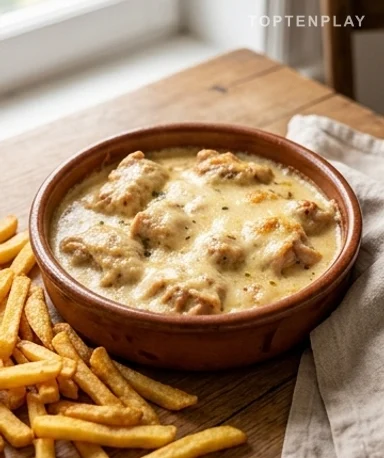
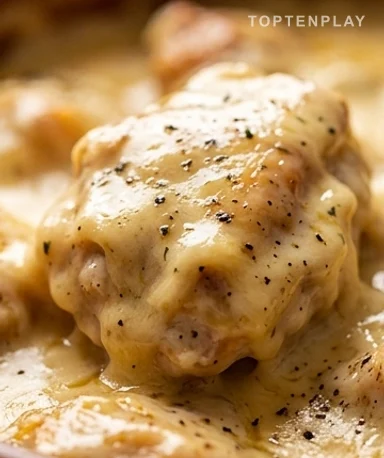
The sauce is an amber beige, almost caramel-like, glossy, coating every piece of chicken without drowning it. it releases a scent of matured cheese melted into cream, with that slightly pungent kick that tickles your nostrils even before the first bite. The fries are there on the side, still steaming. You dip a fork into the casserole and the sauce clings — truly bound, not liquid, velvety without being heavy.
Why you’ll love this recipe
Ingredient Notes
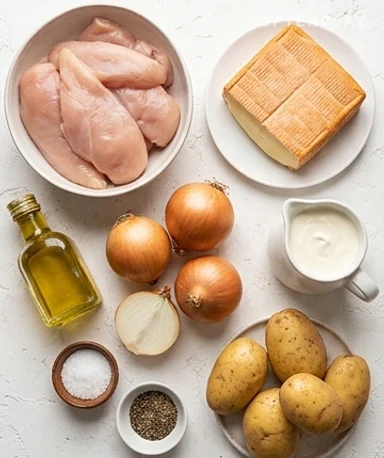
All ingredients gathered: chicken breasts, Maroilles, crème fraîche, onion, and potatoes for the fries.
- Maroilles : It’s the star of the show, so choose it well. The orange rind should be uniform, the cheese slightly flexible under your finger — too young and the sauce will be bland, too dry and it won’t melt properly. If you can’t find it, Époisses does the job: same aromatic profile, same behavior when cooked.
- Chicken Breasts : Get thick fillets, not thin cutlets that dry out in two minutes in the pan. Free-range if you can — the meat is firmer and holds up better in the sauce instead of falling apart into threads.
- Thick Crème Fraîche : Must be thick, not liquid. This is what gives the sauce its body. With liquid cream, you’ll get something that pools at the bottom of the dish rather than coating the chicken.
- Potatoes : Bintje or Agria, without exception. Firm-fleshed varieties like Charlotte produce soggy fries with a chalky center. Bintje is floury — exactly what’s needed for a melting interior and a truly crunchy crust.
Fries first — they take time
Start with the fries because they require a transition period between two frying stages. Peel the potatoes and cut them into even sticks — not too thin, or they’ll burn before being cooked through. Rinse them under cold water until it runs clear, then dry them very well with a tea towel. Water and hot oil are enemies. First fry at 160°C for five to six minutes: they should be cooked but still pale, with no color. Drain, spread on paper towels, and let cool completely. Twenty minutes minimum.
The chicken must sear, not just cook
Cut the fillets into decent-sized chunks — not too small, as they will simmer more later. In a very hot large skillet with a drizzle of oil, place the pieces and don’t touch them for two good minutes. You’ll hear the sharp sizzle against the hot cast iron and smell the searing meat. Flip them once you have a golden-brown crust like light caramel. Salt and pepper. Set aside on a plate — they aren’t fully cooked at this stage, and that’s intentional.
The sauce — low heat and patience
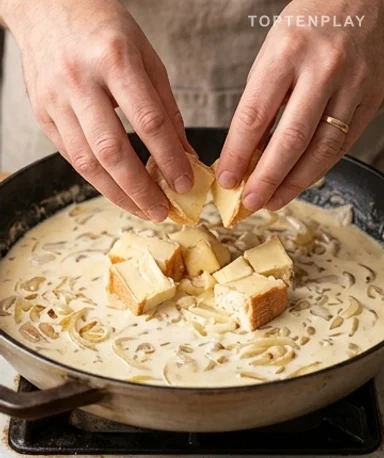
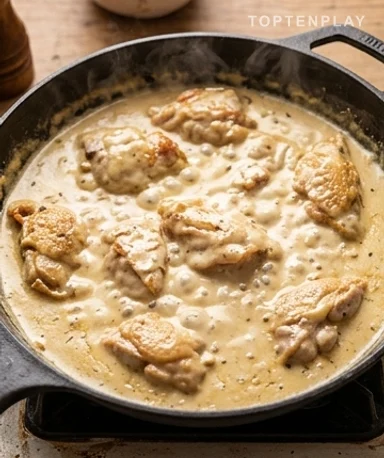
In the same pan, without cleaning it, toss in the sliced onions. The juices stuck to the bottom will deglaze into the onions and add extra depth to the sauce. Sauté over medium heat until translucent and lightly golden, about five minutes. Add the crème fraîche, then the Maroilles cut into small cubes. Low heat, stirring gently. The smell rising now is bold, don’t worry. The sauce becomes smooth, a slightly amber ivory cream color, and coats the back of a spoon. Add the chicken back in, cover, and let simmer for eight to ten minutes.
The second frying of the fries
While the chicken finishes simmering, plunge the fries back into oil heated to 180°C. The sound changes — sharper and higher than the first fry. Two to three minutes is enough. They come out golden, almost mahogany on the edges, and they crunch when placed on paper towels. Salt immediately after removing from the oil; the salt sticks better while they are still scorching hot. Serve right away.
Tips & Tricks
- Never let the Maroilles sauce boil vigorously. As soon as it really boils, the cream separates and you get a greasy puddle with lumps. Low heat from start to finish.
- The resting time between the two fryings is not optional. If you skip this step, they remain soft inside despite the golden crust. Prepare them in advance if needed.
- If your sauce is too thick, a spoonful of hot water is enough to loosen it. If it’s too liquid, remove the lid and reduce for two minutes over medium heat — it thickens up quickly.
Can I replace Maroilles with another cheese?
Yes, Époisses is the best substitute — same cooking behavior, same powerful aromatic profile that mellows in cream. A Munster also works very well. Avoid hard cheeses like Comté or Gruyère as they produce a less creamy and less distinctive sauce.
My sauce separated, what happened?
The heat was too high. Maroilles and crème fraîche dissociate as soon as it boils hard. To fix a grainy sauce, remove the pan from heat, add a tablespoon of cold water, and whisk vigorously — it often smooths back out. Then, use low heat and no lid until the end.
Why use double-frying for the fries?
The first fry at 160°C cooks the inside of the fry without coloring it. The second at 180°C creates the crispy crust. Without the rest time in between, internal moisture prevents the crust from forming properly — leaving the fries soft despite their golden color.
Can I prepare this dish in advance?
The Maroilles chicken can be prepared well in advance — it’s even better gently reheated the next day when flavors have melded. The fries, however, won’t wait: do the first fry in advance, then the second fry just before serving.
Can I cook the fries in the oven instead of oil?
Yes, but the result is different. Coat the sticks in oil and bake at 220°C, turning them halfway through. You’ll get something crispy on the surface but less melting inside than deep-frying. It’s a good alternative if you want to avoid dealing with a vat of oil.
How to store leftovers?
Chicken with Maroilles keeps for 2 days in the refrigerator in an airtight container. Reheat over very low heat with a lid, adding a little water if the sauce has thickened. Do not microwave — the sauce will separate and the chicken will toughen.
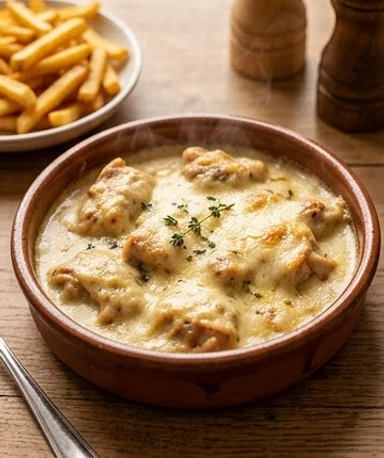
Maroilles Chicken Casseroles with Homemade Fries
French
Main course
Tender chicken simmered in a creamy Maroilles cheese sauce, served in casseroles with double-fried homemade fries. A comforting Northern French recipe in its simplest version.
Ingredients
- 600g chicken breasts (about 4 pieces)
- 200g Maroilles (or Époisses)
- 200ml thick crème fraîche
- 1 medium onion, finely sliced
- 1 tbsp sunflower oil
- 800g potatoes for frying (Bintje or Agria variety)
- 1 litre frying oil
- salt and black pepper
Instructions
- 1Peel the potatoes and cut them into regular sticks. Rinse in cold water until the water is clear, then dry thoroughly with a cloth.
- 2First frying: plunge the sticks into oil heated to 160°C for 5 to 6 minutes, without letting them color. Drain on paper towels and let cool for at least 20 minutes.
- 3Cut the chicken breasts into 4 to 5 cm chunks. Heat the oil in a large skillet over high heat.
- 4Brown the chicken pieces for 2 to 3 minutes without touching them, then flip until a uniform golden crust is formed. Season with salt and pepper, then set aside on a plate.
- 5In the same skillet over medium heat, sauté the sliced onion for 5 minutes until translucent and lightly golden.
- 6Add the crème fraîche, then the Maroilles cut into small cubes. Melt over low heat, stirring regularly until the sauce is smooth and homogeneous.
- 7Return the chicken pieces to the sauce. Cover and simmer for 8 to 10 minutes over low heat — do not boil.
- 8Second frying: plunge the cooled fries into oil at 180°C for 2 to 3 minutes until golden brown. Drain and salt immediately after removing from the oil.
- 9Divide the chicken and its sauce into individual casseroles. Serve with the hot fries.
Notes
• Maroilles chicken keeps for 2 days in the fridge and reheats over very low heat with a lid. Add a spoonful of water if the sauce has thickened.
• The first frying can be done several hours in advance. Keep at room temperature and only do the second frying just before serving.
• For a lighter sauce, use 15% fat crème fraîche — the sauce will be slightly thinner but just as tasty.
Nutrition Facts (per serving, estimated)
| 850 kcalCalories | 48gProtein | 42gCarbs | 53gFat |