Have you ever looked at your salad with that slight resignation, knowing that the dressing was either going to drown everything in oil or sting like pure vinegar? This yogurt sauce solves the problem in five minutes flat. No mystery, no complex technique — just the balance that most vinaigrettes miss.

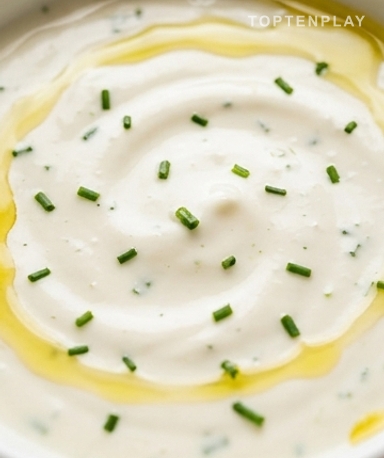
In the bowl, it’s an off-white, almost pearly color, slightly shiny where the olive oil still floats on the surface before being incorporated. The scent arrives in two stages: first the fresh, almost milky yogurt, then the sharp cut of the lemon. The texture sits somewhere between a cream and a dressing — it coats the back of a spoon without running off immediately. The little green dots of chive aren’t just for decoration.
Why you’ll love this recipe
Ingredient Notes

Only four ingredients are needed: plain yogurt, fresh lemon, olive oil, and Dijon mustard.
- Plain yogurt : The foundation. Avoid 0% fat yogurt — it makes the sauce too watery and slightly bitter on the palate. A classic whole milk yogurt or a low-fat Greek yogurt is what you need. If you only have fromage blanc on hand, that works too; the texture will just be a bit denser and less tangy.
- Fresh lemon : Must be fresh. Bottled juice has that metallic taste that you notice immediately in such a simple sauce. A direct squeeze from half a lemon, filtering the seeds with your fingers, is more than enough. Add gradually, as the acidity of yogurt varies by brand.
- Dijon mustard : This is what gives the sauce its kick. A basic supermarket mustard works just fine. What we often forget: it also acts as a natural emulsifier — it’s thanks to the mustard that the sauce stays bound and smooth rather than separating after two minutes.
- Olive oil : One spoonful, no more. It softens the lemon’s acidity and brings a subtle roundness to the palate that you wouldn’t expect until you taste it. No need for a premium oil here — your everyday bottle is perfect.
Why I never go without it anymore — even for a simple salad
There are recipes that become household staples. This sauce is one of them. At first, you bring it out for a big mixed salad, then for dipping carrot sticks on a busy evening, then to coat steamed potatoes on a Sunday lunch when you don’t feel like cooking anymore. The bowl always ends up empty. On the tongue, you first feel the sweetness of the yogurt, then a slight acidity, then that little spicy mustard aftertaste that discreetly settles in. It accompanies without ever overpowering what it touches.
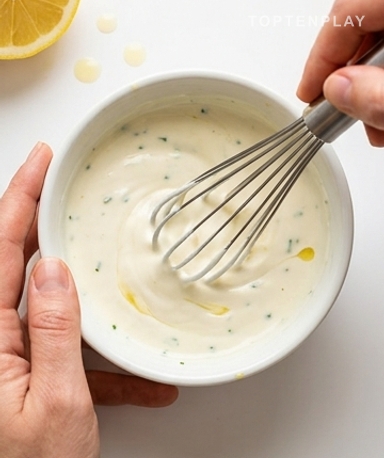
The part everyone gets wrong: the lemon-mustard balance
This is where most people give up too quickly. You mix, you taste, it seems too acidic — so you add yogurt. Then too bland — so you add lemon. And you end up with a liter of sauce for a salad for two. The right approach: add the lemon gradually, one spoonful at a time, tasting between each addition. The mustard should remain subtle — you shouldn’t identify it clearly, just feel it’s there, somewhere in the background, holding everything together. And when you whisk the mixture for thirty seconds, the texture changes visibly: it thickens slightly, taking on a silky appearance, almost like a lightly whipped cream.
Beyond the salad: unexpected uses
A dip for falafels, a sauce for grilled chicken wraps, the base for a crudité platter at happy hour. This sauce goes far beyond the simple role of a vinaigrette. On thinly sliced cucumbers with a few fresh mint leaves, it takes on an almost Mediterranean dimension. On warm steamed potatoes, it melts slightly on contact and permeates every bite with a tangy freshness that contrasts with the sweet starch of the potato. And on a bowl of roasted vegetables with slightly caramelized edges? It cools the whole dish down and balances everything with an unexpected milky sweetness.

Tips & Tricks
- Taste before serving and adjust the lemon based on your yogurt — brands really vary in acidity, and a sauce balanced with one might be too sharp with another.
- Really whisk it, with a real small whisk if you have one. Thirty seconds of effort visibly changes the texture: the sauce goes from ‘runny with lumps’ to ‘creamy and smooth’.
- Make a little more than necessary and keep it for a day or two in the fridge in a sealed jar — it improves slightly overnight as the flavors have time to meld together.
How long can this sauce be kept in the refrigerator?
The sauce keeps for 2 to 3 days in an airtight container in the refrigerator. It might separate slightly, which is completely normal — a quick whisk before serving will bring it back together.
Can I replace plain yogurt with Greek yogurt?
Yes, Greek yogurt creates a thicker and slightly creamier sauce. If the consistency is too dense, a teaspoon of cold water is enough to thin it out without altering the taste.
What should I do if the sauce is too thin?
This often happens with low-fat or very liquid yogurts. Next time, opt for a whole milk or Greek yogurt. In the meantime, let the sauce rest for 15 minutes in the fridge — it thickens naturally.
Can I prepare this sauce in advance?
It’s actually recommended. Prepared the day before, the flavors have time to meld and the sauce gains depth. Add fresh herbs only at the moment of serving so they retain their full aroma.
How can I customize this sauce for different dishes?
Add grated garlic and chives for raw vegetables, half a teaspoon of honey for a sweet and savory salad, or a pinch of mild curry to coat roasted vegetables. Each variation remains simple to make.
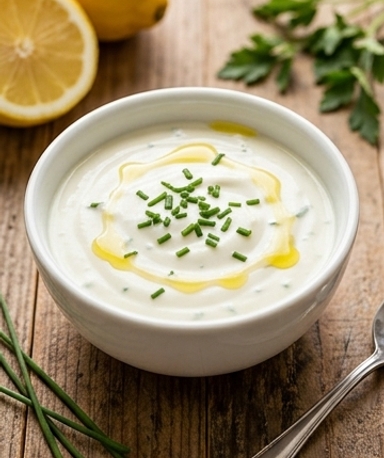
Light Yogurt Sauce
Mediterranean
Sauce
A creamy dressing made with plain yogurt, fresh lemon, and Dijon mustard. Fresh, light, and ready in 5 minutes.
Ingredients
- 60g (4 tbsp) plain whole milk yogurt
- 30ml (2 tbsp) fresh lemon juice
- 15ml (1 tbsp) olive oil
- 5g (1 tsp) Dijon mustard
- 1 pinch salt
- 1 pinch black pepper
- to taste chopped fresh chives or parsley (optional)
Instructions
- 1Pour the yogurt into a small bowl.
- 2Add the fresh lemon juice and Dijon mustard, then whisk vigorously for 30 seconds until the mixture is smooth.
- 3Incorporate the olive oil in a steady stream while continuing to mix.
- 4Season with salt and pepper, then add the chopped chives or parsley if desired.
- 5Let rest for 10 minutes in the refrigerator before serving to allow the flavors to develop.
Notes
• Storage: up to 3 days in a closed jar in the refrigerator. Mix again before serving.
• If the sauce is too thick, thin it with a teaspoon of cold water. If too thin, use Greek yogurt next time.
• Variations: half a clove of grated garlic for a garlicky version, half a teaspoon of honey for a sweet-savory touch, a pinch of mild curry to accompany roasted vegetables.
Nutrition Facts (per serving, estimated)
| 50 kcalCalories | 1gProtein | 2gCarbs | 4gFat |