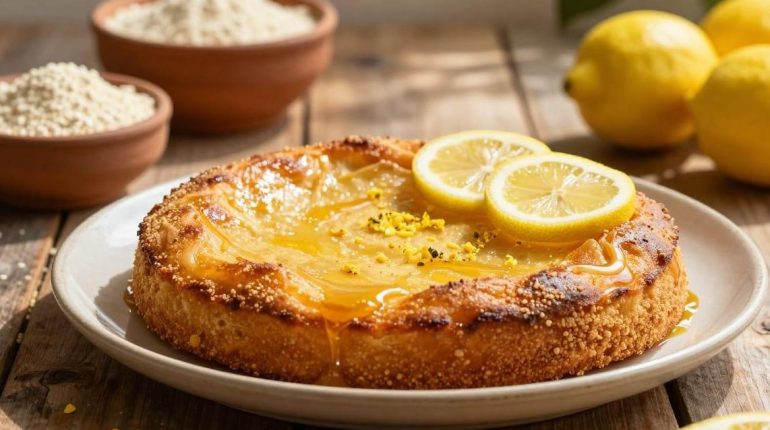
📌 Lemon semolina cake: the economical recipe that replaces flan and keeps for several days
Posted 27 March 2026 by: Admin
Introduction To Lemon Semolina Cake: An Accessible Mediterranean Dessert
Far from complex pastries that require technique and a significant budget, the lemon-scented semolina cake stands out as a revelation for cooks of all levels. This Mediterranean dessert, rooted in Eastern culinary traditions, combines three advantages rarely found together: disarmingly simple preparation, a very low cost, and a flavor that rivals the most elaborate creations.
Its peculiarity lies in its unique texture. Unlike classic flour-based cakes, semolina offers a consistency halfway between flan and cake, slightly grainy but remarkably soft. This distinctive characteristic intensifies when the cake is soaked in lemon syrup, becoming even more melting and indulgent.
Inspired by traditional basboussa, this dessert benefits here from a modernized approach that makes it accessible without altering its authenticity. Lemon zest brings a tangy freshness that perfectly balances the sweetness of the syrup, transforming every bite into a refreshing taste experience.
Ideal for accompanying a mint tea or ending a family meal, this cake proves that culinary excellence and accessibility are not incompatible. Its preparation requires neither rare ingredients nor specialized utensils, just basic products and an infallible technique that even novices can master. This combination explains why this dessert spans generations without ever losing its popularity.
The Step-By-Step Recipe: Technique And Ingredients For 6 To 8 People
This technical mastery begins with a precise assembly of simple ingredients. For 6 to 8 people, gather 200 g of fine semolina, 120 g of sugar, 100 ml of vegetable oil (or 100 g of melted butter), a 125 g plain yogurt, two eggs, a packet of baking powder, the zest of two lemons, and the juice of one lemon. The syrup requires 200 ml of water, 120 g of sugar, and the juice of an additional lemon.
The method is broken down into five rigorous chronological steps. First, whisk the eggs with the sugar until a light foam is obtained, then incorporate the yogurt and oil before adding the lemon juice and zest. The addition of semolina, baking powder, and a pinch of salt constitutes the second phase. Then comes a rest time of ten minutes, a crucial step often neglected but decisive: it allows the semolina to absorb the liquids and guarantees an optimal texture after baking.
Preheat the oven to 180°C before pouring the preparation into a buttered mold. Thirty to 35 minutes of baking are enough to obtain a golden surface. Meanwhile, prepare the syrup by bringing the water and sugar to a boil, then add the lemon juice.
The final soaking technique seals the success: pour the lukewarm syrup over the still-hot cake as soon as it comes out of the oven. This combination of temperatures promotes complete and homogeneous absorption. A minimum rest of one hour then transforms the preparation into a melting dessert, ready to reveal all its aromatic complexity.
Secrets Of Success And Gourmet Personalizations
Success relies on four non-negotiable technical principles. Always favor fine semolina over coarse to guarantee a homogeneous texture. Never skip the dough’s resting time: this hydration phase radically transforms the final structure. It is imperative to pour the syrup over a hot cake to maximize absorption, and adjust the amount of lemon according to your personal acidity threshold.
Chef’s tips elevate this base toward excellence. A spoonful of orange blossom water in the syrup instantly brings an authentic oriental dimension. Replace part of the semolina with almond powder to intensify the melting quality, or incorporate slivered almonds and coconut to create texture contrasts. A light lemon glaze offers a touch of visual and gustatory refinement.
Three variants allow the recipe to be adapted to all profiles. The coconut-lemon version integrates 50 g of grated coconut directly into the dough. The lemon-almond cake combines almond powder and a decoration of whole almonds for a richer result. For an egg-free alternative, substitute them with additional yogurt or condensed milk without altering the structure.
These personalizations transform a traditional recipe into a signature creation, while preserving the delicate balance between the characteristic grainy texture of semolina and the lemony freshness that defines this Mediterranean dessert.
Storage, Nutritional Values, And Tasting Moments
This culinary versatility is accompanied by remarkable storage flexibility. At room temperature, the cake keeps for two days without alteration of its soft texture. In the refrigerator, this duration extends to five days, during which the lemon syrup continues to progressively permeate the semolina. Freezing remains possible, ideally without the syrup to preserve structural integrity during thawing.
Nutritionally, each portion displays between 250 and 300 kcal, a reasonable range for a fragrant dessert. The macronutrient distribution reveals 35 to 40 g of carbohydrates, 10 to 15 g of lipids, and 5 to 7 g of protein, a balance consistent with Mediterranean pastry traditions favoring light satiety.
The presentation amplifies the visual appeal. Cut into regular squares or traditional diamonds to recall the oriental origin. Lemon zest delicately arranged on the surface immediately catches the eye, while a light dusting of icing sugar provides a professional finish. Serve accompanied by a mint tea to respect Mediterranean authenticity, or a spoonful of plain yogurt which tempers the lemon acidity.
This combination of storage practicality, measured nutritional balance, and targeted serving suggestions confirms the functional dimension of a dessert designed as much for daily moments of relaxation as for receptions where simple elegance makes an impression.