The smell arrives first. That scent of hot dough escaping from the oven, slightly milky, slightly caramelized — that’s what signals something exceptional is happening. Jordan Pond popovers are like nothing else in the world of baking.
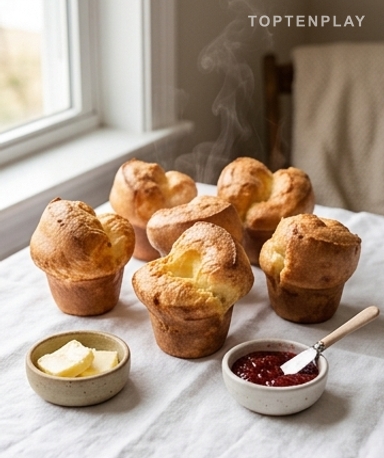
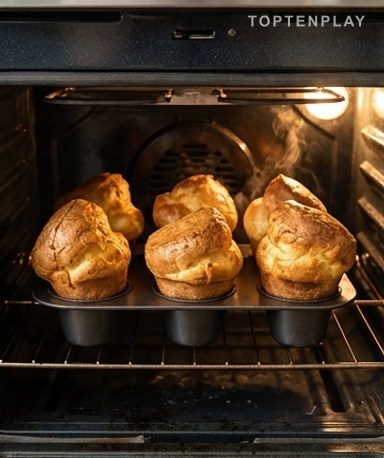
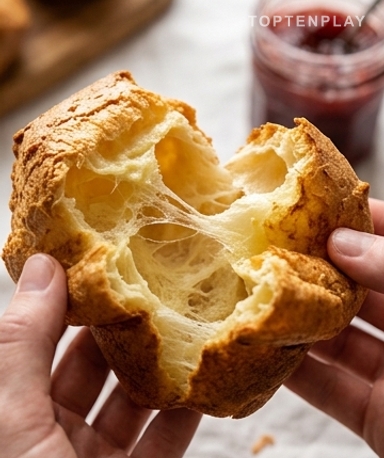
Before you, they stand ridiculously high. Well above the rim of the pan, bulging like giant light honey-colored mushrooms, with a crust that cracks when you press it with your fingertip. The inside is almost empty — just a network of baked dough filaments, light as tissue paper. All this volume was created by steam, nothing else.
Why you’ll love this recipe
Ingredient Notes
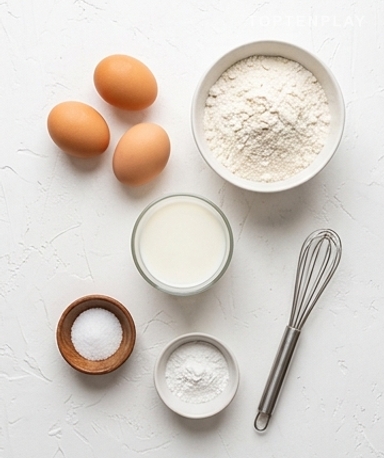
Just whole milk, eggs, flour, and a pinch of salt: proof that magic sometimes depends on very little.
- Whole milk : No semi-skimmed. The fat gives body to the batter and that slightly sweet milky undertone found in the crust. If you only have semi-skimmed, it will work, but the result will be a bit blander.
- All-purpose flour (T55) : Neither too strong nor too weak. Bread flour would make the popovers too elastic and tough. Cake flour would cause them to collapse. The one you have in your cupboard, the classic kind, is exactly what you need.
- Room temperature eggs : Taken from the fridge at the last moment, a cold egg weighs down the batter and slows the rise. Set them on the counter 30 minutes before starting — same logic as for a sponge cake.
- Baking powder : Just a small amount. It’s not there to do all the rising on its own — steam does 90% of the work — but it gives a boost at the very beginning of the bake.
Mix fast, rest long
It all starts in the blender. Heat the milk for two minutes in the microwave — it should be lukewarm, not hot, just pleasant to the touch. Add the eggs, flour, salt, and baking powder, then blend for 30 seconds. The batter is very liquid, almost like a thin crepe batter. Leave the blender on the counter and forget it for an hour. This rest is non-negotiable — it’s during this hour that the gluten relaxes and the batter reaches room temperature, two necessary conditions for the steam to do its job in the oven.
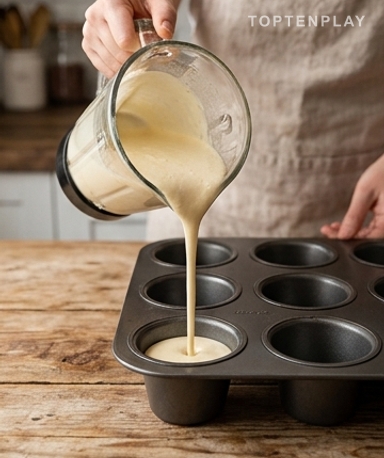
Preheat the pan — not just the oven
The oven goes up to 230°C, and your popover pan goes in empty. It might seem strange, but it’s the key to everything. When the cool batter hits the scorching metal, it seizes immediately on the walls and steam builds up inside, pushing the shell upward at full speed. Without this, popovers rise weakly and slump like socks. Grease generously — inside and out — because the batter often overflows onto the edges and burnt sugar is a pain to clean.
Don’t touch anything for 35 minutes
Fill each cavity four-fifths full. No more. Bake, close the oven, and don’t touch it. Fifteen minutes at 230°C, then lower to 190°C without opening the door — a cold draft is enough to ruin all the work. Another 17 to 20 minutes. The color you’re looking for: a golden brown leaning towards light caramel, uniform, with no pale spots on top. As soon as they come out, pierce each popover with a knife on the side — you’ll hear a little puff, confirming the inside is hollow.
Tips & Tricks
- Take the butter out 30 minutes before serving — popovers are piping hot out of the oven and softened butter melts instantly on the warm crust, which is much better than a cold block that resists.
- Weight the flour rather than measuring by volume: 5 grams too much and the batter becomes too dense to rise well. A scale solves this problem once and for all.
- Pierce each popover with the tip of a knife as soon as they come out of the oven — this releases the internal steam and prevents them from collapsing as they cool.
Why do my popovers collapse after baking?
The most common cause is opening the oven during baking — even a few seconds are enough to drop the temperature and make the popovers slump. The other possible reason: they haven’t baked long enough. A popover that is too pale inside doesn’t yet have a stiff enough crust to stand up.
Can I use a standard muffin tin instead of a popover pan?
Yes, but the result will be less spectacular. Popover pans have tall, narrow cavities that force the batter to rise vertically. With a muffin tin, the popovers will be shorter and wider. Preheat it empty in the oven anyway — it’s essential regardless of the pan.
Can I prepare the batter in advance?
Yes, and it’s actually convenient. The batter keeps for up to 24 hours in the refrigerator, well-covered. Take it out 30 minutes before baking so it returns to room temperature — batter that is too cold won’t rise properly in the oven.
How to store leftover popovers?
Honestly, they are meant to be eaten fresh from the oven. They soften quickly and lose all their crispness. If you have leftovers, keep them in an airtight container and reheat for 5 minutes at 190°C — they’ll regain some texture but will never equal the fresh-baked ones.
Can they be made in a savory version?
Absolutely. Add 30 to 40g of grated cheese (comté, emmental, parmesan) directly into the batter before resting, or stir in chopped fresh herbs. They then become a serious accompaniment for a soup or salad.
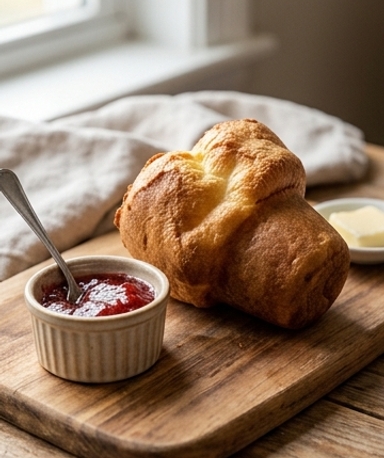
Jordan Pond Popovers
American
Breakfast / Brunch
Crispy American soufflés on the outside, hollow and airy on the inside. Five ingredients, zero complicated techniques.
Ingredients
- 240ml whole milk
- 2 room temperature eggs
- 125g all-purpose flour (T55)
- 1/4 c.c. baking powder
- 1/4 c.c. fine salt
- 1 c.s. neutral oil or melted butter (for the pan)
Instructions
- 1Heat the milk for 2 minutes in the microwave until lukewarm to the touch, not hot.
- 2Pour the milk, eggs, flour, salt, and baking powder into a blender. Blend for 30 seconds until a smooth and liquid batter is obtained.
- 3Let the batter rest at room temperature for 1 hour, uncovered.
- 4Preheat the oven to 230°C. Generously oil the popover pan (inside and out) and place it empty in the oven during preheating.
- 5Remove the hot pan from the oven and fill each cavity four-fifths full with batter.
- 6Bake for 15 minutes at 230°C without opening the oven.
- 7Lower the temperature to 190°C (without opening) and bake for another 17 to 20 minutes, until a golden brown color leaning towards light caramel.
- 8Remove from the oven and pierce each popover with the tip of a knife to release steam. Serve immediately.
Notes
• Popovers should be eaten within 10 minutes of leaving the oven — they soften quickly.
• The batter can be prepared up to 24h in advance and kept in the refrigerator. Take it out 30 minutes before baking.
• For a savory version, incorporate 35g of grated comté or emmental directly into the batter before resting.
Nutrition Facts (per serving, estimated)
| 125 kcalCalories | 5gProtein | 18gCarbs | 3gFat |