📌 Indoor plants: which home substances really heal them (and which ones kill them)
Posted 17 February 2026 by: Admin
Water and Coffee: What Your Plants Really Absorb
A tablespoon of water placed on the soil of your pot produces almost zero effect: the soil becomes moist on the surface, but the roots — located much deeper — receive no real benefit. This gesture, however well-intentioned, illustrates a reality often ignored: quantity matters as much as the substance.
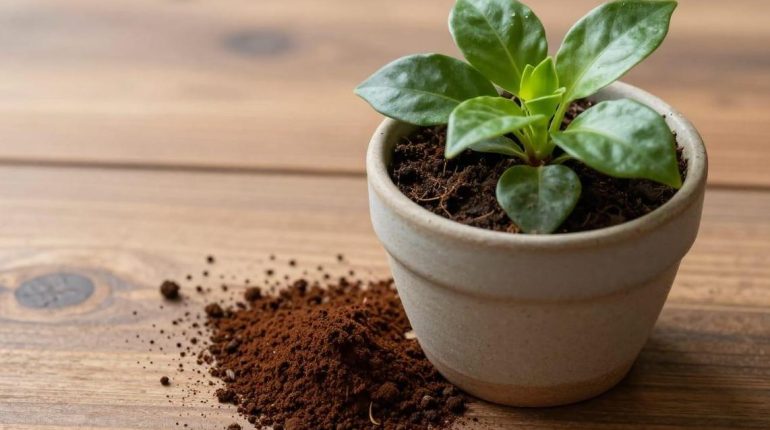
Coffee grounds, however, tell a different story. Rich in nitrogen, they constitute an effective natural amendment for acidophilic plants like azaleas or blueberries, provided the intake is strictly dosed. Moderate use enriches the soil structure and stimulates growth. This is where the delicate balance lies: these same grounds, applied in excess, cause the soil pH to drop to toxic levels for most indoor varieties.
The lesson to remember is paradoxical: a remedy can become a poison simply through accumulation. Coffee grounds do not act as a universal fertilizer and do not forgive excessive generosity. Before integrating these everyday substances into your maintenance routine, it is essential to understand their real mechanism of action — because some apparently harmless ingredients hide very real risks for the health of your plants.
Sugar and Soap: False Good Ideas to Absolutely Avoid
While coffee grounds illustrate the danger of excess, sugar poses a problem from the very first spoonful. Far from nourishing the plant, it attracts ants and other pests while promoting the development of mold in the soil. The result: a degraded root environment, prone to fungal diseases and infestations. Sugar simply has no place in plant care.
Diluted dish soap, on the other hand, deserves a nuance. In small quantities mixed with water, it constitutes an effective natural insecticide against aphids: its surfactant compounds disrupt their cell membrane and eliminate colonies without persistent chemical residue. A tempting solution — but one where the margins for error are narrow.
Because as soon as the concentration exceeds the tolerated threshold, soap ceases to be an ally. It clogs the leaf stomata, those micro-pores essential for the plant’s respiration, and reduces its ability to absorb light. What protects at a tiny dose poisons at an excessive dose: the mechanism is identical to that observed with coffee grounds, but its effects manifest directly on the foliage this time.
The common rule for these two substances remains the same: the effectiveness of a natural remedy depends entirely on its dosage. A logic that applies with even more precision to certain other everyday solutions.
Milk: An Unexpected Anti-Fungal Remedy, Under Certain Conditions
This logic of precise dosage reaches its most striking expression with milk — a substance that few gardeners think to take out of the refrigerator to treat their plants.
However, diluted in water, milk proves to be an effective natural fungicide against powdery mildew, that fungal infection recognizable by its white powdery deposit on the leaves. Its proteins and active compounds create a hostile environment for the development of fungi, allowing the treatment of weakened plants without resorting to chemicals. A use validated by several horticultural studies, and accessible enough to be adopted by any amateur gardener.
But the condition is strict: the milk must imperatively be diluted. Applied pure, it radically reverses its effects. The organic matter it contains then feeds bacteria rather than fighting them, leading to rapid microbial proliferation. The first signals of a wrong dosage are immediate: a persistent fermentation smell and a visible degradation of the plant’s general state.
Milk thus illustrates a central truth in the world of natural remedies: the effectiveness of a solution is measured as much by its formulation as by its ingredients. A distinction that certain other everyday substances — like Epsom salt, often mentioned but rarely well mastered — highlight even more.
Epsom Salt and Missing Substances: What the Article Doesn’t Say
Epsom salt, mentioned implicitly at the end of the previous part, embodies precisely this gray area between popular reputation and rigorous scientific validation.
Chemically known as magnesium sulfate, it is among the most cited natural remedies in amateur gardening circles — to stimulate growth, green the foliage, or strengthen roots. Reputed uses, but whose precise effects on your indoor plants deserve serious verification before any application. The source article mentions it without developing its properties, a gap that illustrates a broader phenomenon: the persistent gap between what circulates as practical advice and what is actually documented.
Several other common household substances also remain to be explored — vinegar, baking soda, wood ash — each carrying its share of supposed virtues and underestimated risks. Caution is systematically required before any experimentation on living plants, whose fragility can transform a benevolent gesture into irreversible damage.
What this exploration reveals, fundamentally, is a universal rule: every everyday substance can become an ally or enemy of your plants depending on its dosage, its dilution, and the context of application. Better an assumed incomplete information than an approximate advice applied without discernment.