Store-bought turtles are a bittersweet scam: too sweet, scrawny nuts, chocolate that tastes of grease. Homemade, with three good ingredients and twenty minutes of active work, they enter a completely different category — the kind you proudly give away or jealously hide in a corner of the kitchen.
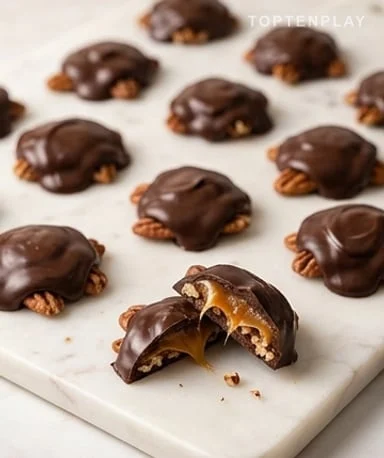
At room temperature, dark chocolate has a matte surface with a slight sheen on the edges, where it has embraced the caramel. When you bite into it, there’s first that clean snap, then the caramel that resists for a fraction of a second before giving way, slightly pulling between your teeth. The pecan adds a roasted bitterness that balances the sugar without overwhelming it. And the smell of hot caramel that lingers in the kitchen long after — that’s the real reward.
Why you’ll love this recipe
Ingredient Notes

Three ingredients, a stunning result: pecans, soft caramels, and dark chocolate.
- Pecans (whole halves) : The crunchy base that structures the candy. Whole halves are essential — broken pieces form clusters that are too compact and less pretty. Choose fresh ones: a rancid pecan is detectable by smell even before biting, and the flaw remains intact under the caramel and chocolate. A quick pass in the oven at 170°C for 8 minutes transforms them: deeper in flavor, crunchier once the chocolate hardens.
- Soft caramel candies (store-bought) : The smart shortcut in this recipe. Bagged soft caramels (like Werther’s Original Soft or equivalent) provide a reliable texture and pre-calibrated sweetness without having to watch a homemade caramel to the degree. Add a tablespoon of heavy cream when melting them: the caramel becomes more fluid to work with and stays soft once cooled, without hardening like a sole.
- Dark chocolate (60-70% cocoa) : It brings the snap to the bite and the bitterness that prevents the candy from being cloying. Avoid low-quality baking chocolate: it melts well but lacks character. A good couverture or a 70% supermarket bar makes a noticeable difference. Melt in a double boiler or microwave in 30-second bursts — never over direct high heat.
- Heavy cream (whole) : A small amount is enough to loosen the soft caramels when melting. Without it, the caramel becomes too thick and sets before you can coat the nuts. The fat in the heavy cream also ensures the caramel remains pliable at serving, even straight from the fridge.
- Fleur de sel : Optional in theory, hard to skip once you’ve tried. A pinch placed on the still-soft chocolate amplifies the caramel and highlights the nut. Fleur de sel is preferable to fine salt: its crystals sit on the surface and crunch lightly under the tooth, creating a contrast that dissolved salt doesn’t give.
Start with the nuts, not the caramel
Before touching caramel or chocolate, arrange your pecan clusters on a parchment-lined baking sheet. Three halves per cluster, in a Y shape: one at the top, two at the bottom, slightly spread to leave room for the caramel. This layout gives turtles their characteristic silhouette — like a little turtle with legs sticking out from under the chocolate shell. If you haven’t toasted your nuts yet, now’s the time: 8 minutes at 170°C, and you’ll take them out lightly golden with a buttery, nutty aroma rising from the oven. Let them cool completely before starting. A still-warm nut softens the caramel too quickly and prevents it from staying in place.

Melt the caramel without burning or hardening it
In a small heavy-bottomed saucepan, put your unwrapped soft caramels with a tablespoon of heavy cream. Low heat, no rush. The caramel melts slowly, taking on a smooth and shiny texture, and the cream incorporates in a few minutes of regular stirring. What you need to watch is the consistency: too runny, it will spread everywhere on the sheet and not stay on the nuts. Too thick, it will set before you can work it. The right stage is when a lifted spoon forms a thick ribbon that falls slowly — not a watery stream. Remove from heat as soon as you reach it, because the caramel continues to cook off the heat in a still-hot pan.
Spoon quickly and methodically
Work quickly: the caramel cools and thickens in minutes. Using a small spoon, drop a hazelnut-sized amount of caramel at the center of each nut cluster, where the three halves meet. Aim for a layer thick enough to cover the heart without overflowing onto the sheet — about a level teaspoon per turtle. If the caramel becomes too thick along the way, return the pan to very low heat for a few seconds while stirring. Then let the clusters rest at room temperature for 15 to 20 minutes, until the caramel is firm to the touch but still slightly tacky on the surface. This slight tackiness is precious: it will help the chocolate adhere perfectly rather than sliding off the sides.
Melted chocolate: a matter of coolness
Melt your chopped dark chocolate in a double boiler or in the microwave in 30-second bursts, stirring between each. The classic mistake: going too fast and ending up with grainy, dull chocolate — a sign it overheated or got moisture. Good melted chocolate is smooth, shiny, and flows in a steady stream from the spoon. Spoon a generous layer over each caramelized cluster, leaving the edges of the nuts slightly visible. That’s what gives the recognizable turtle effect, not a merely coated candy. If using fleur de sel, now is the time: a few crystals on the still-soft chocolate before it begins to set.
Let it set: the hardest part
At room temperature, the chocolate takes between 45 minutes and an hour to fully crystallize, depending on the room’s warmth. In the fridge, 20 minutes suffice, but the surface loses some shine. For really clean turtles when unmolding, wait until the top is matte and dry before lifting them with a spatula. The underside, where the caramel touched the parchment, will be slightly duller — that’s normal and doesn’t affect the taste. Store them flat in an airtight container, between layers of parchment paper to prevent sticking. They are at their best the next day, when all the layers have had time to stabilize and the flavors have melded.

Tips & Tricks
- Toast the pecans even if you’re in a hurry: raw nuts have a bland flavor and a soft texture that disappear under the caramel. Toasting takes 8 minutes and radically changes the final result — it’s the single step that truly makes the difference between a mediocre turtle and a memorable one.
- Never cover the caramel pan while melting: condensation creates water droplets that cause the sugar to crystallize and make the caramel grainy and irretrievable. Keep it uncovered, stir regularly, and keep the heat low.
- If your chocolate seizes — it suddenly becomes thick, dull, and lumpy — it has likely absorbed a tiny drop of water or overheated. Add a small spoon of warm cream and stir vigorously off the heat: it can sometimes rescue it, but not always.
- When gifting these candies, wait until they are completely set before handling or packaging. A still-soft turtle underneath will leave fingerprints in the caramel — a small detail, but on a gift platter, it shows.

Can I use homemade caramel instead of bagged caramels?
Yes, a butter caramel cooked to the soft caramel stage (about 118°C) works very well — let it cool before spooning over the nuts. Bagged caramels remain more practical for consistent results without a thermometer: they melt predictably and their texture is already calibrated to stay soft once cooled.
Which chocolate should I choose: dark, milk, or white?
Dark chocolate at 60-70% is the classic choice because its bitterness balances the caramel’s sweetness and prevents cloying. Milk chocolate also works, but the result is sweeter and less complex. White chocolate is possible for an original version, but its high sweetness then requires a good dose of fleur de sel at the end.
Can pecans be replaced with something else?
Whole cashews give a very good result: milder than pecans, they pair well with caramel. Whole almonds or hazelnuts work too, although the shape and texture change slightly. Avoid peanuts, whose too-strong flavor overpowers the caramel and chocolate.
Why did my chocolate suddenly become grainy and thick?
That’s called seizing: a tiny amount of water — steam, a damp utensil, or cream that’s too cold added too quickly — is enough to make it lumpy. To avoid it, ensure all your utensils are perfectly dry and melt the chocolate in short bursts at moderate power. If it happens, add a spoon of warm cream and stir vigorously off the heat — it can sometimes rescue it.
How long do these candies keep and how should I store them?
In an airtight container at cool room temperature (below 20°C), they keep for up to two weeks. In summer or a warm room, better to refrigerate them — take them out 10 minutes before serving to restore the ideal caramel texture. Layer parchment paper between stacks to prevent sticking.
Can I make them several days in advance?
It’s even recommended. The flavors meld better after 24 to 48 hours, and the caramel reaches an even more pleasant texture the day after making. For a holiday platter or a gift, prepare them two or three days ahead without any problem.
Homemade Turtle Candies: Pecans, Caramel, and Dark Chocolate
American
Confectionery
Homemade candies in three layers — toasted pecans, soft caramel, and crunchy dark chocolate — no thermometer or special technique needed. Perfect for gifting or satisfying a serious confectionery craving.
Ingredients
- 200g pecan halves (about 72 halves)
- 300g soft caramel candies (like Werther’s Original Soft)
- 2 tbsp heavy cream
- 200g dark chocolate (70% cocoa)
- 1 pinch fleur de sel (optional but recommended)
Instructions
- 1Preheat the oven to 170°C. Spread the pecan halves on a baking sheet and toast for 8 minutes, until lightly golden and fragrant. Let cool completely.
- 2Line one or two baking sheets with parchment paper. Arrange clusters of 3 pecan halves in a Y shape (one at the top, two at the bottom slightly spread), leaving about 4 cm between each cluster.
- 3In a small heavy-bottomed saucepan, melt the caramels with the heavy cream over low heat, stirring regularly, until smooth and flowing (5 to 7 minutes). Remove from heat as soon as the caramel forms a thick ribbon when falling from the spoon.
- 4Using a small spoon, drop about 1 teaspoon of melted caramel onto the center of each cluster, where the three halves meet. Work quickly before the caramel thickens. Let rest at room temperature for 20 minutes, until the caramel is firm to the touch.
- 5Melt the dark chocolate in a double boiler or microwave in 30-second bursts, stirring between each, until smooth and shiny.
- 6Spoon a generous layer of melted chocolate over each caramelized cluster, allowing the edges of the nuts to protrude slightly. Immediately sprinkle with a few fleur de sel crystals if desired.
- 7Let set at room temperature for 45 to 60 minutes (or 20 minutes in the fridge) until the chocolate is fully set and matte. Store in an airtight container between layers of parchment paper.
Notes
• Do not skip toasting the nuts: it adds depth to the final flavor and avoids a soft texture under the caramel.
• If the caramel thickens too quickly during spooning, return the pan to very low heat for a few seconds while stirring to loosen it.
• For an even cleaner result, refrigerate the turtles for 5 minutes before gently peeling them from the parchment with a thin spatula.
• These candies are better the next day, once all layers have stabilized and the flavors have melded.
Nutrition Facts (per serving, estimated)
| 130 kcalCalories | 2gProtein | 13gCarbs | 9gFat |