📌 Homemade tarama: the finger lime technique that transforms the classic recipe
Posted 25 December 2025 by: Admin
The Secrets Of An Authentic Homemade Tarama
The success of an artisanal tarama relies on precise movements, inherited from Mediterranean kitchens. The first decisive step: soaking the crustless breadcrumbs in milk. This immersion transforms the dense texture of the bread into a creamy base that will perfectly bind the entire preparation.
Extracting the cod roe requires meticulous attention. After opening the pouch, a methodical scraping with a spoon allows for the recovery of the precious orange eggs. The crucial gesture occurs here: totally eliminating the membrane that envelops the eggs. This thin film, often neglected by amateurs, releases an unpleasant bitterness capable of compromising the final taste balance. Professionals know: this step directly conditions the finesse on the palate.
The same rigor applies to the eggs from the cod pouch. Systematic scraping guarantees a complete harvest while discarding non-edible parts. These apparently simple gestures separate an ordinary tarama from a preparation worthy of the best tables. The perfectly smooth texture sought in this Mediterranean crema depends entirely on this meticulous selection of base ingredients. Once these pure elements are assembled, the true alchemy can begin.
Transformation Through Mixing: The Perfect Emulsion
Once the purified ingredients are assembled, the mixing stage orchestrates their metamorphosis into a velvety cream. In the chopper, cod roe, milk-soaked bread slices, lemon juice, and olive oil meet in a precise order. This choreography is not trivial: it conditions the success of the emulsion, the process that durably binds fats and liquids that are normally incompatible.
Lemon juice plays a strategic double role. It provides the necessary acidity to awaken the natural richness of the eggs, while acting as an emulsifying agent. The olive oil is incorporated gradually during mixing, creating that characteristic creamy texture that distinguishes a successful tarama from a simple egg paste. The chopper blades fragment and homogenize simultaneously, chasing away the slightest trace of granularity.
This lemon juice-olive oil combination constitutes the technical heart of the recipe. The acidity of the lemon stabilizes the emulsion while the oil provides the sought-after smoothness. Experienced cooks recognize the transformation by eye: the preparation changes from a heterogeneous mixture to a smooth and shiny mass, a sign that the molecules have perfectly bonded. At this stage, the classic base is complete, ready to receive the element that will propel it to another taste dimension.
Finger Lime: The Signature Ingredient That Changes Everything
While the classic emulsion is mastered, a rare citrus fruit makes its entrance to transcend the recipe. Finger lime, this Australian citrus fruit with a prohibitive price, contains translucent pearls that justify its presence in elite kitchens. Cutting it requires precision: a longitudinal section that exposes the interior without crushing the precious vesicles.
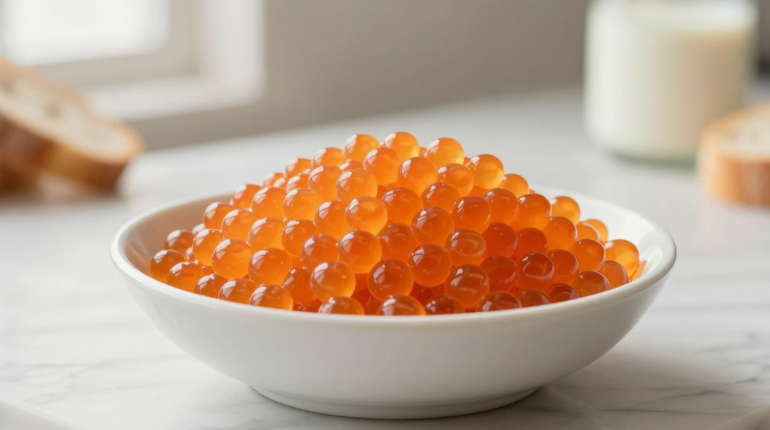
Extracting the pearls requires delicacy and method. The sharp blade of a knife slides along the internal membrane to release the acid capsules without breaking them. Each pearl measures a few millimeters and contains a concentrated juice that explodes under the tooth, creating that taste sensation so sought after by gastronomes. This crunchy texture contrasts radically with the creaminess of the tarama, transforming each bite into a layered sensory experience.
Final incorporation determines visual and taste success. The pearls join the creamy base through delicate mixing, preserving their structural integrity. Too much vigor would break them, diluting their impact in the mass. Correctly integrated, they dot the tarama with shiny points that visually announce the upcoming tangy explosions. This spectacular dimension elevates a traditional preparation toward haute gastronomy, while maintaining the Mediterranean soul of the original recipe.
Finishing And Storage For Optimal Results
Once the finger lime pearls are integrated, the final salt adjustment occurs as a decisive step. The rectification is done after incorporating the citrus, never before, because the pearls bring their own acidity which modifies the saline balance of the preparation. Tasting at this stage reveals if the base requires reinforcement or if the flavors are already harmoniously interacting. An excess of salt would mask the subtle notes of the finger lime, while a lack would leave the tarama bland despite the quality of the ingredients.
Mixing following this correction requires the same delicacy as the initial incorporation of the pearls. Slow circular movements, a flexible spoon that coats without crushing: each gesture preserves the integrity of the acid capsules. A metal spatula that is too rigid or energetic stirring would transform the signature texture into a simple lemon cream, destroying the sought-after effect.
Cold storage is required immediately after this finalization. The refrigerator firms the texture while allowing the flavors to fuse over several hours. This often-neglected step is nevertheless the secret of professionals: tarama tasted immediately lacks cohesion, while that rested for a minimum of two hours develops a remarkable depth of flavor. The finger lime pearls subtly infuse their acidity into the mass, creating that synergy that distinguishes an amateur preparation from a chef’s creation.