Planning to impress at the table this weekend but dreading spending the afternoon cooking? Homemade salmon terrine is exactly the kind of recipe to keep up your sleeve for such moments. Elegant on paper, surprisingly simple to make, and frankly better if you prepare it the day before.
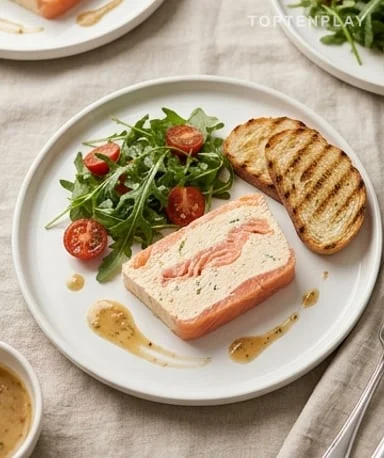
What strikes you first is that deep pink that streaks every slice — the pale flesh of fresh salmon against the intense ribbons of smoked. The texture is dense without being compact, almost velvety under the knife. When you open the fridge the next morning, a subtle marine and herbal aroma rises discreetly — the dill has had time to settle. Serve cold, and the first piece glides off the blade without crumbling.
Why you’ll love this recipe
Ingredient Notes

Fresh salmon, smoked salmon, eggs, crème fraîche, and dill: simple ingredients for an elegant result.
- Fresh salmon (500 g) : This is the base of the filling — it provides the melt-in-your-mouth texture and overall sweetness. Prefer a skinless fillet, easier to blend cleanly. Wild salmon, with leaner flesh, holds up better during cooking and gives a less moist terrine; farmed salmon works too, but slightly reduce the cream if the flesh seems very fatty.
- Smoked salmon (200 g) : It plays two distinct roles: visual structure when sliced and depth of flavor. Cold smoking is much more delicate than hot smoking — read the label. Crucial point: smoked salmon already seasons the preparation during cooking. Only salt after tasting the raw filling, never by instinct.
- Liquid crème fraîche (20 cl / 200 ml) : It binds the filling and gives it that characteristic softness when eaten. Use a full-fat cream at least 30% fat — below that, the fat content is insufficient and the filling may separate during cooking, resulting in a grainy texture and water at the bottom of the mold. As a plant-based alternative, cooking soy cream holds up well.
- Eggs (3) : They coagulate and solidify everything with heat. Without eggs, the terrine won’t hold when unmolded. Three for 500 g of fish is the right ratio; beyond that, the texture becomes rubbery and loses the melt-in-your-mouth quality.
- Chopped dill (2 tbsp) : The dill-salmon pairing exists for good reason: its fresh, slightly aniseed herbal aroma cuts through the fish’s iodized and fatty notes. Fresh is noticeably better — dried dill works in a pinch but loses much of its liveliness. You can also add a small spoonful of grated lemon zest for a brighter note.
- Finely chopped shallot : It brings a slight aromatic pungency without dominating. Finely chopped, it blends completely into the filling when mixed — you don’t feel it in pieces, only in taste. Half a shallot is enough if you prefer a milder flavor; avoid yellow onion, which is too strong and masks the salmon.
The filling: quick to blend
Everything starts in the blender bowl. Cut the fresh salmon into coarse chunks — no need to be precise, they’ll be blended anyway. Add the eggs, crème fraîche, chopped shallot, lemon juice, and dill, then blend until smooth and slightly shiny, resembling a dense mousse of pale pink color. This is where you need to be careful with seasoning: taste the raw mixture and salt sparingly. The smoked salmon you’ll incorporate during assembly will add more salt during cooking — if you overdo it now, the final terrine will be too salty and nothing can fix that. A turn of the pepper mill, and the filling is ready. It should give off that fresh, herbal, slightly iodized scent that makes you want to dip a spoon in.

Layering the mold
Lightly butter the loaf pan — just enough so nothing sticks when unmolding, no need to coat generously. Then line the bottom and sides with half the smoked salmon slices, letting them slightly overhang the edges: they’ll form an envelope around the filling, making unmolding easier and giving that beautiful burgundy-pink exterior. Pour half the filling and gently press with a spatula to remove trapped air bubbles. Then arrange a regular layer of smoked salmon in the center — this is precisely the layer that will create the marbled effect when cut, that contrast between the two pinks. Cover with the remaining filling, finish with a few smoked salmon slices on top. Before cooking, it looks like a rather unglamorous sandwich — that changes completely once unmolded.
The water bath: not just a precaution
Place the terrine in a large baking dish and pour very hot water halfway up the mold. This setup is not a fussy chef’s precaution — it determines the final texture. The steam keeps the temperature around 80°C (176°F), preventing the filling from boiling. Without a water bath, the eggs coagulate too quickly, the terrine shrinks at the edges, releases water, and becomes grainy and dry. Bake at 160°C (320°F) for 45 to 50 minutes. To check doneness, insert a thin knife into the center: it should come out almost clean, and the surface should no longer wobble. Press lightly with your finger — it should be firm with a very slight residual spring. Remove the terrine from the water bath and let it cool completely to room temperature before refrigerating.
Resting: the step that changes everything
Once at room temperature, tightly cover the mold with plastic wrap and refrigerate for at least four hours — overnight is definitely better. Cold does two things simultaneously: it consolidates the terrine’s structure, making slicing clean and neat, and it allows the flavors to meld. The dill, lemon, smoke from the salmon, and the slight iodized scent of the filling balance during these resting hours. A terrine sliced too soon crumbles into irregular pieces and smells of hot cooking — not very appealing. The next day, when you lift the wrap, you’ll smell that fresh, marine, herbal fragrance — it’s the signal that the terrine is ready.
The sauce and plating
The lemon yogurt sauce is ready in two minutes and keeps for several days in a closed jar in the fridge. Mix a plain yogurt (avoid Greek, too thick — it weighs down the whole), the juice of half a lemon, and a few sprigs of chopped dill. It should be runny, slightly tart, not thick like cream: its bright and light character is the counterpoint to the terrine’s subtle richness. To unmold, run a thin knife along all four sides, then gently invert onto a cutting board. Slice with a large knife slightly dampened — water on the blade prevents the filling from sticking and ensures clean cuts that preserve the marbling. Two slices per plate, a spoonful of sauce alongside, a few rocket leaves and cucumber rounds: simple, clean, and speaks for itself.

Tips & Tricks
- Salt the filling after tasting it, never by instinct: smoked salmon releases salt during cooking, and an over-salted terrine can’t be saved once out of the oven.
- Lightly dampen the knife blade before each slice — this prevents the filling from sticking to the steel and preserves the marbling when serving.
- Avoid over-blending: a filling worked too much heats up in the bowl and can become elastic when cooked. A few short pulses are enough to achieve smoothness.
- Unmold just before serving, not in advance: exposed to air, the surface of the terrine dries out quickly and loses the slightly pearly sheen that makes it so elegant.

Can the terrine be prepared several days in advance?
Yes, and it’s even recommended. The terrine keeps for up to three days in the fridge, covered in its mold — flavors continue to develop on the second day. After that, the texture starts to degrade slightly on the surface.
How do I know when the terrine is fully cooked?
Insert a thin knife into the center: it should come out almost clean, without raw filling stuck to the blade. The surface should feel firm under light finger pressure, with a very slight residual spring — if it still wobbles, extend cooking by 10 minutes.
Can the salmon terrine be frozen?
Technically yes, but the texture changes after thawing: the filling loses some of its melt-in-your-mouth quality and may release a bit of water. If freezing, slice it and wrap individually, then thaw slowly in the fridge overnight.
The terrine won’t unmold cleanly — what to do?
Run a thin knife along all four sides, then briefly dip the bottom of the mold in hot water for 10 seconds before inverting. If you’ve lined it with smoked salmon, the terrine usually releases without resistance.
Can I substitute the smoked salmon with something else?
You can replace it with smoked trout slices for a milder flavor, or simply increase the amount of fresh salmon for a simpler monochrome terrine. However, smoked salmon provides natural seasoning and the visual structure when cutting — you’ll notice it in flavor if completely omitted.
The filling looks too liquid — is that normal?
Yes, the raw filling is naturally very soft, almost runny. The eggs coagulate with heat to solidify everything. Don’t be tempted to add starch or breadcrumbs — that would weigh down the final texture without solving anything.
Homemade Salmon Terrine
French
Starter
An elegant and uncomplicated cold starter: fresh salmon blended with cream and eggs, lined with smoked salmon slices for a natural marbled effect when cut. Prepare the day before, serve with a lemon yogurt sauce.
Ingredients
- 500g fresh skinless salmon, cut into pieces
- 200g smoked salmon slices
- 3 eggs
- 20cl full-fat liquid crème fraîche (30% min)
- 1 finely chopped shallot
- 1 tbsp fresh lemon juice
- 2 tbsp fresh chopped dill
- salt and freshly ground black pepper
- butter for the mold
- 1 plain yogurt (for sauce)
- juice of half a lemon (for sauce)
- a few sprigs of dill (for sauce)
Instructions
- 1Preheat the oven to 160°C (320°F). Bring water to a boil for the water bath.
- 2Place the fresh salmon, eggs, crème fraîche, shallot, lemon juice, and dill in a blender. Pulse until smooth and homogeneous. Taste and season lightly with salt — the smoked salmon will add extra salt during cooking.
- 3Lightly butter a loaf pan. Line the bottom and sides with half the smoked salmon slices, letting them slightly overhang.
- 4Pour half the filling into the mold. Gently press with a spatula to remove air bubbles. Arrange a regular layer of smoked salmon in the center, then cover with the remaining filling. Finish with a few smoked salmon slices on top.
- 5Place the mold in a large baking dish. Pour boiling water into the dish until it reaches halfway up the mold. Bake for 45–50 minutes, until a knife inserted into the center comes out almost clean and the surface is firm.
- 6Remove the terrine from the water bath and let it cool completely to room temperature. Tightly cover with plastic wrap and refrigerate for at least 4 hours, ideally overnight.
- 7Prepare the sauce by mixing the yogurt, lemon juice, chopped dill, salt, and pepper. Refrigerate until serving.
- 8When ready to serve, run a thin knife along the sides of the mold and invert the terrine onto a cutting board. Slice with a slightly dampened knife. Serve with the yogurt sauce, arugula, and toasted bread.
Notes
• Only salt after tasting the raw filling: the smoked salmon gradually seasons the preparation during cooking, and an over-salted terrine cannot be fixed.
• An overnight chill gives noticeably better results than a 4-hour rest — the flavors meld and the texture firms perfectly.
• For neat presentation, dampen the knife blade before each slice to preserve the marbling and ensure clean cuts.
• The terrine keeps for 3 days in the fridge, covered in its mold. It can be frozen in individual slices, but the texture loses some of its tenderness after thawing.
Nutrition Facts (per serving, estimated)
| 278 kcalCalories | 23gProtein | 1gCarbs | 20gFat |