📌 Homemade Rocher cream: 3 ingredients and 2 hours for a dessert worthy of a chocolatier
Posted 13 March 2026 by: Admin
The Genesis of an Accessible Gourmet Dessert
Three ingredients. Ten minutes of preparation. A dessert that impresses as much as a complex pastry creation. The Rocher cream defies conventions: it proves that elegance and simplicity are never opposites.
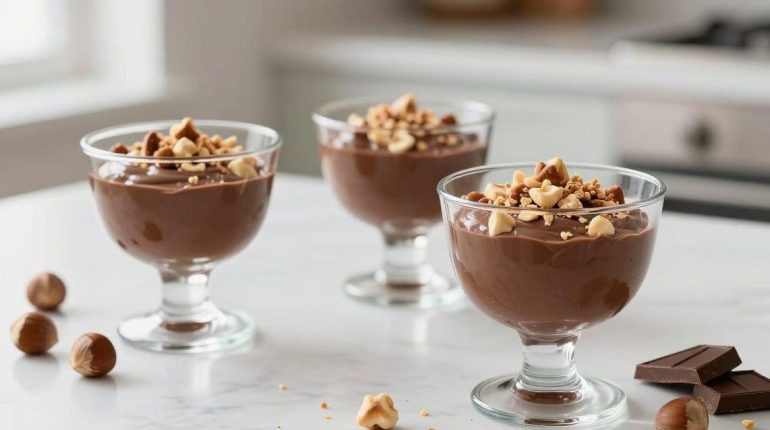
This treat is directly inspired by the famous hazelnut praline chocolates. Melted milk chocolate, heavy liquid cream and crushed hazelnuts are enough to recreate that signature texture, that contrast between silky smoothness and irresistible crunch. No advanced pastry techniques required, no sophisticated robots: a saucepan, a bowl, a spatula and verrines make up the complete arsenal.
This disconcerting accessibility masks a remarkable versatility. The dessert is equally at home as a gourmet finale to a refined dinner or as a Wednesday family snack. It appeals to the chocolate-loving child as much as the adult seeking authentic praline flavors. Two hours in the refrigerator transform this liquid preparation into a cream with the perfect texture, ready to be served.
The revelation lies in this equation: a gastronomic result obtained with minimal equipment and negligible labor time. Where some recipes demand patience and expertise, the Rocher cream yields its secrets without resistance. All that remains is to master the precise gestures that guarantee this incomparable melting texture.
The Infallible Technique in 6 Steps
The perfect ganache is born from a precise, non-negotiable sequence. First step: break 200 grams of milk chocolate into regular pieces, then melt them in a double boiler or at thirty-second intervals in the microwave. The chocolate must become smooth and shiny, without a trace of lumps. This initial texture conditions the final success.
Meanwhile, 200 milliliters of heavy liquid cream heat over medium heat in a saucepan. The fatal mistake: letting it boil. The cream must be very hot, simmering, never in a violent boil. This optimal temperature allows for the perfect emulsion with the melted chocolate.
Incorporation is the critical moment. Pour the hot cream gradually over the chocolate, in at least three stages. Mix gently with a spatula, from the center outwards, avoiding sudden movements that would trap air bubbles. The preparation gradually turns into a smooth ganache, homogeneous and shiny.
The forty grams of crushed hazelnuts then join the ganache. Their uniform distribution guarantees that signature crunch in every spoonful. All that’s left is to pour into the verrines, smooth the surface, and entrust the whole to the refrigerator. A minimum of two hours will transform this liquid ganache into a cream with an incomparable texture, ready to reveal all its taste secrets.
The Secrets of a Perfect Texture
The quality of the chocolate determines everything. Mediocre milk chocolate will produce a dull, grainy ganache, devoid of that characteristic shine. Choosing a chocolate with at least 35% cocoa guarantees the sought-after creaminess and that aromatic depth that distinguishes an ordinary cream from a memorable dessert.
The roaster’s trick radically transforms the taste experience. Dry-roasting the hazelnuts in a pan for three to four minutes, stirring constantly, releases their essential oils and intensifies their fragrance. This light roasting creates a striking contrast with the sweetness of the chocolate, revealing more complex, almost caramelized praline notes.
The gradual pouring of the hot cream requires patience and precision. Each addition must be completely incorporated before the next. This technique perfectly emulsifies the fats from the chocolate and the cream, avoiding the dreaded separation that would produce an oily texture. Slow circular movements, from the center to the edges, drive out trapped air.
The stay in the refrigerator represents the ultimate metamorphosis. During these minimum two hours, the ganache slowly crystallizes, passing from a liquid consistency to this velvety cream that melts delicately in the mouth. Too short, and it will remain runny; too long beyond four hours, and it will become too firm. This precise timing seals the success of the dessert.
Personalization and Refined Presentation
Dark chocolate with 70% cocoa transforms this recipe into an intense, almost sophisticated version. This variant reduces the milky sweetness in favor of a noble bitterness that appeals to demanding palates. Adding a tablespoon of praline paste reinforces the gourmet dimension, creating a cream with frankly caramelized notes reminiscent of old-fashioned candies.
Incorporating crumbled wafers just before resting brings a third texture, crunchy and light, which completes the melting-crunchy balance. These fragments partially absorb the ganache while retaining their structure, creating pockets of surprise in every bite. This technique is reminiscent of the filled pralines of great chocolatiers.
The final decoration transforms a simple dessert into a visual creation. A few crushed hazelnuts placed on top, chocolate shavings taken with a peeler, a thin drizzle of caramel traced in a spiral: these minimal touches are enough. Elegance lies in restraint, three elements maximum to avoid overload.
Storage in the refrigerator for two to three days offers precious flexibility. Prepared the day before a dinner, these verrines at 320 calories per portion even gain in aromatic depth. This texture contrast between melting and crunchy appeals universally, from children won over by the chocolatey sweetness to adults appreciating the complexity of the roasted hazelnuts. A dessert that reconciles simplicity of execution and gastronomic result.