📌 Homemade pizza dough: the yeast activation technique that guarantees a perfect texture
Posted 3 February 2026 by: Admin
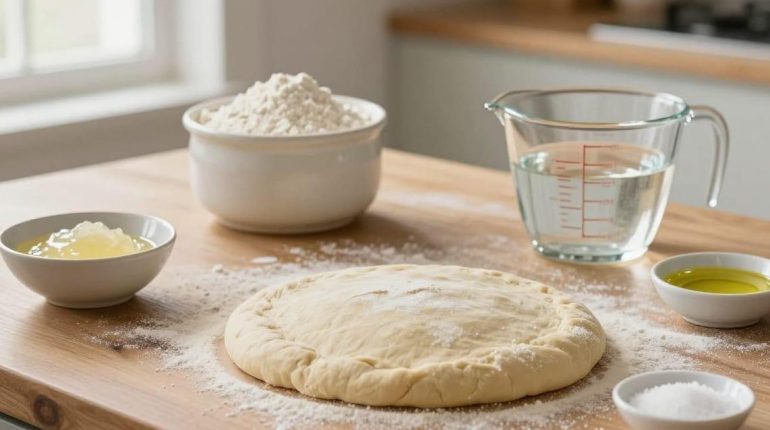
Essential Ingredients For A Successful Dough
Behind every artisanal pizza lies a counter-intuitive truth: six simple ingredients are enough to rival professional pizzerias. No exotic products, no culinary magic tricks, just a precise understanding of the role of each component in the alchemy of fermentation.
Active dry yeast (2 ¼ teaspoons) constitutes the biological engine of this transformation. Without it, no rise, no airy texture. But its activation requires absolute rigor: the water must imperatively reach 110-115°F. Below that, the yeast remains inert. Above, it dies. This narrow thermal window explains why so many homemade doughs fail even before kneading.
All-purpose flour (2 ½ cups) provides the glutinous structure essential for elasticity. Olive oil (2 tablespoons) softens this frame to avoid a rubbery texture. Salt (1 teaspoon) slows down fermentation while developing flavors, while sugar (1 teaspoon) feeds the yeast during its initial awakening.
This millimeter-precise ratio between liquid and solid determines the final success. Too much water produces an unmanageable sticky dough, not enough generates a dry and rigid flatbread. The perfect balance relies on this exact proportion: 1 cup of warm water for 2 ½ cups of flour, thus creating the malleable consistency characteristic of professional bases.
Step-By-Step Preparation Technique
Yeast activation marks the point of no return. In a container, water at 110-115°F meets the yeast and sugar. Expected result after 5 to 10 minutes: a creamy foam on the surface proving the vitality of the microorganisms. This step eliminates any risk of subsequent failure. If no reaction occurs, the yeast is dead and a complete restart becomes necessary.
Once the yeast is activated, the integration of dry ingredients follows a precise logic. In a large bowl, the flour and salt are mixed first to uniformly distribute the crystals. The liquid mixture is then gradually incorporated, forming a coarse mass. Olive oil intervenes at this stage, coating the gluten filaments to guarantee flexibility and extensibility.
Kneading develops the glutinous network essential to the final texture. On a lightly floured surface, the dough is worked for 8 to 10 minutes using pressing and folding movements. The windowpane test reveals success: by gently stretching a piece, a translucent membrane must form without tearing. This characteristic guarantees the elasticity necessary to support toppings and high-temperature baking.
The transformation of raw ingredients into an artisanal base relies entirely on this rigorous methodology. Every gesture counts, every temperature is adjusted, every timing is respected to obtain the exact consistency sought by professionals.
The Secrets Of A Professional Texture
The flour-to-liquid ratio determines the success or failure of any pizza dough. The 2 ½ cups of flour for 1 cup of water create a 2.5:1 proportion that guarantees optimal elasticity without excess moisture. This mathematical precision explains why some doughs tear during stretching while others hold up perfectly. A deviation of a few tablespoons radically transforms the final consistency.
Olive oil plays an often underestimated structural role. Its 2 tablespoons don’t just bring flavor: they coat the gluten chains, preventing their excessive retraction. Direct result: a dough that stretches without resistance and keeps its shape after handling. Neapolitan pizzaiolos consider this internal lubrication non-negotiable for obtaining an airy crust and a malleable center.
Salt acts on two simultaneous fronts. First, it strengthens the glutinous bonds by tightening the protein network. Second, it slightly slows down fermentation to develop complex aromas. One teaspoon is enough for this double action: too little produces a bland and soft dough, too much generates a rubbery texture. The balance between these 6 ingredients transforms a basic recipe into a foundation worthy of an artisanal pizzeria.
Preparation And Continuation Of The Process
The assembled ingredients constitute only the first half of the journey. The recipe explicitly announces “see continuation on next page,” revealing that the kneading, resting, and baking steps remain indispensable to transform this base into a functional dough. Without these complementary directions, even the perfect flour-water ratio remains unusable: the activated yeast requires a precise fermentation time, the texture requires methodical kneading.
This two-stage structure reflects professional logic. Pizzaiolos systematically separate the assembly phase from the development phase. The initial mixing creates the potential, but subsequent manipulations truly release the properties of the gluten and allow fermentation to complexify the aromas. The “Directions” indication followed by a reference confirms that the recipe integrates these crucial steps into its complete sequence.
The “Next→” promise maintains technical continuity. It guarantees access to baking temperature parameters, resting duration, and stretching techniques that determine the difference between a dense dough and an airy crust. This fragmented approach respects the natural chronology: first master the foundations, then execute the transformations that will reveal the artisanal character of this homemade preparation.