📌 Homemade Orange Kefir
Posted 19 April 2026 by: Admin
Everyone imagines that kefir is reserved for naturopaths and people who have a dehydrator in their kitchen. The reality? It’s one of the simplest preparations you can make at home. Ten minutes of work, three days of patience, and you get a one-liter bottle of homemade sparkling drink that costs almost nothing.
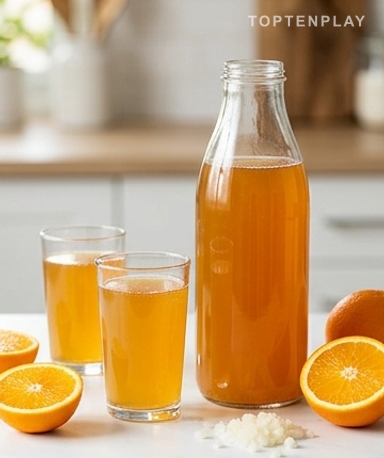
In your glass, orange kefir has this light amber color, slightly cloudy, like home-pressed apple juice. The bubbles rise gently — fine, steady, nothing like the big bubbles of industrial sparkling water. Something more discreet, more alive. The smell is surprising at first: slightly tangy, lemony, with a yeasty undertone that vaguely recalls a brioche coming out of the oven. And the first sip is fresh, a bit tingly on the tongue, with the orange coming through cleanly without being overly sweet.
Why you’ll love this recipe
Ingredient Notes
Everything needed to start: water kefir grains, ripe oranges, and a little sugar.
- Water kefir grains : These are small translucent gelatinous clusters, somewhere between a grain of rice and a soft pebble. You won’t find them in supermarkets — you have to order them online (a few euros for a starter bag) or ask someone who grows them. Once you have them, you never have to buy them again. If you take a break, keep them in a little sugar water in the fridge; they’ll wait patiently.
- Water : A detail that changes everything in the long run: use filtered water or water left to decant overnight in an open carafe. Chlorine from tap water can weaken your grains over time. No need to buy bottled water, just avoid the direct tap.
- Sugar : Classic white sugar is ideal. Blond cane sugar also works. Avoid coconut sugar or sweeteners — the grains feed on glucose, and substitutes don’t nourish them the same way.
- Oranges : Choose organic oranges if you can, especially if you’re using the zest or whole slices. Otherwise, the juice alone works very well. A medium-ripe orange, which smells strong when you hold it in your hand, will flavor the kefir clearly without being aggressive.
Rinse your grains in cold water, never lukewarm
Before starting, rinse your kefir grains under a stream of cold water in a fine strainer. Cold, not lukewarm — heat damages the lactic acid bacteria and yeasts that do all the work. You’ll feel the slightly rubbery, a bit viscous texture of the grains under your fingers, which is completely normal. Place them in your one-liter glass jar. Add the sugar dissolved in a little lukewarm water, then the rest of the cold water to lower the temperature. Slide in the orange slices. At this stage, the mixture has a mild, sweet smell, almost neutral — in 24 hours, it will change completely.
Cover with a cloth, not an airtight lid
During the first fermentation, the grains need air. Cover the jar with a piece of muslin or a clean kitchen towel held by a rubber band. Never a screw-on lid at this step — gases must escape. Place the jar at room temperature, between 20 and 25°C, away from direct light. After 24 hours, fine bubbles will start rising along the grains. After 48 hours, the smell has changed: tangy, slightly yeasty, with that background reminiscent of working bread dough. At 72 hours, the liquid is ready for the next step.
Filter, then seal airtight for the second fermentation
Filter your kefir through a fine strainer directly into your airtight glass bottle. The grains stay in the strainer — rinse them and put them back in the jar with sugar water for the next batch. In the bottle, you can add a few fresh orange slices or a little extra juice if you want a stronger aroma. Seal tight. Let it sit at room temperature for another 12 to 24 hours. It’s this second fermentation in a closed environment that creates the fizz — pressure builds up slowly in the bottle, like cider refermenting in a cellar.
Put it in the fridge as soon as the fizz is there
To check, gently open your bottle over the sink. If you hear a slight “psst” and bubbles form on the surface, it’s good. Transfer immediately to the fridge. The cold stops the fermentation and stabilizes the gas. If you leave it too long at room temperature, the pressure continues to rise, the acidity increases too much, and the result becomes frankly sour. When cold, the orange kefir changes character — the flavors tighten, the orange comes out cleaner, and the bubbles are more present during tasting.
Tips & Tricks
- If your grains are inactive after a long rest in the fridge, give them a wake-up batch with just water and sugar, without orange — they need to reacclimatize before working normally, otherwise the fermentation will be long and lazy.
- Avoid metal utensils in direct contact with the grains over time, especially highly reactive stainless steel spoons. A wooden or food-grade plastic spoon is better — some metals can interfere with the active cultures.
- If your kefir is too sour for your taste, reduce the first fermentation time by 12 hours. Too sweet and not fizzy enough? Leave the second fermentation for an extra day at room temperature before moving to the cold.
Where can one find water kefir grains?
At pharmacies, on platforms like Amazon, or fermentation specialty sites (a few euros for a starter pack). The best option is still to ask someone who grows them — the grains reproduce, so everyone who makes it is usually happy to share.
How to store grains between batches?
Put them in a jar with 500ml of water and a tablespoon of sugar, close it, and leave it in the fridge. They can wait for several weeks without any problem. Before using them again, give them a wake-up batch with just sugar water — no fruit — to reactivate them.
My kefir isn’t sparkling at all, what’s happening?
Two frequent causes: inactive grains that need a wake-up batch, or a second fermentation that is too short or too cold. Make sure the bottle is airtight and that the room is at least 20°C — below that, fermentation slows down significantly.
The kefir is too acidic for my taste — how to fix it?
Reduce the duration of the first fermentation by 12 hours (go from 72h to 60h, for example). Acidity increases with fermentation time. You can also consume it faster after the second fermentation, before it develops too much character.
Can we use other fruits instead of orange?
Yes, water kefir lends itself very well to variations: lemon, grapefruit, strawberries, ginger-lime, or mango. Always add fresh fruit during the second fermentation — that’s when the aroma truly infuses into the drink.
How long does orange kefir keep once in the fridge?
Up to one month in the refrigerator. It continues to evolve slightly over time, gaining in acidity and fizz. If you see a thin whitish layer forming on the surface, it’s yeast — completely normal, shake and drink.
Homemade Orange Kefir
International
Beverage
A naturally sparkling fermented drink, slightly tangy and scented with orange. Four ingredients, ten minutes of work, three days of patience.
Ingredients
- 50g water kefir grains
- 1L filtered or dechlorinated water
- 80g white sugar
- 2 organic oranges, sliced (1st fermentation)
- 1 fresh orange, sliced (2nd fermentation)
Instructions
- 1Rinse the kefir grains under a stream of cold water in a fine strainer.
- 2Dissolve the sugar in 200ml of slightly lukewarm water, then let cool to room temperature.
- 3Place the grains in a 1.5L glass jar. Add the orange slices, the cooled sugar water, then the rest of the cold filtered water.
- 4Cover the jar with a clean cloth or muslin held with a rubber band. Let ferment at room temperature (20-25°C) for 48 to 72 hours.
- 5Filter the kefir through a fine strainer into an airtight glass bottle. Collect the grains and set them aside for the next batch.
- 6Add fresh orange slices to the bottle. Seal tight and let sit at room temperature for 12 to 24 hours.
- 7As soon as a slight ‘psst’ occurs upon opening, transfer immediately to the refrigerator. Serve well chilled.
Notes
• Storage: up to one month in the refrigerator. The kefir continues to evolve slowly — gaining acidity and fizz over time.
• Between batches: store the grains in a closed jar with 500ml of water and 1 tablespoon of sugar in the fridge for up to several weeks.
• Variations: replace the orange with lemon, grapefruit, strawberries, or a ginger-lime mix to vary the aromas with each batch.
Nutrition Facts (per serving, estimated)
| 30 kcalCalories | 0gProtein | 7gCarbs | 0gFat |