📌 Homemade mille-feuille: why your pastry can contain up to 2048 layers of puff pastry
Posted 22 December 2025 by: Admin
The Fascinating Etymology Of The Mille-Feuille
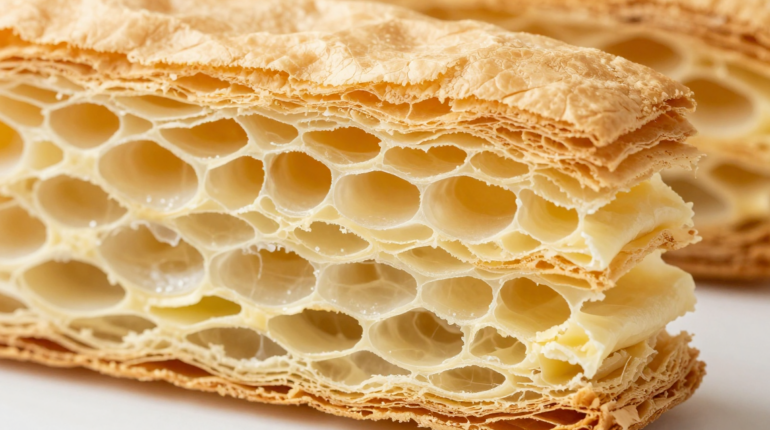
At first glance, the name “mille-feuille” seems exaggerated. This iconic pastry has only five to six visible layers, including the icing. However, its name is based on a little-known technical reality: the microscopic structure of its puff pastry.
The traditional preparation method generates exactly 729 pairs of superimposed layers. This impressive figure results from the successive folds made during the folding process, an ancestral technique that alternates layers of dough and butter. Each fold exponentially multiplies the number of layers, creating that characteristic airy texture that melts in the mouth.
The evolution of pastry techniques has even made it possible to exceed this threshold. Modern methods now reach 2048 pairs of layers, further justifying this thousand-year-old name. This technical feat explains why the pastry puffs up so much during baking: the water contained in the butter turns into steam, lifting each layer to create those crispy, golden strata.
The mille-feuille therefore bears a scientifically accurate name, although its internal architecture remains invisible to the naked eye. This French pastry hides a remarkable structural complexity beneath its apparent simplicity, the fruit of expertise passed down from generation to generation.
From Naples To Napoleon: The Story Of A Linguistic Misappropriation
This French technical complexity actually hides an Italian origin. The pastry initially took its name from Naples, referred to by the adjective “Neapolitan”. This geographical reference testified to the influence of Neapolitan master pastry chefs on European courts, renowned for their mastery of puff pastry since the 17th century.
But the military conquests of Napoleon Bonaparte disrupted this etymology. In foreign countries, particularly Anglo-Saxon ones, the sound of “Neapolitan” gradually transformed into “Napoleon”. This linguistic confusion was not accidental: the French Emperor was then leading his campaigns across Europe, leaving a lasting mark on the collective imagination.
The semantic shift occurred naturally. Foreign pastry chefs, unfamiliar with Italian geography but daily confronted with stories of the Napoleonic wars, renamed the dessert. The imperial personification supplanted the geographical reference, creating a persistent historical misunderstanding.
Even today, the Anglo-Saxon “Napoleon” and the French mille-feuille refer to the same creation, but with two radically different etymologies. One celebrates a Mediterranean port city, the other involuntarily glorifies a conqueror whose gastronomic legacy had nothing to do with this iconic pastry. This cultural appropriation testifies to the power of political events on the evolution of culinary language.
The Classic Composition: Architecture Of An Iconic Dessert
This history-laden pastry rests on a rigorous tripartite structure. The two rolls of puff pastry constitute the crispy skeleton, cut and superimposed to create the characteristic layers. This technical base, inherited from Neapolitan secrets, requires precise baking to reveal the 729 to 2048 pairs of layers trapped in the dough.
Between these golden strata is inserted the vanilla pastry cream, the true soul of the mille-feuille. The traditional recipe uses 750 ml of whole milk infused with a vanilla bean, worked with 9 egg yolks and 180 g of granulated sugar. This generosity of yolks gives the dessert its legendary creaminess, while 75 g of cornstarch stabilizes the whole. The final incorporation of 75 g of butter brings that velvety texture that contrasts with the puff pastry.
The two-tone icing crowns the structure. Four to five tablespoons of white pastry icing cover the top surface, streaked with 50 g of melted dark chocolate. These chocolate lines, drawn using the combing technique, create the immediately recognizable geometric pattern.
These calibrated proportions produce eight individual portions, the ideal size to preserve structural integrity. Each mille-feuille thus becomes a miniature architectural work, balancing crispiness and creaminess in a ratio mathematically established by generations of pastry chefs.
Mastering Pastry Cream: The Creamy Heart Of The Mille-Feuille
The success of this architectural work rests above all on its central filling. The pastry cream is the most delicate technical element, the one that distinguishes a mediocre mille-feuille from a memorable pastry. Its preparation requires a precise understanding of the balance between ingredients.
The fundamental ratio establishes 9 egg yolks for 750 ml of whole milk. This proportion guarantees the characteristic creamy density without tipping into excess. The yolks, whisked with 180 g of granulated sugar until pale, create an emulsion that will capture the vanilla essence. The vanilla bean, split and infused in the hot milk, releases its complex aromas far beyond what an industrial extract would offer.
The intervention of 75 g of cornstarch transforms this preparation into a stable cream. This starch, incorporated into the pale yolks, acts as a thermal stabilizer during cooking. Without it, the egg proteins would coagulate randomly. Whisking during cooking until thickened gradually reveals the desired texture.
The final incorporation of 75 g of butter, off the heat, brings the ultimate smoothness. This fat enriches the cooled cream, giving it that velvety mouthfeel that masterfully contrasts with the crispiness of the pastry layers. The powdered sugar sprinkled over the whole completes the composition, creating that textural harmony that defines the taste experience of the traditional mille-feuille.