📌 Homemade Lemon Powder
Posted 17 April 2026 by: Admin
We all think the same thing when squeezing a lemon: the peel goes in the bin. That’s where we’re wrong. The zest concentrates more flavor than the juice itself, and when turned into powder, it becomes a condiment that lasts for months in a drawer.
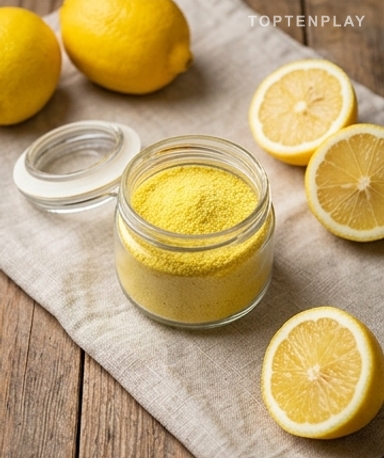
Imagine a powder of almost luminous yellow, as fine as sifted flour, that smells like lemon the way it always should—vibrant, fresh, slightly floral, without the stinging acidity. A pinch on roasted chicken. A spoonful in a cake. A touch in a vinaigrette. Homemade lemon powder is that thing you put on the table that guests immediately want to know the origin of.
Why you’ll love this recipe
Ingredient Notes
Everything you need to make lemon powder: lemons, nothing else.
- The lemons : Get untreated or organic lemons—this is a non-negotiable point. The powder is strictly the skin, and if the lemons were treated after harvest, you’ll concentrate all that in your powder. Classic yellow lemons, Eureka or Primofiori, both work. Avoid limes for this recipe, as the result tends towards bitterness.
- The fine grater (Microplane preferred) : Technically it’s a tool, but it’s the most important variable. A coarse grater gives you thick pieces that won’t dry uniformly. The Microplane produces filaments as fine as down that dry in a few hours. If you don’t have one, the fine side of a classic grater will do—just a little less consistent.
First, well-washed lemons
Scrub the lemons under hot water with a brush or the rough side of a sponge. Even organic ones have traveled, been handled, and stored. Dry them completely before zesting—moisture on the skin slows down the drying process. Once dry, they have a slightly waxy, almost silky feel under the fingers. Now it’s time to start.
Zesting, quick and easy
Take your grater and tackle the lemon with light pressure. You want the yellow, not the white underneath—the white part, the pith, is bitter and will remain so even in powder form. In two or three passes on each side, the fragrance is released immediately: a sharp scent of fresh lemon, almost tingling in the nostrils. Spread the zest on a baking sheet lined with parchment paper. They form a kind of straw-yellow down, light as air. Fluff them with your fingertips so they don’t stick together.
Low temperature oven, and we wait
Slide the tray into the oven at 80°C, fan-assisted if you can. Leave the door slightly ajar with the handle of a wooden spoon—this allows moisture to escape. After an hour, the zest begins to shrink and curl, like tiny paper rolls. The smell in the kitchen at that moment will surprise you—an amplified, concentrated, almost sweet lemon sensation, nothing like what you smell when squeezing the fruit. After about two hours, touch the zest: it should crack under your fingers and turn to powder immediately. If it still bends, give it another twenty minutes.
From zest to powder
The perfectly dry zest goes into a spice grinder or a small blender. Ten seconds of mixing and you go from a pile of crumpled filaments to a fine powder, as bright yellow as a sunflower in midsummer. Sift it if you want something very uniform. Pour into an airtight glass jar. The powder keeps its aroma for several months—but honestly, it never lasts that long because you end up using it everywhere.
Tips & Tricks
- Don’t zest down to the white flesh. Even a small amount of pith changes everything—the powder becomes bitter and it’s unfixable once blended.
- You can do several citrus fruits in the same batch: lemon, orange, tangerine. The result is a composite citrus that works great in marinades and desserts.
- No suitable oven? Air drying works. Count on two to three days depending on ambient humidity, stirring the zest once a day—slower, but it works.
How long does homemade lemon powder keep?
In an airtight jar away from light, the powder easily lasts 6 months. Enemy number one is ambient humidity—if the powder starts to clump, it has absorbed moisture. Do not store the jar near the stove.
Can I use treated lemons?
No, that’s the only real rule of this recipe. Drying concentrates everything on the skin—including post-harvest treatments. It is imperative to use untreated or organic lemons.
My powder is bitter. What happened?
You probably zested too deep and caught some pith—the white part between the yellow skin and the flesh. This part is naturally very bitter, and drying amplifies it further. There’s nothing to be done to save the batch: next time, only zest the colored surface.
I don’t have a suitable oven. How else can I dry the zest?
Air drying works: spread the zest on a plate and let it dry for 2 to 3 days at room temperature, stirring once a day. A dehydrator at 55°C also gives great results in 3 to 4 hours. The microwave in 30-second pulses can work, but you risk burning the zest if you don’t watch closely.
Can I do the same thing with other citrus fruits?
Yes, and it’s very interesting. Orange, tangerine, grapefruit, lime—the process is identical. Orange powder is particularly good in chocolate desserts. You can also mix several citrus fruits in a single batch for a custom blend.
How do I actually use it in cooking?
One teaspoon of powder is roughly equivalent to the zest of half a lemon. It fits anywhere fresh zest is used: marinades, dressings, cakes, creams, fish, poultry. Its advantage over fresh zest: being dry, it incorporates without adding moisture, ideal in meat rubs or spice blends.
Homemade Lemon Powder
French
Condiment
A simple technique to transform lemon zest into concentrated and versatile powder. Zero waste, keeps for 6 months, only one ingredient.
Ingredients
- 6 untreated or organic lemons (about 600 g total)
Instructions
- 1Scrub the lemons under hot water with a brush or the abrasive side of a sponge. Dry completely before zesting.
- 2Zest each lemon with a Microplane or fine grater, collecting only the yellow part, without touching the white flesh underneath.
- 3Spread the zest in a thin, even layer on a baking sheet lined with parchment paper, without overlapping them.
- 4Dry in the oven at 80°C fan-assisted, with the door held slightly ajar with a wooden spoon handle, for 2h to 2h30.
- 5Check doneness by touching the zest: it should crumble and crack immediately under your fingers. If not, extend by 20 minutes and check again.
- 6Pour the dry zest into a spice grinder or a small blender. Blend for 10 seconds to obtain a fine powder.
- 7Sift if necessary, then store in an airtight glass jar away from light and moisture.
Notes
• Storage up to 6 months in an airtight jar. Do not store near the stove—steam is the enemy of the powder.
• Practical equivalence: 1 teaspoon of powder ≈ zest of half a lemon.
• Same technique with orange, tangerine, or grapefruit. Drying times remain the same.
Nutrition Facts (per serving, estimated)
| 55 kcalCalories | 1gProtein | 15gCarbs | 0gFat |