Hollandaise sauce has built a reputation that far exceeds its actual difficulty. Many home cooks avoid it as if it required a special permit — even though with three ingredients and a whisk, it’s within anyone’s reach. The real problem isn’t the recipe. It’s the fear of messing up.
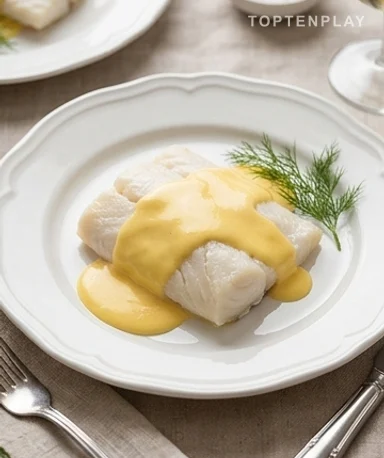
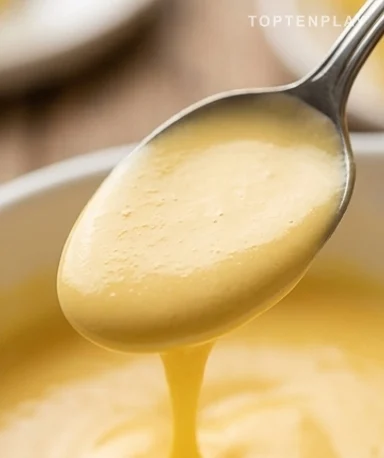
It arrives on the plate with that slightly pearly straw-yellow hue, shining like wet silk. When poured over a fillet of white fish, it flows gently, almost lazily, without separating or running. A smell of warm butter mixes with the frank acidity of fresh lemon. In the mouth, it’s rich but never heavy — a creamy texture that melts on the tongue before you’ve even had time to chew.
Why you’ll love this recipe
Ingredient Notes
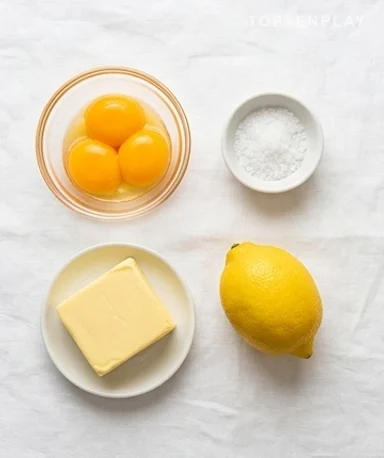
Three egg yolks, butter, a lemon: the foundations of a great classic sauce.
- Egg yolks : They are what hold the sauce together. Not the whites — only the yolks, which contain natural emulsifiers capable of binding fat and water. Three yolks for four servings is the right proportion. Fresh, high-quality eggs make a real difference: bright orange yolks from free-range eggs give a more beautiful and flavorful sauce.
- Butter : It provides everything: richness, texture, taste. No need to get an overpriced churned butter — a classic unsalted butter works just fine. What matters is melting it over very low heat without letting it bubble. Butter that has slightly burned gives an acrid taste that nothing can fix.
- Lemon : It counterbalances the fat of the butter. Without it, the sauce is heavy and monotonous. Half a lemon is usually enough, but taste before adding everything — some are very acidic, others almost flat. Squeeze by hand, strain the seeds, and add gradually at the end of cooking.
- White pepper : A detail that matters visually. Black pepper leaves small dark specks in the sauce — no consequence on the taste, but it gives a less polished look. White pepper remains discreet. A light pinch, really light.
Why everyone avoids it even though it deserves to be your Sunday sauce
In cooking shows, we see hollandaise fail live with a dramatic soundtrack. Good for suspense, not for reality. When successful, it has that pearly shine, that sweet smell of melted butter that promises something comforting. The truth is that the technique rests on a single principle: gentle and constant heat. No thermometer, no sophisticated equipment. Just a bowl over a simmering pot, a whisk, and a little attention. What makes the sauce difficult is only rushing.
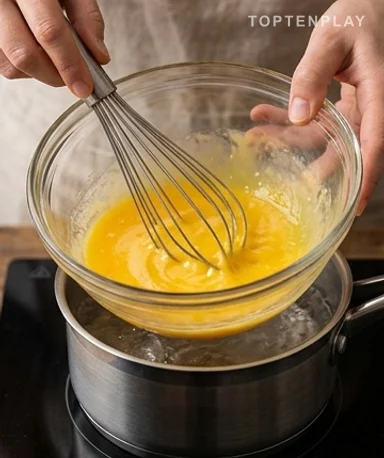
The bain-marie is not a chef technique, it’s just common sense
A stainless steel or glass bowl placed over a pot of barely simmering water — the bottom of the bowl well above the water, never in contact. The steam heats gently without ever exceeding dangerous temperatures for the eggs. In this bowl: the yolks and a tablespoon of cold water. Whisk. At first, the mixture is liquid, almost watery. Then it becomes foamy, a pale foam with small uniform bubbles. And finally, it starts to thicken — the whisk leaves tracks that stay visible for a second before disappearing. That’s it. That’s exactly the moment you need to learn to recognize.
The part everyone messes up: the stream of butter
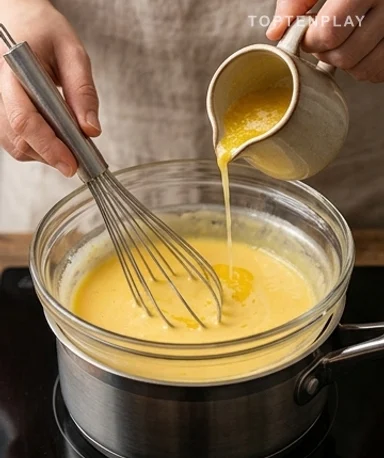
This is where the majority of failures occur. The melted butter — lukewarm, not boiling — must enter the bowl in a very thin stream, almost drop by drop at the start, while continuing to whisk without stopping. If you add too much at once, the emulsion doesn’t form and the sauce separates into an unappealing oily layer. But if you go slowly, you see the texture gradually change: the mixture thickens, takes on a shine, becomes dense and creamy like a supple mayonnaise. The lemon arrives at the end, off the heat. A pinch of salt, a little white pepper. Taste. Adjust.
When it breaks — and how to recover everything without throwing in the towel
It happens, even to people who make it often. The sauce separates, becomes lumpy, looking like scrambled eggs in melted butter. First thing: remove immediately from the heat. In a clean bowl, pour a teaspoon of cold water and start incorporating the failed sauce very gradually, whisking hard. The cold water and the emulsifiers still present in the yolks often allow for a complete rebuild. If that isn’t enough, add an extra egg yolk to the clean bowl with a little water, whisk until foamy, then start incorporating the sauce in a stream again. In nine cases out of ten, it works.
Tips & Tricks
- Never let the water in the bain-marie truly boil — if it boils hard, remove the bowl for a few seconds and lower the heat. A calm simmer is enough, not an eruption that sends bursts of steam under the bowl.
- If you prepare the sauce in advance, keep it warm in a lukewarm (not hot) bain-marie for a maximum of 30 minutes, uncovered, whisking occasionally. Beyond that, it begins to destabilize.
- For a bolder taste, replace the starting tablespoon of water with a dash of warmed lemon juice. It strengthens the acidity from the base and gives a slightly livelier character to the final sauce.
My hollandaise sauce broke — is it salvageable?
Yes, in the vast majority of cases. Immediately remove the bowl from the heat, pour a teaspoon of cold water into a clean bowl, and incorporate the failed sauce in a very thin stream while whisking vigorously. If that’s not enough, start over with a fresh, lightly whisked egg yolk as a base, then incorporate the lumpy sauce gradually.
Can hollandaise be prepared in advance?
Yes, but with a limit: maximum 30 minutes in advance, kept warm in a lukewarm (not hot) bain-marie, uncovered, stirring occasionally. Beyond that, the emulsion begins to weaken. Hollandaise cannot be frozen or kept in the fridge to be reheated.
Can you make hollandaise without a bain-marie?
Technically yes, directly in a small saucepan over very low heat, but the risk of cooking the eggs too fast is much higher. The bain-marie remains the most reliable method for beginners because the heat is much gentler and more controllable. With experience, the direct method works well.
Which fish does hollandaise work best with?
It pairs particularly well with delicate white-fleshed fish — cod, sea bass, sole, turbot, salmon. It is ideal on poached or steamed fish, where the neutral taste allows the sauce to express itself fully. On oily and very briny fish like mackerel, the contrast is less harmonious.
Can I use clarified butter instead of regular butter?
Yes, and it is even recommended for a more stable sauce. Clarified butter has been stripped of its milk solids and water, which reduces the risk of separation. For a quick homemade version, regular butter works very well — it just gives a slightly less firm but equally flavorful sauce.
Why use white pepper instead of black pepper?
It is purely visual. Black pepper leaves small dark spots in the sauce, which doesn’t change the taste but gives a less polished look. White pepper remains discreet and preserves the beautiful pearly color of the hollandaise. If you don’t have any, black works perfectly.
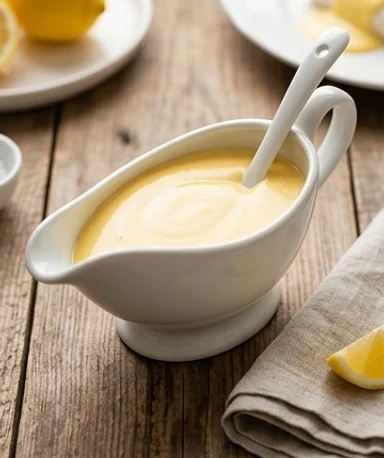
Homemade Hollandaise Sauce for Fish
French
Sauce / Side Dish
A classic emulsion of egg yolks and melted butter, seasoned with a dash of lemon. Creamy, glossy, and much more accessible than it looks.
Ingredients
- 3 fresh egg yolks
- 120g unsalted butter
- 1 lemon (approx. 2 tablespoons of juice)
- 1 tablespoon cold water
- 1 pinch fine salt
- 1 pinch ground white pepper
Instructions
- 1Melt the butter over very low heat without letting it bubble. Remove from heat and let cool to lukewarm.
- 2In a heatproof bowl, whisk the egg yolks with the tablespoon of cold water.
- 3Place the bowl over a pan of simmering water (bottom of the bowl above the water, no contact). Whisk continuously until the mixture thickens and forms a ribbon — about 3 to 4 minutes.
- 4Remove the bowl from the bain-marie. Incorporate the lukewarm butter in a very thin stream, whisking constantly until you obtain a smooth and glossy sauce.
- 5Add the lemon juice gradually. Season with salt and pepper. Taste and adjust seasoning.
- 6Serve immediately over poached, steamed, or grilled fish.
Notes
• If the sauce breaks (separates), remove from heat immediately and whisk in a stream into a clean bowl with a teaspoon of cold water to try and rebuild the emulsion.
• Hollandaise cannot be kept in the refrigerator to be reheated. It can be kept warm in a lukewarm bain-marie for 30 minutes maximum, stirring occasionally.
• For a more stable version, use clarified butter (melted butter where the foam and milk solids are removed) instead of regular butter.
Nutrition Facts (per serving, estimated)
| 270 kcalCalories | 3gProtein | 1gCarbs | 29gFat |