📌 Homemade dish soap: how orange peels and salt replace chemicals
Posted 9 February 2026 by: Admin
A Natural Detergent Based On Household Waste
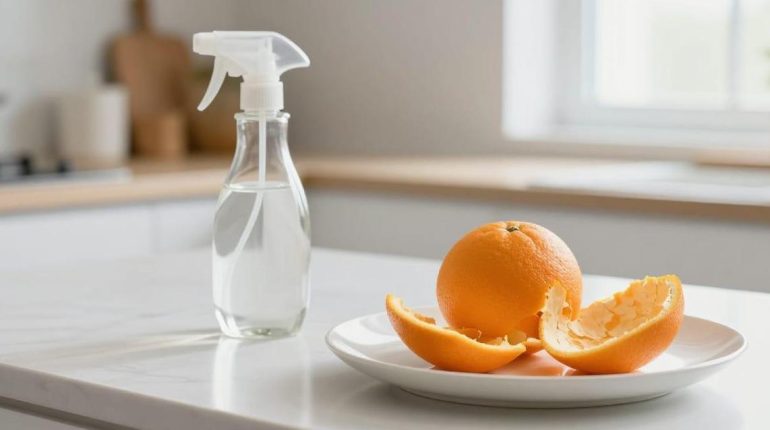
Orange peels usually end up in the trash. However, they hold unsuspected potential: transforming food waste into a high-performance cleaning product. This anti-waste tip relies on a simple but formidably effective combination: citrus peels and table salt.
The idea may seem surprising, but it is based on a solid scientific reality. Orange skins contain essential oils with natural degreasing properties, capable of rivaling industrial detergents. Combined with salt, they create an ecological alternative that intelligently values what we throw away daily.
This method requires no expensive ingredients or sophisticated equipment. It allows for replacing conventional dish soaps with an entirely natural solution made from household residues. A revelation for anyone looking to reduce their chemical footprint while managing their budget.
The principle is as simple as it is ingenious: collect citrus peels usually destined for compost or the trash, combine them with a few basic ingredients, and obtain a detergent that cleans, degreases, and perfumes. A transformation that questions our consumption habits and demonstrates that efficiency does not necessarily rhyme with industrial complexity.
The Science Behind The Efficiency
The efficiency of this homemade detergent is not due to chance. Orange peels contain limonene, an essential oil with powerful degreasing properties, capable of dissolving fatty residues as effectively as synthetic surfactants. This natural molecule penetrates fats and breaks them down, facilitating their removal.
Salt and baking soda play an essential complementary role. Their gentle abrasive action helps dislodge stubborn residues without scratching surfaces. These natural agents act mechanically, creating friction that eliminates encrusted dirt while respecting the dishes.
Vinegar completes this tripartite formula. Its natural acidity disinfects surfaces, eliminates bacteria, and neutralizes odors. It also softens the water, thus optimizing the cleaning power of the other components. This chemical synergy transforms ordinary ingredients into a remarkably high-performing all-in-one cleaning solution.
This scientifically coherent combination explains why this artisanal mixture rivals industrial detergents. Essential oils dissolve, abrasive agents loosen, vinegar disinfects: three complementary actions that meet all daily cleaning needs. A simple formula whose effectiveness relies on the natural chemical complementarity of its components.
Economic And Ecological Advantages
Beyond its technical efficiency, this homemade formula offers an undeniable double financial and environmental advantage. The manufacturing cost remains derisory: orange peels come from free food waste, while salt, baking soda, and vinegar are among the least expensive household products on the market. One preparation costs a few cents, compared to several euros for a bottle of industrial detergent.
The ecological impact is the second major benefit. This natural alternative totally eliminates synthetic surfactants, phosphates, and chemical preservatives present in conventional formulas. These substances pollute waterways and disrupt aquatic ecosystems when discharged. By opting for this solution, each household directly reduces its contribution to the contamination of natural environments.
The approach is also part of a consistent anti-waste logic. Reusing citrus peels destined for the trash transforms waste into a useful resource. This simple valuation decreases the volume of household waste while replacing a manufactured product, thus reducing the carbon footprint related to the production, packaging, and transport of industrial detergents.
This entirely natural and economical solution illustrates how simple domestic gestures can generate substantial savings while adopting responsible consumption. An effective, non-polluting, and almost free detergent: three hard-to-dispute arguments for rethinking daily cleaning habits.
Instructions And Final Result
Preparing this natural detergent requires no special skills. Place the peels of three to four oranges in a glass jar, add two tablespoons of coarse salt, and cover with white vinegar. Let it macerate for two weeks in a cool, dark place, shaking the container every two days. Then filter the resulting liquid and add a tablespoon of baking soda to strengthen the degreasing action.
The effectiveness against stubborn grease is immediate. This mixture quickly dissolves food residues on dishes, cleans greasy cooktops, and eliminates grease marks on work surfaces. Its deep-cleaning action rivals conventional products without leaving a chemical film on treated surfaces.
The fragrance is an additional significant asset. Unlike industrial detergents with often overwhelming synthetic fragrances, this formula releases an authentic and subtle citrus scent. Orange essential oils persist slightly after rinsing, leaving a feeling of natural freshness in the kitchen. This pleasant scent transforms a daily chore into a more pleasant sensory experience.
Regular use of this detergent presents no particular constraints. It is applied directly to the sponge or diluted in dishwater as needed. Storing it in the refrigerator extends its life for up to three months, allowing for anticipation of needs without multiple preparations.